Drugstore beetles are a small insect about 1/10th to 1/4 of an inch long and brown in color. Adults can fly and are attracted to light. They’re oval in shape and closely resemble a cigarette beetle. However, there are two differences which a trained eye will note: the antennae have a distinct three segmented club structure compared to the cigarette beetles serrated antenna and the wings of the drugstore beetle have deep grooves or pits where the cigarette beetle has none. Though both beetles will infest many of the same foods, drugstore beetles can and will eat from a much larger list of “food”. If you have drugstore beetles in your home, you will have to do several things to both remove the active infestation and stop their eggs from completing their life cycle which would effectively cause a re-infestation.
Related articles: CIGARETTE BEETLES CONFUSED FLOUR BEETLES GRAIN BORERS HIDE BEETLES INDIAN MEAL MOTHS RED FLOUR BEETLES RICE WEEVILS
DRUGSTORE BEETLE BIOLOGY
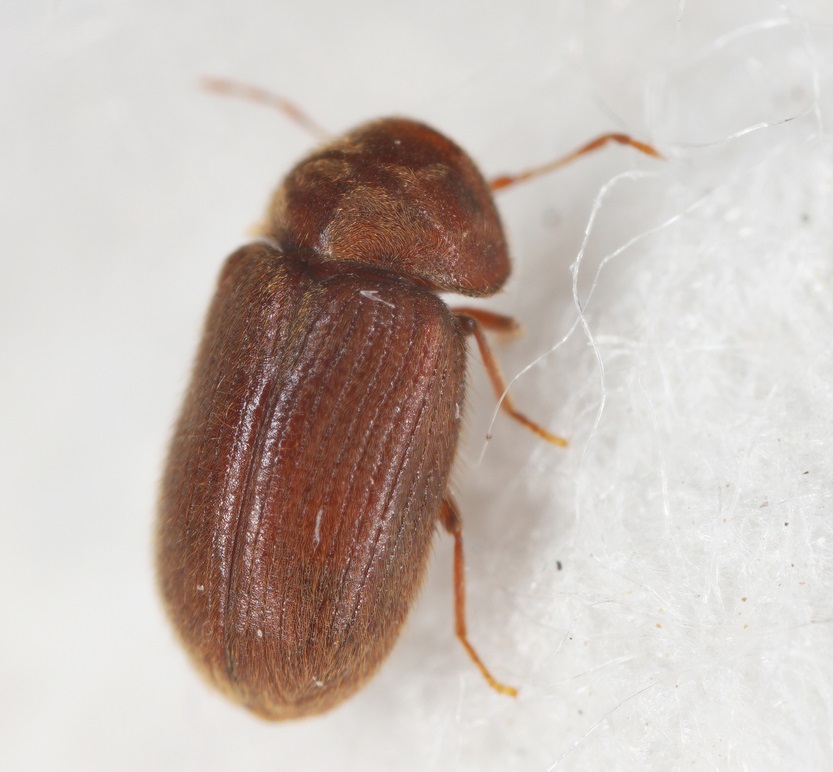
Drugstore beetles are found throughout most of the world. Though their name implies they may be a problem for pharmacies, homes are the most common structure they invade. Drugstore beetles hatch from eggs which are generally laid on food stuff their larva like to eat. Once hatched, the larva will start to eat and will do so for 3-5 months. It was once thought they mainly liked flour because they are such a common pest found in bread. However, careful research during the twentieth century taught us that drugstore beetles can live on just about anything found in the home. The list includes flour but also has anything meal based such as any common breakfast food as well as condiments, spices, coffee, any type of bean, rodenticide and other poison baits used for rodents, books, fabric, wood, furniture and wall paper. Their diet has been found to be so large that one entomologist was heard saying “they will eat anything except cast iron”.
THE LIFE CYCLE OF DRUGSTORE BEETLES
Once drugstore beetle eggs have fed enough to derive the nutrition they need to become adults, they’ll spin a cocoon and undergo metamorphosis. This will take 2-4 weeks and once complete the adult will emerge to mate and lay eggs. Since adults fly they will look for adequate food on which to lay eggs in case prime food stuff has been removed. It is for this reason alone that controlling drugstore beetles can be a tiresome task.
Most drugstore beetle life cycles take 6 months to complete but in warm climates like the south, three cycles can be completed in one year. In order to break the cycle once and for all, you will have to do three key things: 1) Remove or treat any contaminated food or other items where larva or adults have been found 2) Treat such areas to insure hatching larva are not able to survive by eating something other than the contaminated food stuff found and 3) Set out Pheromone traps to catch reproduction minded adults before they are able to mate and lay eggs in some other part of the home.
Also remember, seeing adults does NOT mean you have activity that will continue indefinitely. Adult’s hatch from Pupae and since we can’t kill pupae, if you’re seeing adults throughout the home, this will continue until all the pupae “run out”. So assuming you’ve done a proper treatment, the treatment will prevent this activity from having success and continuing. But only when all pupae have hatched will you no longer see the adults.
Now you might wonder how long can this go on? This depends on many factors. In general, problems during the summer months will run their course in 2-3 months. Once fall and winter set in, it can take a good 4-8 months before all pupae hatch. This means you should continue to spray at least once a month as long as activity is present but again, realized the dead beetles you’re finding aren’t mating or laying eggs. True, they can be annoying, but eventually they will “run out” and you won’t see anymore. The only exception to this would be if there is some remote nest where they’re feeding and cycling you have not treted. In that case, a problem that lingers more than 8 months will require something more like wall dusting, attic treating, etc.
HOW TO TREAT DRUGSTORE BEETLES IN THE HOME
The first part of getting this pest under control is the need to identify the central food or item they’re eating. Most adults will emerge from cocoons which are located very close to where larva fed. If you are finding adults in the pantry then you most likely have some type of cereal, spice, flour, cookie, grain, bean or some other item with active larva and/or adults.
The best approach is to initially remove everything from the cabinets where activity has been noted. The good news in this case is that the infestation may be limited to just these items. As you remove boxes and containers, be sure to inspect them carefully for white grub like larva, adults and empty cocoons (empty cocoons is a sign of hatching adults).
Anything suspect should be thrown out; boxes which you don’t want to throw away can be stored in a plastic bag to see if adults emerge. In 2-3 weeks after being bagged, if you find adults in the bag, you’ll know its contaminated and should be discarded.
BEST DRUGSTORE BEETLE SPRAY FOR THE MAIN NEST
If the problem is isolated to the kitchen or pantry, use FS MP AEROSOL. This fast working oil based aerosol will quickly kill all activity (including eggs and pupae) and penetrate all cracks and crevices where eggs might lodge and adults might use to roost. One thorough application will knock out all stages and can solve the problem when the main nest site is known and the activity has been limited to a small area.
This following “short video” (less than 60 seconds) shows why FS MP is the best aerosol for the job because its oil based. Water based products can’t kill eggs or pupae and why they require multiple applications. With FS MP, if you treat all areas properly you can kill all of them with one application.

One can will cover the average kitchen and pantry 2-3 times so it should be enough to solve most small problems. Plan on doing one thorough treatment but if more adults come back within 2 weeks, treat again. And if you have them throughout the home, you’ll be better served using the next aerosol option listed below.


BEST LIQUID SPRAY FOR DRUGSTORE BEETLES
If drugstore beetles are being found throughout the home, there is a good chance they’re taking advantage of something else other than traditional “food”. When this happens, you’ll need to broaden your treatment zone to include furniture, fabric, carpet, books or other inanimate objects.
For this task, you’ll need a good adulticide and growth regulator. Working together, these two actives can solve persistent problems and are especially helpful when the problem is active in many areas of the home.
Labeled for treating open areas like furniture, carpeting, baseboards and more, BITHOR is odorless and treatments will last 30+ days providing good residual. Overall it will be more cost effective to use when treating many rooms or the entire home.
The following short video (less than 60 seconds) explains why Bithor is safe for use in the home and yet still so effective.

Bithor combines a quick killing active that gets drugstore beetles active. This active breaks down within a few days and then the second active takes over and does the bulk of the work. The second active is stealthy meaning pests can’t detect it. They’ll readily move over it not knowing its even there. Like the Alpine aerosol, this mode of action ensures all beetles are affected and killed, even where they’re nesting.
Use our MINI MISTER for making the application with Bithor or a good PUMP SPRAYER. Our Mini Mister video below shows why its so good for the job.


The best way to apply Bithor is with our Mini Mister. The following “short video” shows why its so helpful for use in the home for treating baseboards, furniture and other sensitive areas without making a mess.

As the video above shows, the Mini Mister lets you do the application easily, without making a mess.
Plan on adding .5 oz of Bithor to the 12 oz tank for every 250 sq/ft of carpet/baseboard you plan on treating.


You can also use a good PUMP SPRAYER to apply the Bithor and this one will give you a nice wide fan pattern for wide and uniform coverage.
Plan on adding 1.5 per gallon of water for every 750 sq/ft of carpet/baseboard you plan on spraying.


When treating, be sure to cover furniture, bedding, carpets and just about anyplace these beetles have been seen or found. Bithor is unique in that its both odorless and non-staining. It too is encapsulated so you will only have to apply it every 2 months once the problem is under control but use it monthly when first treating.
ADD GENTROL IGR TO BITHOR
For extra protection, add GENTROL EC to the tank mix. This material is what we call a juvenile growth hormone. It won’t kill active adults affect pupae. But it will effectively stump larvae from growing into adults. And since one application can last 3-6 months, it can help prevent having to retreat with the Bithor every 1-2 months when Bithor is used by itself.
Gentrol is also very much like Alpine in that it won’t be noticed by foraging beetles. And it trans-locates. So if you spray the baseboards in one room with a mixture of Bithor and Gentrol, the Gentrol will effectively move up the wall and cover a much larger area thus ensuring some beetles will cross over it.
Add 1 oz of Gentrol per gallon of mixed Bithor (and yes, the two should be mixed together, in the same sprayer, and applied at the same time). You don’t have to keep adding Gentrol every two weeks like you might with the Bithor but using it that frequently is okay if you want to keep applying it. But in general, one application of the Gentrol will last 2 months.


DRUGSTORE BEETLE TRAPS
Now that you’ve removed contaminated food and/or treated inanimate objects on which the larva or eggs might be hiding, you need to complete the treatment process by installing traps. DRUGSTORE BEETLE TRAPS rely on strong pheromones to attract adults to the protected cavern which contains a sticky glue. Once they enter, the glue will capture and hold foraging adults. This is important; by capturing adults you will prevent them from mating and laying eggs. This first trap will target nothing but adults and will be active for up to 4 months. After then, discard if all activity has ceased; replace them if there is reason to suspect there might be a recurring problem.


Now if you’ve seen a lot of foraging young, get the combo model known as the XLURE TRAP. This trap combines a pheromone and a food lure so it will attract all stages. Traps should be placed in all rooms where activity has been noticed and replaced every 4 months in homes with ongoing problems.


Though kitchen, pantry and cabinets may be the main areas one thinks of for trap placement, be sure to inspect any window in the home. Remember, drugstore beetles are attracted to light and will tend to accumulate on window sills. If this is happening, locate traps by these windows.
Next, be sure to inspect the traps once a week to insure they don’t fill up and stop catching beetles. And if they do fill, change them out immediately. Keeping a fresh set up of traps is imperative if you want to catch all potential reproducing adults and end the cycle.
Drugstore beetles are a pest which can be tough to control because they fly. If you’ve found some in your home, you’ll have to find the main food supply and remove or treat it using the PT-Microcare and/or Bithor. If you have adults flying around the home every day, use some Microcare to fog air spaces insuring flying adults will not be able to relocate and start a new population.
Lastly, be sure to set out drugstore beetle traps in all rooms with activity so reproducing adults can be intercepted and captured before they start laying eggs on books, fabric or furniture in an attempt to get colonized in new parts of the home.
CONTACT US
Give us a call if you need further help. Our toll free is 1-800-877-7290 and we’re open Monday through Friday, 9:00 AM to 4:00 PM and on Saturday, 9:00 AM to 2:00 PM (Eastern Standard Time).
Email questions here: https://bugspray.com/about-us/contact-us
Order online and get a 5% discount! We ship fast with 99.9% of all orders shipping within 1 business day!!
Learn more about BUGSPRAY.COM and why it’s never been easier or safer to do your own pest control.
Please show your support for our business by purchasing the items we recommend from the links provided. Remember, this is the only way we can stay around to answer your questions and keep this valuable web site up and running. Thanks for your business!
Louis Pecora says
Very helpful and hopeful. I’d rather phone in to order and control drug store beetles. The local pro was not too certain about what he could do. The traps were not mentioned. Thanks.
Tech Support says
Give us a call anytime if you need more help or to place an order. Our toll free is 1-800-877-7290 and we’re open 9:00 AM to 4:00 PM Mon-Thur; 9:00 AM to 4:00 PM Friday and 9:00 AM to 1:00 PM Saturday, Eastern Standard Time.
With the right products applied in the right areas, you can definitely control this pest.
Technical Support
http://www.bugspray.com
Darcy says
We have had a pest control specialist out to our home three times and he has identified our problem as drugstore beetles, but the source cannot be found – by him or us. The problem is centrally located in our master bathroom with no beetles present in the pantry, at all. The pest pro has sprayed each time and left pheromone traps but the problem continues to get worse. We do not keep a dirty home, and my husband and I are at our wits end having dealt with this problem for months now. Everything I read says that finding the source is key, but what do we do when the source is nowhere to be found?
Tech Support says
Darcy,
Traps should be used to alert you to a problem. Using them once you know you have them is counterproductive. We have seen many cases where the traps are the “source”. In other words, the traps/pheromones are literally attracting outside beetles into the structure. So to start, I’d remove all of them and see if things slow. If they do, then over time the pheromone odors will wane and by the fall, the problem will be gone.
But if they persist, they it would seem they are coming from either the walls or your attic. Currently I’m helping a customer who has had a bad problem in her wall so its not uncommon. There are many things that can feed them there in that space and from there, they can migrate out into the open areas. Traps present would help get them inside because naturally they’d want to be outside considering its summer.
So for now, removing the traps and see if things improve over the next 1-2 weeks and go from there. If not, you’ll need your service company to dust the walls and/or attic space or do it yourself to rule out these areas as the “source”. Remember, these beetles are active outside right now so the source could be from there.
Technical Support
U-Spray Bugspray
http://www.bugspray.com
1-800-877-7290
Lucy says
I am right here with you. Only in my master bedroom/bathroom and I cannot find a source. I have pets so I worry about spraying anything that could cause them harm. I am at a loss. I have to check my bed at night because they crawl into it somehow. Any suggestions on what to use with pets and children around?
Tech Support says
Lucy,
First and foremost, all our products are federally labelled for use in the home where people and pets reside. Only the safest of compounds enjoy this labeling. So when used properly, there will be no hazard present to the local residents including the dpets. Just keep them away when treating but once the treatment is dry, they can come back to the areas and go about business as usual.
Second if you review our online article on this pest, you’ll see we recommend treating with Alpine when the “source” of the beetles is unclear or unknowns. Alpine is slow acting and undetectable so foraging beetles will ensure getting in contact with it and then sharing it with others until they all die. You can read up on it above or order direct from our catalog page here:
Alpine Aerosol: https://bugspray.com/catalog/insecticide/aerosol/pt-alpine-aerosol-20-oz
One can will last a good while as it can treat the average home many times.
Technical Support
800-877-7290
PS: Are you signed up for our informative twice a month Pest Report Newsletter? More info here: https://bugspray.com/bugspray-pest-report
Ralph says
I have purchased your biscuit beetle traps. They seem to be working, but can’t find the source. Would a bird nest be a source? I live in a mobile home and have a nest in my soffit, soon to be removed. My pantry is clean, my cupboards are clean and I vacuum every other day. I have an indoor cat so I can’t use a lot of chemicals. I live in Hamburg NY so I can’t get Bither SC. Would love to get it. Any other suggestions?
Tech Support says
Ralph,
Sounds like you have some confusion about what is happening.
The traps catching them tells us they’re active in your home. But there is rarely a “source” as you call it, some magical place where forth they all release. In fact what most likely happened is that a rogue adult female laid eggs all over and after growing up, these young adults are not migrating about looking for food. Since you are so thorough in cleaning, they are struggling to find anything to eat causing them to be more active than normal. But from whence do they come? The simple answer is “everywhere”.
At this point our best advice is to get a can of Alpine and treat all baseboards, under appliances, around windows and basically all cracks and crevices where they may be coming from. This will surely impact them to some degree but more importantly, ensure no more eggs are successful so the problem won’t go on forever.
Given the current status, it could last for many months since this pest thrives outside during the summer. But if you treat with Alpine, it should end in 1-3 months. Plan on treating every 2 weeks till it does as added protection.
Lastly, neither the Alpine or the Bithor would present a hazard to you or your pet as detailed here:
Product Safety: https://www.bugspray.com/about-us/who_is_bugspray.html#safe_for_the_home
Technical Support
http://www.bugspray.com
Lili says
Our house is wooden and there are three windows that in summer time the drugstore beetles appear. We recently made a big renovation at home changed whole kitchen and paint walls. Changed whole flooring hopping they will disappear. Our kitchen has 3 windows and every year the same window will have them around. Living room window also has them every year and one of the bedrooms window also is the place we can see them. I’m really upset of seeing them again in the new repaired house. Please help how can I get ride of them. We are living in finland and they are around in summer time.
Tech Support says
Lili,
We are a bit confused by your message; it appears you did renovations hoping to cure this problem? If so, we can tell you for sure changing anything in the home would not impact an active infestation. Drugstore beetles, like many other insects, rely on “pheromones” to gather, mate and nest. As long as the “scented” structure is luring them in, they will continue to thrive unless you treat.
In summary, all you need to do is follow our instructions detailed above. The FS MP Aerosol can usually solve the problem if properly applied; the Bithor is easier to use, especially when you are needing to treat a huge area.
Our online video training details this process as well and if you prefer to learn via video, watch it here:
Pantry Pest Video Training: https://bugspray.com/pantry-pest-control-video-training.html
Technical Support
bugspray.com