Grain Borers can be found in most any part of the home. There are two main species of this insect; the Lesser Grain Borer and the Larger Grain Borer. As their name indicates, they like to “bore” into grain and grain products. This boring will many times leave nothing but empty shells where they’ve fed.
Related articles: CABINET BEETLES CIGARETTE BEETLES DRUGSTORE BEETLES LARGE ROACHES RICE WEEVILS SAWTOOTH GRAIN BEETLES
All information: PEST ARTICLES
Grain bins, storage bags, boxes and just about anywhere pantry type food is processed are all environments where grain borers will thrive. Once established in food processing facilities, grain borers will inadvertently packaged and shipped to stores where consumers will ultimately buy and bring them home.
Once in the home, some will eventually migrate looking for anything on which to lay eggs. And since grain borers can eat just about anything found in the home, it’s not likely they’ll “starve” to death and disappear. So if you find grain borer activity in any part of your home, control measures should be taken to insure active populations are eliminated.
GRAIN BORER BIOLOGY
Grain borers are found all over the world. Closely related to Powder Post Beetles, grain borers are able to eat cellulose products like books, boxes, furniture and anything made of wood. However, they prefer grain like wheat, corn and sorghum.
The two species of grain borers are very similar in look and biology. The main difference is their size.
Lesser Grain Borers are about 1/8 of an inch long; Larger Grain Borers are about 1/4 of an inch long. Both will readily infest and thrive on the same types of food commonly found in the home.
GRAIN BORER FOOD
Grain borers can feed on just about anything. Common food items include nuts, wheat products, pasta, pet food, rice, cookies, dried fruit, corn, books, boxes, dried flowers and many other “natural” products. If brought home in a package, adults will most likely stick around if the eating is good. But if the main food they came in on is depleted, they can easily relocate to a new area from there, start laying eggs on anything they can eat.
Adult female grain borers will lay 300-500 eggs over her life time and since she can fly quite well, it is not uncommon for infestations to appear randomly throughout the home. Eggs will hatch in a week or two after being laid and larva will immediately begin to feed on whatever they can find close to where they hatch.
Most will go through 2-4 molts before pupating into adults and though the average time this process will take is about 60 days, it can happen in 30 days or less. This ability to rapidly populate and the random nature in which it can occur is why you should take control measures to control any activity as soon as it is identified.
GRAIN BORER TREATMENTS
Here are guidelines and treatment schedules to follow when you have found grain borers in the home.
1) First, empty all cabinets, shelves and closets where you’ve seen or thought activity might exist. Any food stuff which has activity should be discarded in sealed plastic bags. This will help contain them until the garbage is picked up.
If you are unsure if something has activity, store it in a plastic bag and check it every few days. If any grain borers are in the item, they’ll try to emerge within a few weeks. And if some are found, throw the item away immediately.
Since grain borers are temperature tolerant, don’t waste your time trying to freeze adults, eggs or larva. This approach will certainly kill some but too many will continue to live and these survivors will quickly repopulate. So don’t try to save infested food; throw it away.
Lastly, be sure to vacuum all your closets, shelves and baseboards which have been emptied. This will help to remove eggs which are too small to see. Grain borers lay eggs with a glue like excretion which helps attach them to surfaces where food may be available. Vacuuming will insure none of these hiding eggs are missed or overlooked.
GRAIN BORER AEROSOL SPRAY
2) Once everything has been removed from the cabinets and you’ve vacuumed them out, you can start treating. The first product to use is FS MP AEROSOL. This comes in a spray can with a straw attachment which makes it ideal for applying to cracks and crevices. This is important because it’s a common area where adults and larva like to hide.
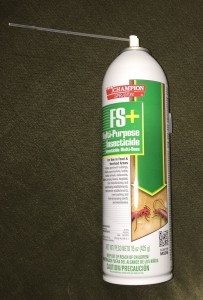


Be sure to treat any area like this you have – not just where you think beetles may be hiding. Grain Borers are small, fast and quick to hide when ever people are around – especially if you’re disturbing where they’ve been feeding. So in the process of cleaning and removing items, some have surely slipped out of sight and treating with an aerosol like FS MP will provide that extra bit of protection.
GRAIN BORER LIQUID SPRAY
3) Now that the cabinets and pantry areas have been treated, you may have to treat other areas of the home if activity has been seen. Laundry rooms, garages, basements and other areas where pet food and grain products like grass seed are stored will be prime nest locations and shouldn’t be overlooked. One or two rooms like this will be easy to treat with FS MP but if you have several which need treatment, get some BITHOR and GENTROL. Apply it with a PUMP SPRAYER and focus on baseboards, moldings and floor joists if accessible.
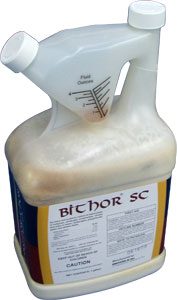
Bithor contains two actives. The first will act quickly killing any active stages. The second will remain long after the first is gone so any that come around weeks later will be controlled too. But adding Gentrol to the tank mix ensures you don’t miss any part of the home.
GENTROL will “translocate” to other parts of the room so hatching eggs will pick some up and not be able to fully mature. This in turn will break the local cycle and end the problem for good.

GRAIN BORER TRAPS
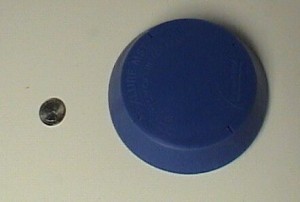
4) Now that you’ve treated all the cabinets, pantries, rooms and baseboards where adults may be hiding, install some GRAIN BORER PHEROMONE TRAPS. These traps use strong pheromones or sex attractants to lure adults. Once borers crawl or fly into the holding tray, the thick catching oil will hold them for good.
Set the traps in the back of any shelf or cabinet area. They’re quite discreet and easy to conceal. However, borers will easily find them. Place out at least one trap per shelf. The traps should remain active for 1-2 months but replace them if they fill with insects.
Grain borers can be a persistent pest once established in the home. To break their cycle, you’ll need to remove any infested or suspect food. Next, clean and vacuum all cabinets or closets where they’ve been found. Treat with these areas FS MP to kill off hatching larva and migrating adults. This treatment will provide several weeks of protection should any new eggs hatch or if any new adults come to the area.
If you have activity throughout the home, treat with Permethrin to get better coverage. Finally, set out traps in the cabinets and pantry areas where activity has been noted. Be sure to keep the traps fresh so they’re always helping by catching adults before they mate and try to reproduce.
CONTACT US
Give us a call if you need further help. Our toll free is 1-800-877-7290 and we’re open Monday through Thursday, 9:00 AM to 4:00 PM (Eastern Standard Time).
Email questions here: https://bugspray.com/about-us/contact-us
Order online and get a 5% discount! We ship fast with 99.9% of all orders shipping within 1 business day!!
Learn more about BUGSPRAY.COM and why it’s never been easier or safer to do your own pest control.
Please show your support for our business by purchasing the items we recommend from the links provided. Remember, this is the only way we can stay around to answer your questions and keep this valuable web site up and running. Thanks for your business!
Leave a Reply