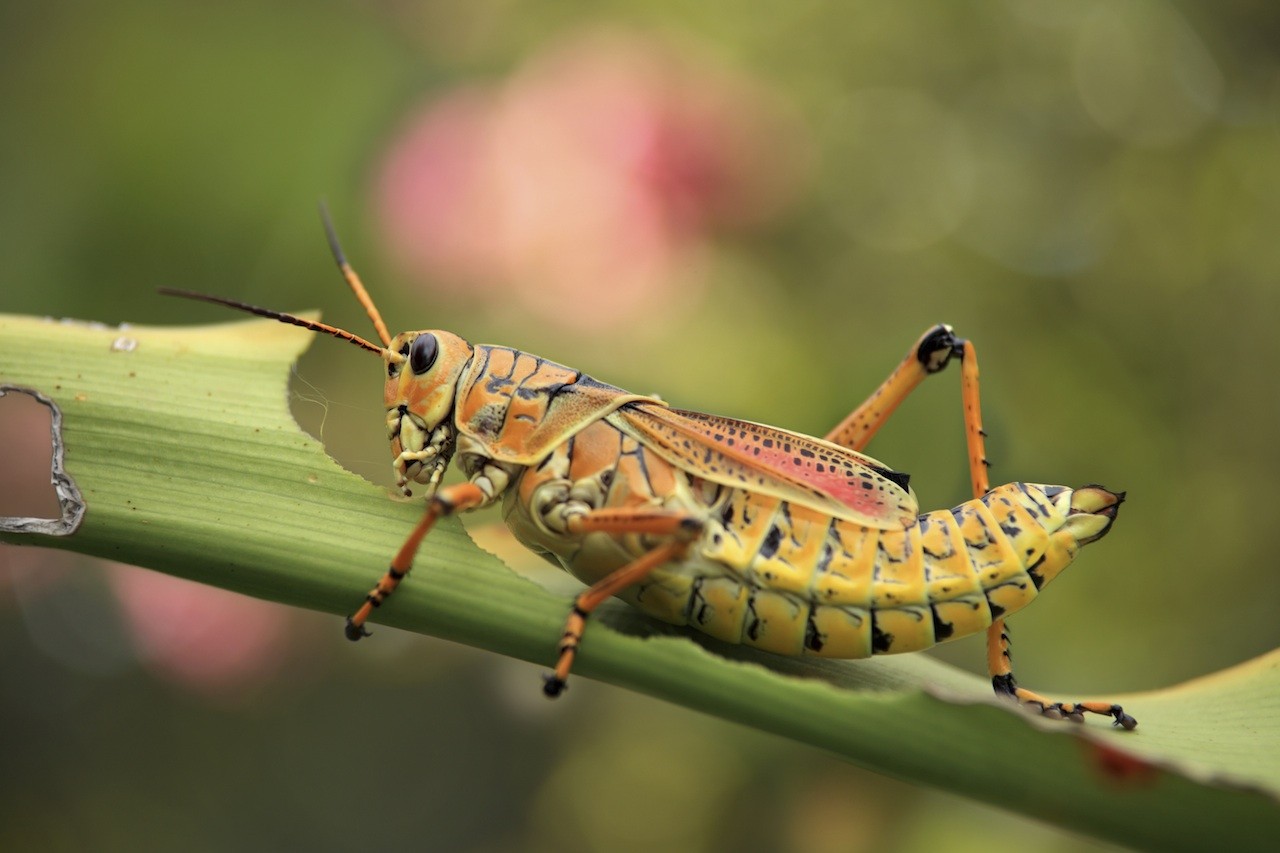
There are many species of grasshoppers around the world. Over twenty thousand have been identified and over one thousand exist in the United States alone. Grasshoppers are strong jumpers and they can fly. Though they don’t bite intentionally, they have been known to “chew” a person or two during migration or prolonged contact.
Grasshoppers are strong insects with a body well protected and sight which enables them to identify predators from afar. Closely related to crickets, these ferocious and crop damaging pests know how to “sing” and “chirp”.
This article will detail some basic biology of grasshoppers, list why they are a pest and then offer solutions on how to keep them away from your gardens and plants.
Related articles: CICADAS JAPANESE BEETLES KUDZU BEETLES
SO MANY GRASSHOPPERS!
Grasshoppers are known around the world. They are great jumpers and most species can fly as well. They have a tough outer-skin which affords them great protection. Pygmy grasshoppers are the least important. They are small with thin bodies which has a dorsal shield completely protecting it. Though they can do damage, Pygmy grasshoppers are thought to have the lease amount of impact.
Longhorned grasshoppers are much larger and have antennae which extends beyond the end of their body when folded back. Katydids, Cone-headed Grasshoppers and Meadow Grasshoppers are all members of this family. Long horned grasshoppers do a lot of damage every year; the Mormon Grasshopper was a meadow grasshopper which was responsible for so much damage which early settlers endured while farming Utah.
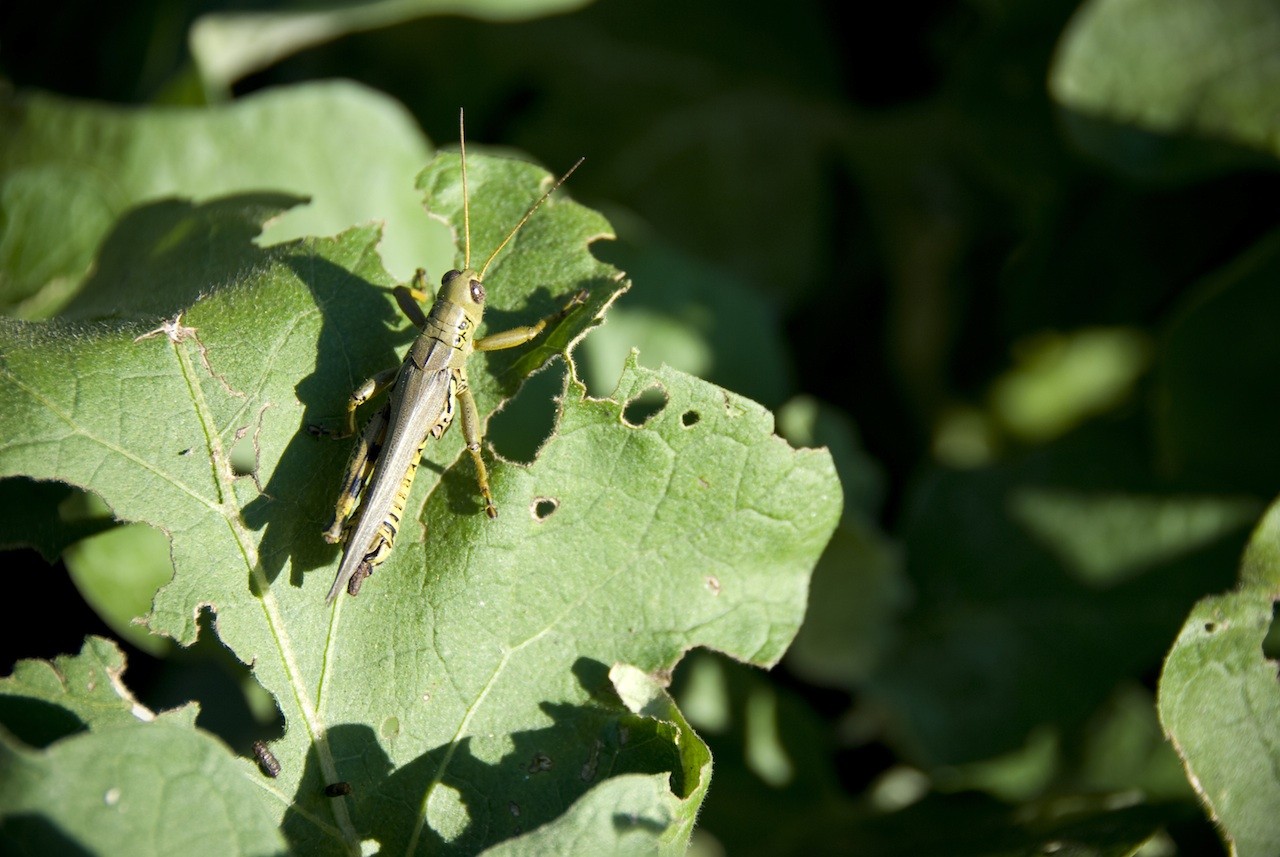
The shorthorned grasshopper is by far the most common of all species and has short antennae. This species includes the Spur-throated grasshopper which is able to molt and migrate when local food supplies are not sufficient. These are the true “locusts” which will leave in late summer/early fall in search of food. They will fly miles and miles when local food is scarce or if they reproduced too much for local conditions to support. Slant faced crickets and Band-Winged grasshoppers are also in the shorthorned species.
Grasshoppers vary in color. This will depend largely on local environments. Dry arid environments tend to produce more species which are tan to brown in color. Moist, succulent terrain will have more green grasshoppers. However, many species will start a season green and turn brown as the summer lags on into fall.
Most grasshoppers are great songsters. Males will use sound during courtship and so distinctive is their voice that many people are able to identify species by their song! Shorthorned species are only able to sing by rubbing various body parts together so they are really only able to “chirp”. However, both females and males will use sound throughout the year. It is believed their song is used to communicate food locations, mating seasons and the general state of local populations.
Grasshoppers have well developed ears which enable their sound to find the right target from great distances. It is clear their use of sound keeps them close together which is essential for species development and survival.
GRASSHOPPER BIOLOGY

Most grasshoppers will die by winter and start from eggs the following year. Pygmy grasshoppers are one of the only species which overwinters and emerges as adults in the spring. What little damage they do is mostly noted at the beginning of the growing season. Most other species will emerge as nymphs in the spring looking like adults but lacking the ability to fly. As they molt through the summer they will reach adulthood late in the season.
Once they mate, females will use their ovipositors to lay eggs in plants or the ground, depending on the species. This egg laying process causes great damage to plants. Eggs will then lie dormant through the winter and young will emerge at the beginning of the new growing season the following year.
GRASSHOPPERS EAT EVERYTHING!
Grasshoppers are worst known for the damage they do while eating. They have strong chewing mouth parts along with ferocious appetites.
Grasshoppers have been known to clear acres of crops, wild terrain and urban landscaping. At times they appear to eat whatever is in their path. This is particularly true when short horned species change over to locusts and migrate. Generally caused by overpopulation or lack of food, locusts are strong flyers and capable of causing uncontrollable damage.
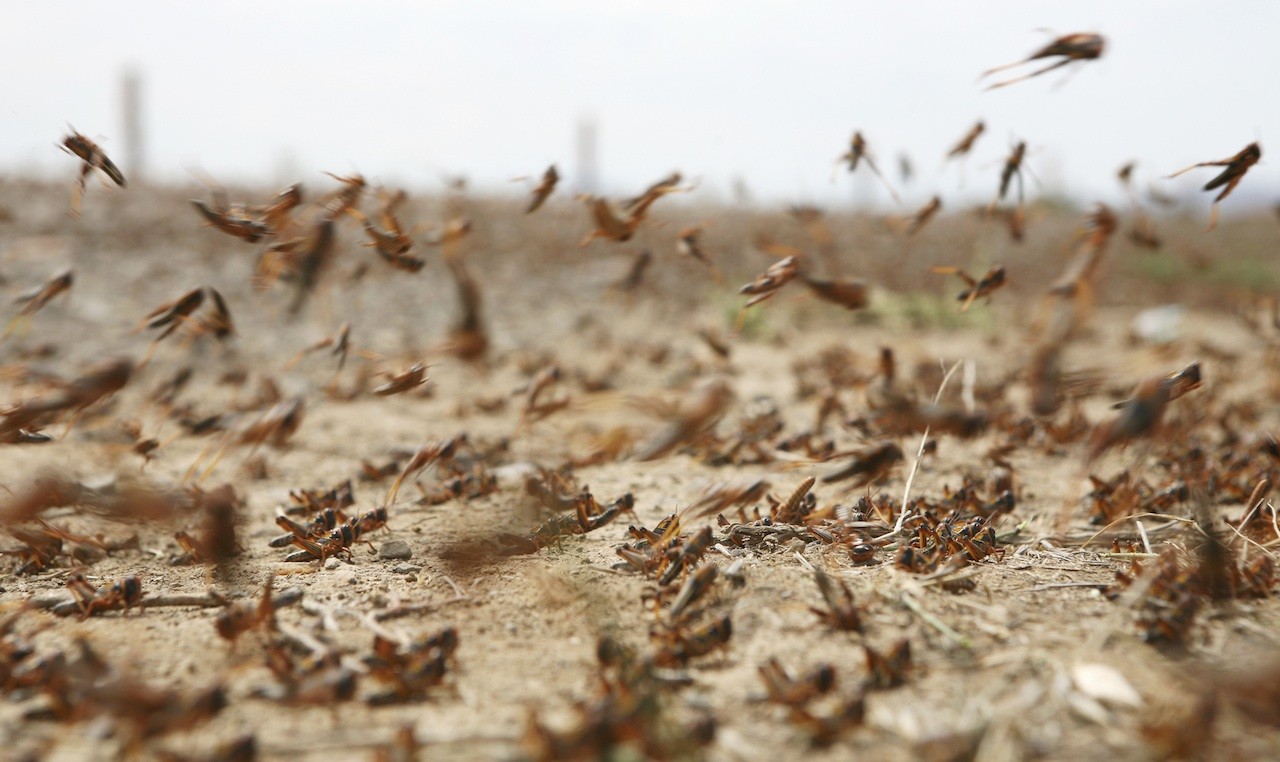
There is a certain feeling of helplessness many farmers have felt when they see the great bands of locusts descending upon their crops. Locusts act quickly and will sometimes eat entire plants; other times they ravish randomly. Small local populations are easy to control; large migrating locusts are difficult to stop but preventative steps can be taken to minimize loss.
HOW TO CONTROL GRASSHOPPERS
The key to successful grasshopper control is the timing of treatments. The timing of your treatments is dependent on which type of grasshopper problem you are experiencing.
If you are an avid gardener which experiences grasshopper damage and activity every year, you most likely have a local population which needs to be eliminated. This can be done by applying granules to your turf in the spring and some liquid during the season. The granules will help control developing young; the liquid will kill off active adults.
If you are in a region which generally has very little activity but migrating locusts typically find their way to your property from time to time, immediate action will be needed to minimize damage and followup treatments recommended to prevent population establishments. This can be handled with liquids only which will quickly kill and control the active numbers but also repel new ones off treated surfaces.
LAWN GRANULES FOR LOCAL GRASSHOPPERS
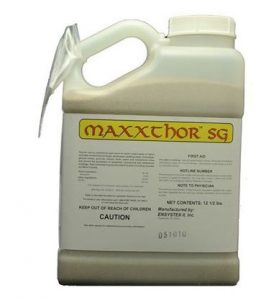
Throughout the spring, summer and fall, apply MAXXTHOR SG to your turf for season long prevention of nesting grasshoppers. These slow releasing granules will kill off young nymph grasshoppers as they emerge from eggs. Gardeners and property owners who have had an ongoing problem with grasshoppers need to make special note; by treating early in the season you will successfully break the cycle which is having a negative impact on your plants and landscape.
The following “short video” (less than 60 seconds long) gives you a good summary of how to apply the granules around the home and why treating the whole yard is best for this pest.

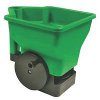
Maxxthor is easy to apply and can be spread with a HAND SPREADER to get proper distribution and coverage. If you are in a dry spell or generally arid part of the country, water them in following application. The granules will release into the ground providing control of many turf pests which emerge in the spring.
Use 6 lb’s for every 5,000 sq/ft of grass, mulch or flower gardens. Retreat every 60 days for prevention; every 30 days when infested.


Any decent fertilizer spreader can be used to make the application; just make sure it’s uniform and complete.
As the spring turns to summer, watch local grasshopper activity. If you treated in the spring, you should see a decrease in seasonal activity. The granules should have prevented most of the emerging nymphs to die off. If you begin to notice increasing populations by June or July, its possible new grasshoppers are emerging and developing from other places besides your turf; some species lay their eggs on plants, above ground, and spraying the adults during the summer and fall is the only way to break the cycle. Make sure to keep abreast of regional grasshopper populations. If your local media and farm reports are talking about migrating locusts, get ready to do liquid treating.
BEST GRASSHOPPER SPRAY FOR THE YARD
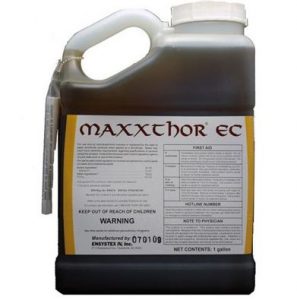
If you have a history of grasshoppers arriving during the summer, spraying your plants before they arrive should head off most of the damage. Grasshoppers may like to eat but they don’t like the taste of certain chemicals. Treat ahead of their arrival with MAXXTHOR EC. Expect to see some land on treated plants but they will die in 1-2 if they don’t leave.
If treating a small area, you can use a PUMP SPRAYER to spray. Add .5 oz of Maxxthor per gallon of water and use this mixture to cover up to 1,000 sq/ft of turf, plants, shrubs or trees.
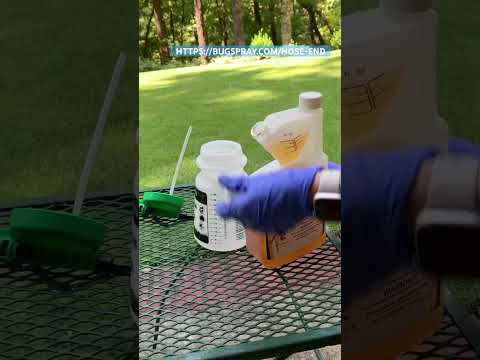
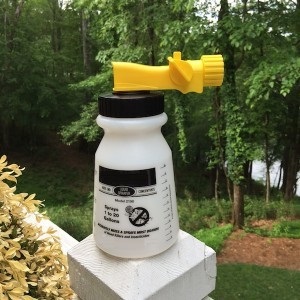
In general, you’ll be best served using our 20 GALLON HOSE END SPRAYER to get this done. The Hose End uses the power of your garden hose to pump the Maxxthor out so very little effort compared to using a pump sprayer.
The following “short video” (less than 60 seconds long) shows how to set up our Green Topped Sprayer. For Grasshoppers, our Yellow Topped Sprayer (seen below) will be setup the same exact way. Its best for turf applications and treating grasshoppers so what you see in the video is exactly how you should use the sprayer below.
Treat as needed when active; this might be once a week during a severe season. And treat in the evening an hour before dusk so the spray has a chance to set up on the turf and dry without long exposure to the sun.
To get the most of your Maxxthor treatment with added knockdown killing power, add SPREAD-X BOOST to your tank mix. Boost is an adjuvant, also known as a wetter spreader or spreader sticker. It basically makes water and the mixture more “slippery” so you get better coverage over targeted pests and the foliage they like to eat. Treatments will spread 2-3 times wider and penetrate deeper. On grasshoppers, this is super important so the treatment can get through their armor like exoskeleton.
The following short video summarizes why Boost can help deliver your treatment to where it matters the most. And this is extra helpful when treating homes with siding like vinyl, aluminum and stucco where clovermites are likely hiding.
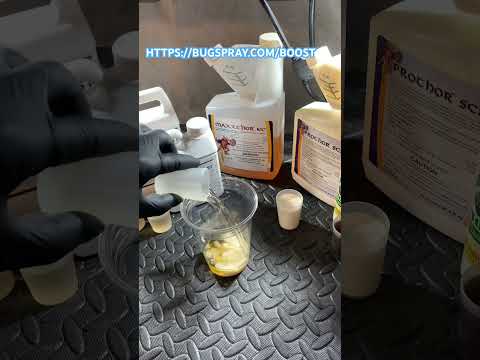
Add no more than the rate you’re applying the Maxxthor so in this case, if you’re adding 2.5 oz of Maxxthor to the hose end sprayer, add 2.5 oz of Boost too before adding water. If you’re adding Maxxthor to a pump sprayer at the rate of 1 oz per gallon, use 1 oz of Boost.
And don’t spray in the middle of the day; treat late in the day close to sunset so the treatment can dry without direct sunlight. UV light on the Boost can stress plants if the temperature is 85 degrees or higher so treat 2 hours or less before sunset to reduce sunlight stress.


If you have a yard 5,000 sq/ft or more to treat, use a HOSE END SPRAYER. With our unit, you only need to add 1 oz of Maxxthor to the sprayer and then fill the sprayer to the 5 gallon line with water. Next, hook it to your garden hose and as you spray, the water being pumped out will suck out the mixture from the sprayer and deliver the prescribed dose to your plants.
Treatments may only be needed every week or two but if you are experiencing a massive onslaught of grasshoppers, don’t be afraid to treat every few days until the initial wave subsides. Once activity slows, expect to find some damage but most importantly, be sure there are none around able to lay eggs and get established.
GARDEN SAFE GRASSHOPPER SPRAY
For a fruit or vegetable garden with grasshoppers, we have an organic concentrate that will kill on contact and have just a few hours till “harvest”.
ORGANIC SPRAY FOR GRASSHOPPERS
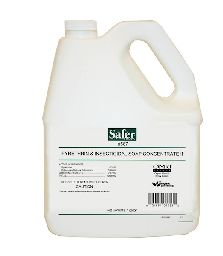
Known as MULTIPURPOSE INSECT KILLER, its approved for organic gardening and has just one day to harvest when sprayed on fruit or vegetable plants.
Mix 6 oz per gallon of water and use the mixture for up to 500 sq/ft of garden plant foliage. Treat as needed during the growing season and be sure to spray after dinner, just before dusk. One quart of concentrate will make up to 5 gallons of mixed solution and cover up to 3,000 sq/ft.
CONTACT US
Give us a call if you need further help. Our toll free is 1-800-877-7290 and we’re open Monday through Thursday, 9:00 AM to 4:00 PM (Eastern Standard Time).
Email questions here: https://bugspray.com/about-us/contact-us
Order online and get a 5% discount! We ship fast with 99.9% of all orders shipping within 1 business day!!
Learn more about BUGSPRAY.COM and why it’s never been easier or safer to do your own pest control.
Please show your support for our business by purchasing the items we recommend from the links provided. Remember, this is the only way we can stay around to answer your questions and keep this valuable web site up and running. Thanks for your business!
MJ says
Started using this product in late Feb to control a grasshopper infestation. It’s June now and we have seen very few grasshoppers. Will continue to use this every 6 weeks or so and break the nesting/hatching cycle.
.
Thanks for your help!
Deborah says
Hi,
I am in southern West Australia. Do you sell any of your products in Australia as I will need a bag of granules, as we have 7 acres, which is not all garden but is all green.
Tech Support says
Deb,
At this time we do not have anyone in your region selling this product. But do send Essentria Granules there direct and you can order them from us using this link:
Essentria Granules: https://inter.bugspraycart.com/exempt/granule/eco-exempt-org-g-22-lb
This will work effectively the same as the Maxxthor.
Technical Support
U-Spray Bugspray
http://www.bugspray.com
1-800-877-7290
PS: Are you signed up for our informative twice a month Pest Report Newsletter? More info here: https://bugspray.com/bugspray-pest-report