LARDER BEETLE BIOLOGY
Larder Beetle species are common throughout the world. In fact, larder beetles play an important role when it comes to recycling. Larder Beetles feed on most any dead animal. This includes animal hair and flesh. But this ferocious appetite can many times cause larder beetles to forage into homes and other buildings where their feeding will become a problem.
This is because larder beetles will readily infest anything “natural”. So once in the home, they can nest on furniture, carpeting, drapery, taxidermy mounts, horse hair mattresses, insulation, etc. Basically anything in the home that has natural fibers can be food for larder beetles.
WHAT DO LARDER BEETLES LOOK LIKE
Larder beetles are small and dark. They typically have a light gray to brown band around their mid section but can be completely solid and uniform in color. Adults will range from 5-10 mm and be dark brown to black in color. They are strong flyers and are attracted to decaying flesh and rotting meat. Larder beetles will regularly penetrate and nest in stored products like pet food or cheese. They love hanging meat like hams and sausage. And though adult larder beetles are attracted to such food, they don’t eat nearly as much as their offspring.
LIFE CYCLE OF LARDER BEETLES
Adult larder beetle females will seek a good food supply on which to lay eggs. If conditions are right, these eggs will hatch in as little as 2 days. Larva should be able to find food close by (since females lay eggs close to food) and will eat continuously till they are ready to pupate and become adults. They are ferocious eaters and can chew though most anything. This feeding may go on for 1-8 months depending on local temperatures, humidity and food quality.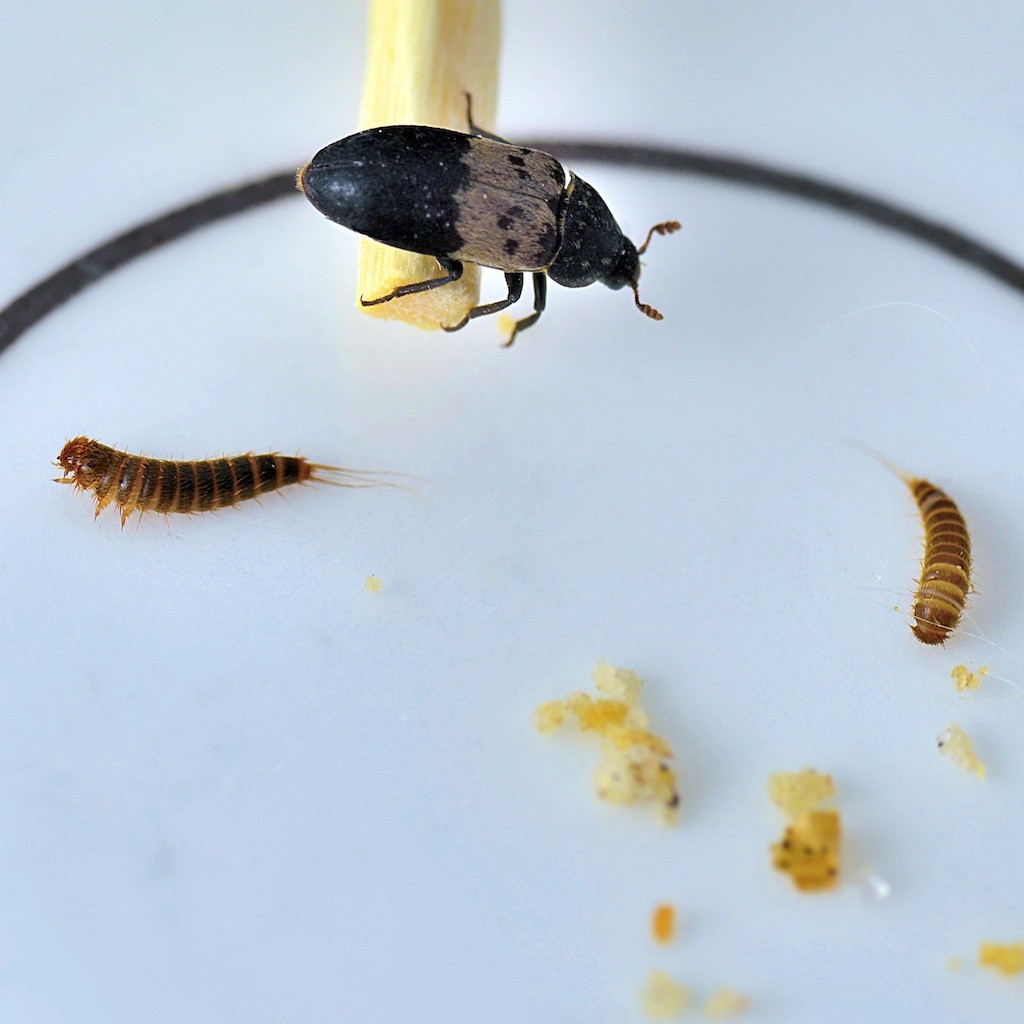
Once larvae get their full, they’ll move off the food source and find a safe location on which to pupate. This could be in a slight crack or crevice, behind some type of siding or on a tree. Larvae can chew into wood and have been known to cause a lot of damage to structural members of homes and buildings during their trek to find safe harborage. Larder beetle pupa will take a week or two to fully development before emerging as adults. This process could be delayed if it’s cold or other weather factors slow the process. When done, they will emerge as an energetic, light avoiding adult.
LARDER BEETLES ARE MOSTLY NOCTURNAL
Adults will mostly fly in darkness searching for fertile ground on which to continue their cycle. Males will be chasing females, which can start egg laying in as little as a week, and females are always seeking good food supplies on which to lay eggs. Female larder beetles will lay hundreds – in some cases thousands – of eggs. If she planned accordingly, her young should have plenty to eat once they hatch.
Larder beetles are important to the natural cycle of animals. By consuming both flesh and carcass, larder beetles enable dead animals to filter back into the earth. But this process can prove costly and expensive if they target something we’re trying to preserve.
Larder beetles will become a nuisance when they find their way into homes and other buildings. Barns, poultry houses, sheds, dog kennels and other areas where animals are kept seem to naturally attract larder beetles. Though they prefer decomposing meat on which to feed, larder beetles will take advantage of animal skins, leather, rugs, mattresses and clothing when food supplies are limited.
They can live on hats, fabric and just about anything which uses animal parts such as hair or skin. Larder beetles can be a hunters worse enemy since they love any animal that’s been mounted and displayed on the wall!! For this reason they will target museums, taxidermists and butchers too. Cattle farms are another favorite location as are zoos and even animal shelters. Larder beetles have been found on living animals too. Sickly dogs and other disease ridden wildlife can all become a target of this pest. Their small size and light body weight can make them difficult to notice. If left alone, they can cause huge amounts of damage and in extreme cases loss of life.
LARDER BEETLE TRAPS
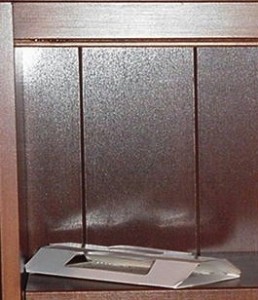
If you’ve found a few larder beetles and would like to know if you have a problem, set out some LARDER BEETLE TRAPS. Deploy them in rooms where activity has been noted. If you catch more than 1 a week, you have a problem and should treat. And though traps will catch foraging adults, this won’t stop or control the problem.
For example, if you have several traps deployed and are catching adults in one room which has a small place rug or animal skin showing signs of activity, it’s best to assume adults have left eggs elsewhere in parts of the home too. So if you only treat the rug, you could allow other stages close by to continue their cycle. So once any activity is discovered, treat as large of an area as possible – especially if the traps are showing larder beetles to be active in more than one location.


HOW TO TREAT LARDER BEETLES
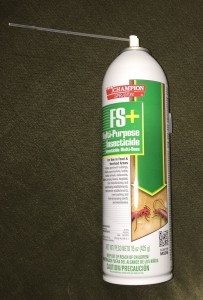
Treatment strategies for larder beetles should be determined based on the area or areas showing larder beetle sign or activity. Small sheds with stored animal skins or other food items won’t need a lot of product and can be adequately treated with something like FS-MP AEROSOL. This aerosol is easy to apply, has low to no odor and is gentle on most any surface.
Use it on animal skins, fur, carpets, furniture, animal mounts, cabinets, pantries and just about any surface larder beetles might find attractive. Initially you should treat every 2 weeks and then every 3 months to assure larder beetles won’t return.
BEST LARDER BEETLE SPRAY
For large areas, using a liquid concentrate will prove more cost effective. And for larder beetles, the best option is BITHOR.
Mix 1 oz per gallon of water and apply the mixture to baseboards, carpeting and other surfaces where beetles are active or thought to be hiding. Be sure to treat once every two weeks during initial phases of treatment and then monthly to insure they don’t return.
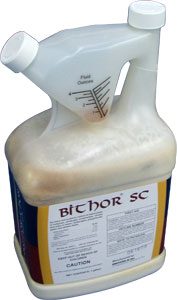
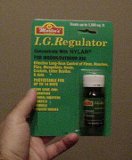
Now its important to understand Bithor will only kill adults and larvae. So for long term control, add NYLAR to the tank mix. Nylar is a growth regulator and essentially helps by preventing larvae from growing into mature, reproducing adults. It won’t kill adult stages but it will help a lot because it will translocate to all areas well beyond where you spray. This means you can’t miss when Nylar is added and in most cases, its what you need to end the problem once and for all.
Nylar is active for many months too so even after the Bithor wears down, if you included Nylar you’ll have something in place working long after you’re done spraying. Larder beetles can be persistent so it’s smart to employ long lasting materials. Nylar is such a product and is a great product by itself to keep beetles from ever getting established.
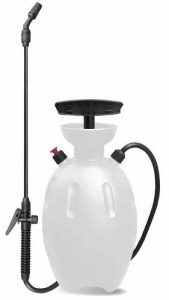
Lastly, make sure you make the applications with a good PUMP SPRAYER. Our sprayer comes with an adjustable nozzle so you can get a nice wide swath for treating carpets. A wide swath is needed and the material must be distributed evenly which most pump sprayers can’t do.
Larder beetle control can be done once you know where to treat and what they are targeting. Remember, they’re excellent flyers and will many times find different areas of the home to occupy. Animal mounts, horse hair mattresses and just about any natural fabric or material in the home can become food for this ferocious insect.
FS MP Aerosol might be easy to use and handy but it may not be the most economical option if you have a large home to treat. So for treating the entire home, go with Bithor along with Nylar (the egg killer). Lastly, install larder beetle traps to monitor the problem and make sure as much of the home is treated as possible.
CONTACT US
Give us a call if you need further help. Our toll free is 1-800-877-7290 and we’re open Monday through Thursday, 9:00 AM to 4:00 PM (Eastern Standard Time).
Email questions here: https://bugspray.com/about-us/contact-us
Order online and get a 5% discount! We ship fast with 99.9% of all orders shipping within 1 business day!!
Learn more about BUGSPRAY.COM and why it’s never been easier or safer to do your own pest control.
Please show your support for our business by purchasing the items we recommend from the links provided. Remember, this is the only way we can stay around to answer your questions and keep this valuable web site up and running. Thanks for your business!
David says
How much nylar per gallon of bithor mix is needed
Tech Support says
It depends on which one you got from us. The less concentrated form packed in 1 oz or 4 oz jars will require 1 oz per gallon. The more concentrated form, it will show 10% on the label, just 1/3 of an oz per gallon.
Technical Support
800-877-7290
phyllis bagley says
I have two house cats…will bithor or nylar treatment harm them….I leave dry cat food out 24 7…..what month/time is best to use product?
Tech Support says
Phyllis,
As explained on our site (link on the right side of this page), none of our products will pose a hazard to people or pets when used properly.
Pet Safe: https://bugspray.com/about-us#Are_our_products_pet_safe
As for when to treat? Anytime you have this or any other pest for that matter is when you need to treat. Inside any home is what we call a “controlled” environment. As such, insects which get active inside and start to nest, like larder beetles, will thrive all year until you treat. Unlike outside where pests are active for 2 or maybe 3 seasons, inside pests are active all year long. Ironically most are worse during the fall and winter inside.
Technical Support
http://www.bugspray.com
K says
I have found a few (3) larder beetles in my home over the past 4 or so months, should this be a cause for concern?
To this day I haven’t found larvae or nests, however I will investigate further.
Tech Support says
Based on what you’re “finding”, there is a problem. Remember, what you see is most likely less than 5% of what’s going on. This is especially true for insects like larder beetles who in general are secretive and not easy to find.
.
My best guess is that they have some direct route of entry into your home. Could be a window, garage, basement or something else. But in general, seeing adults inside means one of two things: either they flew in from outside OR they are hatching from pupae inside the home left by some adults earlier this summer.
.
If they are hatching from pupae, it means a pregnant female was inside and was able to lay eggs. If that happened, the larvae must be feeding on something AND surviving. For this reason, it would be wise to give the home a good treat of FS MP Aerosol to all cracks and crevices and if you have rugs, a good treatment to them with our Bithor.
.
Remember, larger beetles are active outside during the summer and fall and will seek refuge to lay eggs. But they could be drawn to any home with natural fiber like pet hair or “meat” smells. Many homes have common things larder beetles can eat and trying to locate that source could be near to impossible. This is why a good general treatment will usually be smart; it will eliminate any possible threat of nesting as well immediately killing off any already developing.
.
FS MP: https://bugspray.com/catalog/insecticide/aerosol/fs-mp-insecticide-15-oz-aerosol
.
Bithor: https://bugspray.com/catalog/insecticide/liquid/bithor_sc
.
The article above details this to great extent with the above two products being essential for treatments. Now if you have any taxidermy mounts, the FS MP can be sprayed on them or the Bithor mixed.
.
Technical Support
bugspray.com
Sara says
I have been finding larvae and beetles ALL OVER my house! I don’t even know where to start. We have a newborn and I am devastated. At this point I feel they are out of control and too far gone to get rid of. Is it possible to get rid of them if I’m finding larvae and beetles all over?
Tech Support says
Sara,
Larder beetles exist outside like most all pests and often times will forage inside. One female laying hundreds of eggs can cause a big problem. If you treat with our Bithor and Mini Mister as detailed in our article above, you’ll be able to control them.
.
Bithor: https://bugspray.com/catalog/insecticide/liquid/bithor_sc
.
Mini Mister: https://bugspray.com/equipment/foggers/mini-mister
.
Technical Support
bugspray.com
Raymond Arnone says
When using the mini mister with bichor should you wear a respirator? When treating carpeting is it safe for the kids to play in the area after it dries?
Tech Support says
Raymond,
In general, the “mist” is not light enough to drift “up”. For this reason, no product should make its way up to where you are breathing assuming you are treating “downward”. That said, wearing a respirator when applying a mist or aerosol of any kind will always help reduce if not eliminate the chance of accidentally breathing some in. We explain this in our Safety First videos here:
https://bugspray.com/safety-first-videos
As for the safety of pets and children post treatment; there will be no hazard presented to them as our video details on this page:
https://bugspray.com/catalog/insecticide/liquid/bithor_sc
Tech Support