BEST PINE BARK BEETLE SPRAY AND TREATMENTS
PINE BARK BEETLE BIOLOGY
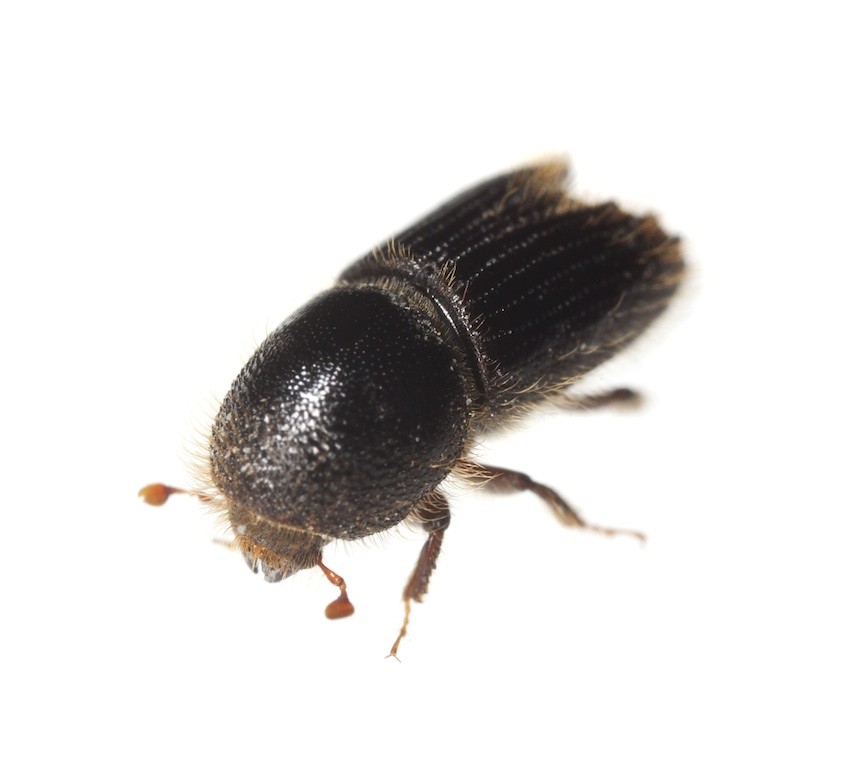
Pine Bark Beetles are small reddish to dark brown beetles about 1/4 to 1/2 of an inch long. They are able to fly, reside in trees and can be found at many altitudes around the world. Though they prefer live trees, they can and will feed on freshly cut stands when available.
This short video (less than 60 seconds long) gives you a brief summary of all the detailed information below. As you scroll down, you’ll see everything you need along with “add to cart” buttons for ordering directly from this page:

Pine bark beetles are the single most destructive pest which attacks pine trees. They are quick to reproduce, migrate and eat so once active on any one tree in a stand, it is important to start dealing with them immediately to minimize casualties. There are other species which will feed on a variety of hardwood trees but these tend to be slower at both reproducing and causing damage. Softwoods, like pine trees, tend to get damaged quicker and are able to provide harborage to more insects then hard woods over the same period of time.
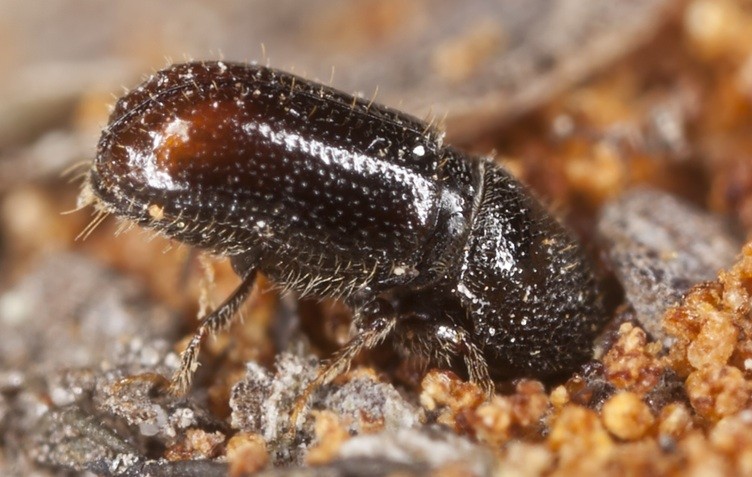
Pine bark beetles are attracted to pine trees by smelling the trees sap. Though most trees will emit small amounts of sap naturally, trees which sustain injury due to man or nature are more likely to get beetle activity. Pruning at inappropriate times (like the summer), mechanical damage by construction crews cutting protective tree bark, lightning, drought, disease or insect damage like that which can occur from termites can all make a tree more susceptible to pine bark beetles. Once a flow of sap is more than normal, the odds that beetles will find the tree are increased.
PINE TREE INJURIES FROM PINE BEETLES
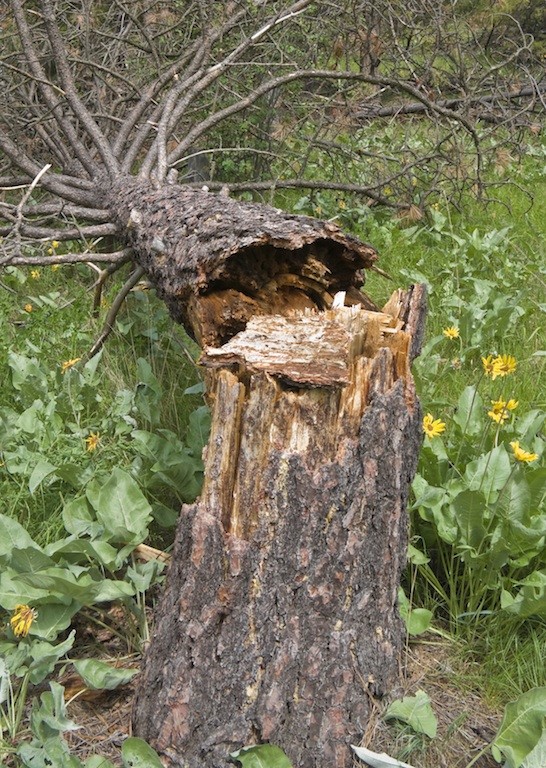
A normal healthy tree will emit or release some sap that can attract beetles. When a tree is injured and sap runs freely and the odds that beetles find the tree are greatly increased. Once found, beetles will penetrate the bark and then begin excavating tunnels between the bark and the wood of the tree. These tunnels will serve as egg cavities. Eggs will be laid and when the larva hatch they will immediately begin to feed on the live part of the tree called the phloem and xylem. This feeding will lead them on a random journey which typically moves around the tree weakening it’s bark to the point of it falling off. Trees which have been severely damaged will shed their bark and appear naked; galleries and tunnels will be visible leaving a sure sign of what caused the damage.
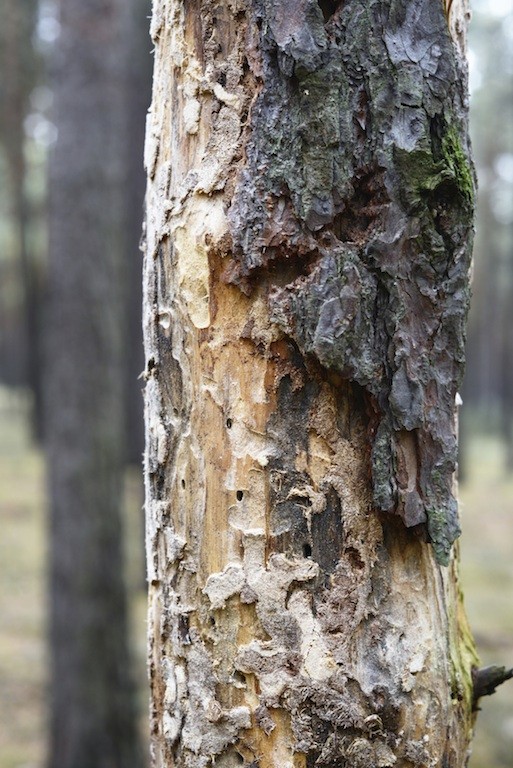
Once the larva get their fill, they will undergo a metamorphosis during which time they change to adults. This third stage is called the pupa and when ready, they will hatch and emerge from the tree. Their emergence will leave a bunch of new holes through which the attractive scent of sap along with their natural pheromones will attract even more beetles. For this reason it is always wise to treat any tree which you suspect may have a small amount of activity.
In general, most healthy trees can withstand a beetle or two but if left alone, this initial activity will multiply to hundreds of beetles as new ones are attracted to exit holes.
At this point the survival of the tree will be jeopardy. More important are the adult beetles which emerge. Remember, they’re looking for new trees on which to land and start laying eggs. And though they typically target the most “active” trees, it only a matter of time before the infestation spreads.
WHEN TO TREAT PINE BARK BEETLES
In general, spraying pine trees you’d like protect once a year would be wise. This is especially true if you reside in region with known activity.
Once beetles are on your land and feeding on your trees, the scenario will change from “preventive” to “saving”.
So lets say you identify activity in the spring. Then you need to treat all the surrounding trees you want to prevent from getting activity and then decide if you want to attempt to “save” the trees with activity. The other rule to follow is that pine borers will be most active in the spring, summer and fall.
In the spring, activity will increase with migrations happening as beetles seek mates. In the summer, maturing beetles hatching from pupae will be on the move looking for a new tree to infest and this will occur through fall. At some point trees will be too “cold” for beetles to leave. But if you get late season treatments in place, the cold of winter will protect the tree for 3-6 months. This way even if it warms in your region, the treatment will continue to work so nothing new will forage to these protected trees.
So in summary, a treatment in spring and fall is always good and considered to be the “minimal” frequency of treatments done. But if you only identify a problem in the summer and treat then, it may carry you to next spring but treating in the fall wouldn’t be a bad idea if the problem is bad.
Unfortunately saving trees with extensive activity may be near to impossible. That’s not to say you shouldn’t tree. But letting the beetles have one “untreated” tree or removing the infested tree is not a bad idea. Just remember that remaining trees will quickly become targets if left unprotected.
At that point you’ll need to make some decisions regarding how much “preventive” treating you want to do. The good news is spraying the bark once a year before you have activity can really help. Combine this with a use a systemic and you can help most any tree from predatory pests.
Below are all the products you’ll need; the following video gives you a great “overview” of process verbally and should make everything very clear.
VIDEO EXPLAINING HOW TO TREAT PINE BARK BEETLES
BEST PINE BARK BEETLE SPRAY
If you are in a region where pine bark beetles are active or if you have had some bad experience with them in the past, consider treating and protecting any tree you value. Such treatments should done at least once a year; once in the spring and once in the fall would be ideal.
By spraying the bark you can help to establish a protective barrier through which beetles cannot enter. Furthermore, MAXXTHOR EC is highly repellent to most any insect so they will definitely leave treated trees alone. Treatments to the bark will last 1-2 months and even trace amounts of the active will be detected helping to keep the tree insect free.
Mix it at the rate of 1 oz per gallon of water and expect to get up to 500 sq/ft of surface area protected per gallon of mixed spray. That means you should be able to get 2-4 average pine trees protected per gallon of mixed solution.


For preventive treatments, focus on the bottom 10 feet of trunk. Any standard PUMP SPRAYER can be used to do the treatment. In general, you want to spray high first so that the material will run down the bark allowing you to maximize the area treated without spraying the same area over and over.

To get the most of your treatment, add SPREAD-X BOOST to your tank mix along with the Maxxthor. Boost is an adjuvant, also known as a wetter spreader or spreader sticker. It basically makes water and the mixture more “slippery” so you get better coverage. Treatments will spread 2-3 times wider and penetrate deeper. This is super important when spraying trees. Boost will help the Maxxthor get “into” the bark that much deeper and as a result, residuals will be longer and the immediate impact your treatment will be magnified.
The following short video summarizes why Boost can help deliver your treatment better.
Add no more than the rate you’re applying the Maxxthor so in this case, if you’re adding 2.5 oz of Maxxthor to the hose end sprayer, add 2.5 oz of Boost too before adding water. If you’re adding Maxxthor to a pump sprayer at the rate of 1 oz per gallon, use 1 oz of Boost.
And don’t forget to add Boost to your soil drenches with the Prothor. Boost and Prothor, as well as Joy Juice, are all compatible and the Boost will get the treatment at least twice as deep. This insures the actives will be “in” the tree that much faster with Boost speeding up the time it takes to get the actives to the roots for absorption.

HIGH REACHING SPRAYERS FOR INFESTED TREES
For trees with current activity, spray as high as possible. Pump sprayers will generally reach 10-15 feet which may not be enough. But if you have a garden hose with high water pressure, use a HOSE END SPRAYER to deliver the Maxxthor and Spreader Sticker.
Everyone wants to know “how much do I apply per tree”? In general, a tree with a tree trunk 1 foot wide would require about 1 gallon of spray starting up as high as you can reach and letting it “drip” down as you try to cover as much of the sides as possible. Obviously some spray will miss when applied and some will drip to the ground but try to minimize these two events so you get the best coverage. The goal is to cover the bark with enough fluid/mixture to get it damp but no so much that is all running off the tree.
To get started, add 5 oz of Maxxthor to the sprayer and if you get the Spreader Sticker, 2.5 oz and then lastly, water so the level in the sprayer is about half full which is around the 10 gallon line. Now use this on 10 or more trees that are about 1 foot wide on their trunk. If the trees are 2 feet wide? Use the entire amount on about 5 trees.
The treat thing about this sprayer is that you can remove the nozzle so the spray will come out like a laser and reach straight up.

If you need to reach up 30-35 feet or more, our NO PUMP SPRAYER will help big time. It relies on air pressure and can be pumped up to 80-90 psi safely. The small one can hold 1.5 gallons of mixture and when pressurized, will pump out the entire contents with only one time filling it with air. It’s especially helpful when you need to treat trees that are not reachable with a garden hose.

This video covers all you need to know about the sprayer:
TREAT PINE BEETLE HOLES DIRECTLY
Another option for treating light problems and the cracks and crevices of the bark is to inject some FS MP AEROSOL. It comes with a straw which can be inserted into small holes so that you can treat “into” the tree. The pressure of the can along with the aerosol sized particles which are released insures a thorough treatment. FS MP uses an oil base solvent system enabling it to both penetrate an last long compared to traditional water based products.\
This next short video (less than 60 seconds long) will show how to use this for “quick” control of bark beetles. Mind you this is not as “good” as the Maxxthor but it can be helpful since you can penetrate deep where the spray can be tough to get back and “under” bark as easily.
Simply insert the thin straw, hold the can on for 5-10 seconds and you’re done. Any beetles in the hole will be dead and the FS MP will provide long lasting residual so new beetles can’t use the same hole again.

REMOVING PINE BEETLE INFESTED TREES
When a tree has been found with a lot of activity, you probably won’t be able to save it. The original thinking of handling such trees has been to remove the infested tree and then to burn it along with all the infesting beetles. However, this is not always so easy to do. One thing is for sure: If you have a tree infested with Pine Bark Beetles and there are other trees close by, you need to treat the other trees ASAP. This preventive application should be done with the Maxxthor and careful inspections of these same trees should be done monthly as well until the infested tree can be removed or taken down.
There are other considerations regarding the infested tree. First, does it pose a threat to a home or wildlife should it unexpectedly fall? Trees that have been weakened by beetle damage will eventually crash to earth. Be sure the tree you have identified does not pose a direct hazard to nearby residents.
Second, can the tree which is infested be removed? If the answer is yes, you should consider treating if before the removal. Remember, the act of taking down the tree will stir up adults causing them to leave. This exodus will undoubtedly allow several of them to find a new home elsewhere basically infesting another tree. Avoid this problem by treating the tree being removed with FS MP or Maxxthor along with a thorough treatment of any trees you want to protect.
Third, once removed, where will the dead tree be taken? Trees which have been treated prior to being taken down may have less active adults and larva but many will be active and thriving. As a general rule you don’t want to leave a fallen tree laying around which is infested with pine bark beetles. They will quickly start to leave and nearby trees will become immediate targets.
For this reason its important to have the tree taken away, mulched or burned immediately upon being cut. There have been too many cases of trees which look to be OK which turn out to have hundreds and thousands of adults leave it once cut down. These migrating adults are then able to relocate and start their infestations all over again.
Make sure you don’t let this happen by disposing of the tree completely. Burning works well and mulching the burned remains is okay. But the last thing you want to do is keep the logs laying around intended to become firewood for next winter. This would be a big mistake. Since adults and larva will start leaving this now dead and dehydrating lumber, you should never keep and store infested wood around the home. Get rid of it any way you can.
USE SYSTEMICS FOR GOOD TREE HEALTH
Something else to consider is the use of a good systemic. These are products you water into the ground around the trunk of the tree. Once injected, these products will be absorbed up into the tree and kill pests which attempt to feed on the treated tree. The best product for this is PROTHOR. It can be sprayed on the tree too but it’s real strong point is when used as a systemic.
Though it will take a few weeks to make it’s way throughout the tree, annual treatments with Prothor can protect trees from most any insect infestation and help cure current problems. Remember, there is a huge range of insect pests which will target trees. And though one species may not be enough to kill it, a combined infestation can easily make a tree weak and cause it to succumb to the disease. For this reason protecting any tree you treasure with Prothor makes sense.
Use Prothor at the rate of 1 oz per 10″ trunk diameter. Mix it in 5 gallons of water and drench inside the tree’s drip line to insure good root absorption. Prothor only needs to be applied once a year and can really help “preserve” your trees overall good health.

To best apply the Prothor, use a 5 gallon bucket with 3-4 gallons of water. Add the needed Prothor to the bucket and then poke 8-12 holes at least 1/2″ wide in the ground around the trunk of the tree. These holes should be inside the “drip line” of the tree but not closer than 2 feet to the trunk. A SOIL AUGER can help create holes; use it with a hand drill.
This short video (less than 60 seconds long) shows how the Auger can help:
Make the holes at least 6-10″ deep so the liquid solution will filter down the hole and ultimately reach the roots of the tree.

ADD JOY JUICE FERTILIZER WHEN DRENCHING WITH PROTHOR
To help stress trees, adding equal amounts of JOY JUICE LIQUID FERTILIZER to your bucket of Prothor is recommended. Soil drenching is like using an “IV” in a tree and why not add some good food to the treatment? This formulation is stable and won’t shock the tree but does include nitrogen immediately available for absorption. Trees in stress will quickly suck it up and this little boost will help by healing and promoting new growth.

SET OUT PINE BORER REPELLENT
One last preventive measure you can take is to set out PINE BORER REPELLENT POUCHES on any tree you want save. These pouches release a pheromone only pine borers will detect which tells them to stay away. The message received by foraging beetles is that the tree where they’re placed is infected and already saturated with beetles so move on.
Place one pouch per tree in yards with a few trees. Make placements in early spring as beetles will be on the move March-Apri-May and then again in Sept-Oct-Nov. Pouches will cover up to 2500 sq/ft of turf and should be replaced every spring and fall.

PINE BARK BEETLE CONTROL SUMMARY
Pine bark beetles can be a problem for homeowners and land owners all around the world. They strike quietly and their damage will quickly kill infected trees. If you are in a region where activity is high, inspect your trees every couple of months to try and identify if any get activity. Pine bark beetle control can be achieved if you treat with Maxxthor once or twice a year to help safeguard against infestations. Once active, you will need to first protect the trees surrounding the one with activity and then make some decisions regarding the infested tree which could include using a systemic like Prothor. For added support, add some liquid fertilizer.
If you decide to try and save it, be sure to do thorough applications behind the bark with FS MP to kill off current activity. If the tree has to be removed, be sure to destroy all the wood properly so the present beetle population is not able to survive and relocate. Following these guidelines will help keep your trees both healthy and happy so they can continue to be an active part of your landscape.
CONTACT US
Give us a call if you need further help. Our toll free is 1-800-877-7290 and we’re open Monday through Thursday, 9:00 AM to 4:00 PM (Eastern Standard Time).
Email questions here: https://bugspray.com/about-us/contact-us
Order online and get a 5% discount! We ship fast with 99.9% of all orders shipping within 1 business day!!
Learn more about BUGSPRAY.COM and why it’s never been easier or safer to do your own pest control.
Please show your support for our business by purchasing the items we recommend from the links provided. Remember, this is the only way we can stay around to answer your questions and keep this valuable web site up and running. Thanks for your business!
Windy says
Client does not want to remove infested mulch from beds. Can it be controlled?
Tech Support says
@Windy: Easily. In fact pine bark mulch and other wood is commonly used as mulch around the home. Unfortunately most any wood used will inadvertently attract all kinds of insects and once they gather and populate, some will start moving to live trees or even inside the home. This will many times lead to costly damage, repairs and aggravation when they move inside. And when they move to live trees, the damage can be just as bad.
So when there are wood chips around the home and you either want to prevent or control insect pests from moving onto them, get some of the Maxxthor listed above. Mix it at the rate of 1/2 oz per gallon of water and apply it to the chips at the rate of 1 gallon per 500 sq/ft of area. This will both kill the beetles and keep new ones away. It will also keep away other pests like ants, roaches, crickets, scorpions and millipedes. Do this treatment quarterly and the chips should remain pest free.
Pine bark beetles in wood chips is quite common and but easy to control with the Maxxthor:
Maxxthor EC: https://bugspray.com/catalog/insecticide/liquid/maxxthor-ec
Carol says
I recently purchased log furniture and a few of the beetles have emerged from the wood I set off a insect bomb and am waiting to see if this will take care of the problem. Is there anything else you can suggest for this problem or will they die off since the wood is lacquered but it seems like they have bored inside the log post of the bed. Please reply.
Tech Support says
In fact what you’re describing sounds a lot more like some type of Anobiid beetle. These include furniture, deathwatch and powderpost beetles. This species lives deep in the wood. Larvae feed and when they get their fill, they’ll spin a cocoon where they turn to an adult. When ready, they’ll hatch and bore out of the infested wood. Hole sizes will be in the 1/16″ to 1/4″ range. What’s important to understand is that these are exit holes, not entrance holes, so directly treating them won’t help.
Now if you read the article above, you’ll see pinebark beetles are quite different in what they do. As explained, this beetle lives between the bark and tree trunk and doesn’t do much damage to dead wood. I don’t think this is what you’re seeing – especially if the logs are bare with the outer bark removed. This process generally eliminates pine bark beetles but won’t have any impact on anobiids.
So what should you do? First, read our Wood Beetle article:
Wood Borer: https://bugspray.com/wood-borer-treatment-for-my-cabinet
This will give you a better understanding of this pest. From the reading you’ll learn that the problem will most likely continue for some time because deep in the wood, there could be an untold amount of developing beetles. So how do you treat?
So first, aerosols like our FS MP can really help since they’re oil based. With that being said, you should stop setting off total release bombs. They’ll do nothing to help and in general, are a bad product choice since they spew chemical all over and most of where they end up isn’t where the treatment needs to be. This is especially true when it comes to wood beetles.
But what will help is if you treat the wood with either Borathor or FS MP. Both options will solve the problem and in most cases, one treatment will last indefinitely if the furniture is kept out of direct weathering.
Here are links to these items in our cart. Please show your support for our business by purchasing the items we recommend from the links provided. Remember, this is the only way we can stay around and keep this valuable web site up and running. Thanks for your business!
Borathor: https://bugspray.com/catalog/insecticide/liquid/borathor-max
FS MP: https://bugspray.com/catalog/insecticide/aerosol/fs-mp-insecticide-15-oz-aerosol
Robbie says
Do the pine beetles also live in the dead needles on the ground? Wanting to use some straw for landscaping but, don’t want to invite a problem into my home.
Tech Support says
Good question. In general, pine bark borers will not be found living in pine straw. However, pine straw is something many pests love including crickets, roaches, ants, straw itch mites and many others (see our main page for info on any of these other pests). Does this mean you shouldn’t use it for mulching? No way!
In fact, pine straw is one of the best mulch materials you can use around the home. Besides looking great, it can help the soil and the plants it surrounds. Just be sure to apply some Maxxthor Granules and Maxxthor spray immediately after the install. This way if the straw had any unwanted guests, the treatment will take care of them.
And this goes for anything you might apply as “mulch”. Wood chips, rocks, pine straw – every one of these choices can carry or attract pests because once you cover the ground with something that can trap moisture and create heat, pests (both insect and animal) are sure to follow. And once they’re living adjacent to any structure, it’s just a matter of time before they get inside which is why treating around the home throughout the year is both smart and the best way to do pest control: before you get a pest problem.
Maxxthor SG: https://bugspray.com/catalog/insecticide/granule/maxxthor-sg-granules
Maxxthor EC: https://bugspray.com/catalog/insecticide/liquid/maxxthor-ec
Travis says
I have a pine tree that was annihilated by these beetles… I still use the tree to attach targets to. What are the negative effects of leaving the tree in the ground opposed to cutting it down and treating the area? Will it attract any other nasties like termites?
Thanks,
Travis
Tech Support says
Any rotting stump is not a good idea to let sit – especially if it’s close to a structure you’d like to keep or other trees of value on the land. The reason is simple. The short list of pests that will target a rotting tree includes pine beetles, carpenter ants, carpenter bees and termites but the list is actually much longer. And once the stump gets any one of these destructive pests, the surrounding area will no doubt get the some of the same pests as the populations in the tree start migrating and spreading.
So if you want to keep the tree, I suggest you drench it with some Prothor. This will essentially make it impossible for anything to live in or on it and in turn the tree will be able to serve you much longer as a “target holder”. Keeping it treated will also help to minimize the chances of anything starting there and then migrating elsewhere on the property.
Prothor: https://bugspray.com/catalog/insecticide/liquid/prothor-sc
Robin says
Hello,
We recently cut down several dead pines around our house and now we have tons of these little brown bugs all around the house and they are coming in the house. Can you send me a picture of this pine beetle so I can see if that is what we are dealing with?
Much appreciated, Robin
Tech Support says
Sorry but no. There are literally hundreds of species of these guys and it’s not likely you’ll be able to match a photo to what you’re seeing. Their size, color and overall look can be so varied it’s not a practical idea or solution to proper pest id.
Now what you can do is bring a sample to local pest control company to see what they believe it is. Regardless, I suggest you treat the outside of the home with some of the Maxxthor we have listed above as soon as possible. This active will work on any pest so whether it’s a pine borer or some other nuisance beetle, you won’t have to worry about them moving inside your home and becoming a long term problem.
Here is a link to this item in our cart. Please show your support for our business by purchasing the items we recommend from the links provided. Remember, this is the only way we can stay around and keep this valuable web site up and running. Thanks for your business!
Maxxthor EC: https://bugspray.com/catalog/insecticide/liquid/maxxthor-ec
Bill says
I have three trees infested but would like to save them. Would it be worthwhile to treat with both Maxxthor and Prothor or is there a better approach??
Tech Support says
If these trees are valuable to you, still pushing out leaves and don’t appear to be on the verge of dying, by all means give them a chance to make it by treating. The Maxxthor will get you some immediate results and the Prothor will provide long term control by acting as a systemic. And don’t forget to treat any trees you wish to preserve. Give any other tree or shrub on the property a good dose so they don’t fall victim to any migrating beetles.
Maxxthor EC: https://bugspray.com/catalog/insecticide/liquid/maxxthor-ec
Prothor: https://bugspray.com/catalog/insecticide/liquid/prothor-sc
Mike says
I have about a dozen Norwegian Pines that have browning needles and the browning is moving up the tree. The trees are losing all needles. What might be the cause, and cure or prevention?
Secondly, several of the pines have a boring beetle boring 3/16 to 1/4″ holes, evenly space around the trunk, and then moving down an equal distance, and repeating a second row of holes, then a 3rd, 4th, etc. etc. I could not drill a more uniform pattern intentionally. Help!!!!
Tech Support says
No doubt you have some kind of boring beetle that’s causing the trees to get weak. At this time I recommend you treat with the Maxxthor and FS MP as explained above in our article. Basically you’ll be spraying the trunks and limbs of the trees with Maxxthor followed by treating all the holes with the FS MP.
Maxxthor EC: https://bugspray.com/catalog/insecticide/liquid/maxxthor-ec
FS MP: https://bugspray.com/catalog/insecticide/aerosol/fs-mp-insecticide-15-oz-aerosol
Next, spray all surrounding trees you want to protect. This should help protect them for getting like this one tree which could end up dying even after being treated based on the condition you’re describing.
Lastly, I suggest you also soil drench using the Prothor. This will provide long term control for all treated trees and basically, only one application a year will be needed. This way once the trees have the Prothor in their system, you’ll only need the Prothor and no more spraying.
Prothor: https://bugspray.com/catalog/insecticide/liquid/prothor-sc
It’s important to realize it may be too late to save the tree in question but I’ve seen trees rebound that appear dead so you never can tell. More importantly, treating this problem directly will help reduce the beetles around the property so that you don’t have this problem spreading.
David Pugh says
Thank you for this article. It has been very enlightening to read. I have several mature pine trees around my trailer home and I am concerned. One tree has fresh wood chips appearing at the base from red head wood-peckers. Does this mean the tree is infested with pine borers? David.
Tech Support says
I can’t say conclusively that in fact the tree is infested with this pest. But I would say there is a strong chance (90% or more) that there is some kind of pest attracting the wood pecker. So for now, here’s what you should do.
First, treat as much of the tree (and any close by you’d like to protect) with the Maxxthor listed above. This would be easy to do and no doubt control most any pest that might be living on it or in the area.
Maxxthor EC: https://bugspray.com/catalog/insecticide/liquid/maxxthor-ec
Next, install at least one Bird Flasher. This device will keep the attacks from happening and drive damaging birds away.
Intimidator: https://www.bugspray.com/deterrents/visual/bird-intimidator-flasher.html
Lynn Phillips says
Due to a lightning strike I have had to remove 2 very large pine trees (2 ft. diameter) due to beatles. I now have two more that are infested to the point of needing removal. Would it be best to wait until cold weather to remove the trees or is it best to remove them ASAP. I am not sure if cold weather would help in the prevention of beatles spreading further.
Tech Support says
Removing the trees now or in the winter will not matter. Here’s why.
First, the life cycle of this pest is active and constant as soon as the local air temperatures are high enough. This means they’re feeding and migrating from spring to early winter. During the winter all stages shut down and go into a state of hibernation. Come the new spring they will all become active again and the life cycle will pickup where it left off last fall.
Second, the act of cutting down any tree will not bother them. So if you were to remove your trees now, you shouldn’t fear any kind of “mass migration” from the tree because that won’t happen. Typically what you see is that this pest will become frightened and immobile due to all the violent action going on around it. Now if you were to leave the dismembered tree on your property, no doubt some would start migrating in the coming days. But cutting it down now and immediately taking it away would insure most every beetle would be carried away too.
Third, what you should fear is that every day there are adult beetles leaving your infested trees migrating and searching for new trees to infest and that this migration will allow for the problem to spread. Now the only way to stop this from happening is to treat the trees you wish to save as explained above using the Maxxthor spray.
Maxxthor EC: https://bugspray.com/catalog/insecticide/liquid/maxxthor-ec
Lastly, the one thing we do know that will help prevent the spread of this beetle is to keep your trees treated with Maxxthor and to keep them as far away as possible for infested trees. That means for you, the proper (more efficient course of action) is to first spray all the trees you want to protect and then remove any infested tree on the property you can legally remove.
sherrie lee says
We live in Idaho. We just cut down a tree infested with pine beetles. How long will it take for the beetles to move to another healthy tree? We have beautiful trees on our land and I really need to save the others.
Tech Support says
If you refer to the answer I left for the last question that posted, you’ll learn that in fact they won’t be migrating just because you cut the one tree down. In fact they migrate from infested trees all the time so yes, it’s good that you removed the one tree. However, failure to treat the trees you’d like to keep pine bark beetle free means they’ll likely develop the same problem in the near future. So to prevent this from happening, start treating to protect them Maxxthor.
Maxxthor EC: https://bugspray.com/catalog/insecticide/liquid/maxxthor-ec
Previous comment that applies to your question is here:
https://bugspray.com/article/pinebark.html#comment-20916
Mrs Adams says
We have noticed that we have a couple of pine trees that have been destroyed by the pine beetles and after reading the articles above I have a question. If we choose to use a spray will it harm the bees that we have on the property?
Tech Support says
Not at all. If you read the article above, you’ll see you only need to treat the tree trunks you want to protect. In general bees won’t be landing there so there is very little if any risk to them. Additionally, bees are able to detect the treatment quite well and they don’t like it. That means they tend to stay away from where it’s been applied. So even if they did come around the treated trees, they’ll detect the Maxxthor and stay off any where you spray.
Here are links to these items in our cart. Please show your support for our business by purchasing the items we recommend from the links provided. Remember, this is the only way we can stay around and keep this valuable web site up and running. Thanks for your business!
Maxxthor EC: https://bugspray.com/catalog/insecticide/liquid/maxxthor-ec
FS MP: https://bugspray.com/catalog/insecticide/aerosol/fs-mp-insecticide-15-oz-aerosol
K says
I picked up a couple of tree trunk pieces from a yard where the tree had been cut down to use as props. I brought them home and placed them under my carport. A couple of weeks ago I heard a rhythmic chewing sound but could not find anything making the noise. Now the bark has begun to fall off and I saw tiny black ant like insects and larvae under the bark. I rolled it to the street and most of the bark fell off. I did not see any larvae in the exposed area after moving it. The bark has tiny holes in it too.
1) What should I do with the trunks?
2) Should I be concerned for my home?
3) Living in a rural area, trees are everywhere..should I make neighbors aware that the trunks had this problem? Thanks.
Tech Support says
Dead trees will typically attract all kinds of insects and wood borers are no doubt one species that will seize the opportunity and move in on the vulnerable cellulose as quickly as it’s detected. That being said, these very same pests will usually stay on the log where they are happy and their food is plentiful. In other words, they don’t look to relocate until they mature or use up the food supply.
Now since the log was “rolled” around a bit, I wouldn’t be surprised if some larvae fell out and may be foraging around the yard. Is this reason to be “concerned”? Probably not. But if this happened in my yard, I would definitely get a fresh application of granules applied to my turf to insure none that were foraging were able to get very far. A good granule for this would be the Maxxthor seen here:
Maxthor SG: https://bugspray.com/catalog/insecticide/granule/maxxthor-sg-granules
This alone should quell any chance of them surviving but if you wanted to be 100% sure they were not able to migrate to a nearby tree and live, spray down any trunks with the Maxxthor listed above and this will knock them out for sure.
Maxxthor EC: https://bugspray.com/catalog/insecticide/liquid/maxxthor-ec
As for your neighbors; I wouldn’t mention anything if I treated my yard following the incident because I would know the problem was handled. But if you choose to not act, you might want to inform your immediate neighbors of what you saw. This way if they have any trees they value and want to protect, they’ll be able to act and take some precautionary measures to assure nothing happens to them.
K says
Thank you for taking time to respond!
Craig says
How many ounces are required to treat the outside of a 1-2 ft diameter pine? Spraying approx 30′ up the trunk?
Tech Support says
The Maxxthor should be mixed 2 oz per gallon of water and for a tree of this size, you shouldn’t need but 1/2 to 1 gallon of mixed solution. Now most people tend to waste a lot of the solution by spraying with too much pressure (which creates splash back and lost spray) and they tend to miss the surface area. But if you’re careful taking care to not miss the trunk much and if you start up high on the trunk (so the run off drips down and onto untreated area), you can get it done properly without too much waste.
Maxxthor EC: https://bugspray.com/catalog/insecticide/liquid/maxxthor-ec
C Pryor says
I have just discovered that one of my young pine trees died from a pine borer and some other trees near it look to be infected. Can I treat the remaining trees now or should I wait until spring? Thanks.
Tech Support says
Trees will be absorbing nutrients all year long so no doubt if you soil drench them now with some Prothor, you’ll start to knock out this problem right away. Granted it takes 30-45 days for the active to get distributed throughout the average sized tree but there is no need to wait and subject any tree to more damage.
I recommend you treat any tree you want to protect now with the Prothor and then followup with some of the topical treatments if you find any new boring damage. This two pronged defense system should keep them under control.
Here is a link to this item in our cart. Please show your support for our business by purchasing the items we recommend from the links provided. Remember, this is the only way we can stay around and keep this valuable web site up and running. Thanks for your business!
Prothor: https://bugspray.com/catalog/insecticide/liquid/prothor-sc
A Robinson says
We have noticed this fall that we have lost quite a few trees to some sort of borer this fall on our property. We are talking about 20-30 trees so far. We did some cutting this spring and unfortunately did not know this could happen. We are planning to cut down all of the dead or infected trees now but wonder if we need to take any other action?
Tech Support says
I would say you should definitely take some action. Based on your message, it would appear that you have some kind of borer that is targeting your local forrest. And I would also say this has been going on for some time.
Now at this time I suggest you try to learn if it’s just one species of tree that’s under attack or more of a random assault. Next, I’d try to determine if it’s one given area (1/4 to 1/2 acre) or a large expanse with specific trees singled out.
Usually what one will find is that the damage will be to a specific species in a small area but since you state you found activity on 20-30 trees, it makes me think the area involved might be quite large. Either way, do some inspecting to see just what extent they may have gotten and then as soon as spring arrives, start treating. Most borers will get dormant once the temperatures drop below 45 degrees so if it’s winter where you live, wait at least till March before you start spraying. But exit holes can be found any time of year so no doubt you can get out there and start inspecting to see just how many trees have been attacked.
Now how large of an area you will have to treat will depend on what you find. So if you find only one type of tree is being targeted throughout a few acres, you could choose to spray just that species of tree.
But if you find activity on a wide range of trees, I’d treat every one within the active area as well as any healthy trees within 10 yards. This should both slow their damage to infested trees and more importantly, slow or stop their ability to infest more trees. And you should start treating every spring, summer and fall using the Maxxthor listed above.
Maxxthor EC: https://bugspray.com/catalog/insecticide/liquid/maxxthor-ec
Now following this schedule should slow if not stop their damage and by this time next year, you should notice some more “lost” trees but the number should be way less. I would say just 5-10 more compared to the 20-30 you reported above. And if you treat this way for a second year (2014), you should expect the damaged tree total at the end of 2014 to drop even more with just 5 or less trees lost. From there on the losses should be nominal and manageable if you stay the course.
Kim says
A family member just recently built a house (September – October of 2012) in an area where bark beetles had been doing a great deal of damage (in close proximity to a pine tree forest) in Wisconsin. One of the main supporting beams in their home is a large kiln-dried white pine tree trunk (approximately 24″ in diameter) which had been de-barked prior to drying. It is weight-bearing and supports the roof and much of the second floor. We recently noticed some fine sawdust like material on and around the beam and heard a scratching sound near one of the knots in the wood. We are concerned that bark beetles may have intruded the wood when it was brought from the kiln-drier to the construction site but prior to installation in the house. Removing the beam is not a practical option. What do you recommend for treating what we suspect are powderpost beetles? Any direction or guidance you can give would be greatly appreciated.
Tech Support says
The best way to proceed would be to thoroughly treat this main beam, along with any others you can access, with a liquid material known as Borathor. This product mixes with water and once applied, will penetrate the wood through and through. It can be applied with any common pump sprayer but when treating overhead wood, you might find it more efficient to “paint” it on using a paint brush. Using a paint brush will take longer but it will enable you to maximize the coverage and reduce waste big time.
Borathor: https://bugspray.com/catalog/insecticide/liquid/borathor-max
Borathor uses boron as it’s active which is both very safe and odorless. Plus, once applied to the wood, you won’t even know it’s present since it Borathor won’t affect the color or the texture of the wood.
More information can be found on this pest in our article posted here:
Wood Borer: https://bugspray.com/wood-borer-treatment-for-my-cabinet
chris says
Pine borers are a big problem. I have noticed several dead pine trees in our area so I looked at them closer and noticed holes in the trees and black insects flying around. What can I do?
Tech Support says
Chris,
For starters, get the Maxxthor listed above and start treating. Focus on trees you’d like to save from getting infested as well as any with small amounts of activity.
https://bugspray.com/article/pinebark.html#best-pine-bark-beetle-spray
We also suggest you read the complete article above for other information that might be relative to your problem.
Technical Support
U-Spray Bugspray
http://www.bugspray.com
1-800-877-7290
Brad says
We have a group of 4 pine trees. Two of them are infected with the beetles. We are going to treat all 4 with Maxxthor , spreader sticker and Prothor, but will still need to get rid of the 2 infected trees. My question is how long after treating the 4 trees do you think we should wait to chop down the 2 infected trees and have a lesser chance of them spreading to the good trees?
Maxxthor EC: https://bugspray.com/catalog/insecticide/liquid/maxxthor-ec
Tech Support says
Brad,
Great question. Since the Maxxthor will work quickly by killing exposed beetles and chasing off any in the area, I would give it at least 1 day but 2 would be best to ensure all emerged stages either die or get forced to leave the area.
Cheers,
Jonathan
Tech Support
http://www.bugspray.com
770-985-9388
1-800-877-7290
Cathy Howard says
Thank you! I called in last year with 25 dead looking pine trees. With your excellent advice and product, 24 of the pine trees are recovered and only one is still in doubt. Thank you so much!!
Les McAfee says
I have a number of pines at various ages and sizes that I have treated. I am planting 20 to 30 more ranging from 2 to 4 feet. Will any of the chemicals listed damage the young trees? How long should I wait to treat?
Tech Support says
Les,
No need to worry. The Maxxthor sprayed on the trees bark will do nothing but keep them safe; the Prothor applied as a systemic will do the same. Lastly, the fertilizer will help get them off to a strong start growth wise. Long story short, no need to wait more than a month after they’re planted to start treating.
Tech Support
Heather says
Hi my name is Heather,
I just bought a house 3 months ago. There is a huge pine tree in the backyard that is at least 100 feet tall. It is about 20 feet away from my house.
The other day I discovered a bunch of holes bored into the trunk of the tree at my eye level, but as I found one, then two, there seemed to be hundreds as far as I could see. But there was no fungus or sap coming from the holes. My fiancé thinks it’s from a bird called the “yellow bellied sap sucker.”
I’m sad because it’s such a beautiful old tree but I’m afraid it could fall on my house eventually in a storm!!! How can I tell if it is safe and how can I protect it?
Please help!
Tech Support says
Heather,
So first, it could be the sap sucker doing the damage you see; their patterns when pecking are very distinct and easy to identify. This post shows it clearly:
Yellow Bellied Sap Sucker: https://bugspray.com/woodpecker-killing-my-tree
Unfortunately what this means is the tree most certainly has some food in it, specifically a tree borer of some kind, so it would be wise to treat it as our article above details.
.
To treat, you’ll want to first spray the bark with the Maxthor ec which will both repel the Sap Sucker and kill off any food the birds might be targeting. Next soil drench with our Prothor for long term control. And if you think the tree is suffering or needs some food? Add the joy juice.
Maxxthor EC: https://www.bugspray.com/insecticide/liquid/maxxthor_ec.html
Prothor: https://www.bugspray.com/insecticide/liquid/prothor_sc.html
Monty Joy Juice: https://www.bugspray.com/yard/fertilizer/mont-joy-juice
.
If any more wood peckers come around within a week, install one of our flashers:
Intimidator: https://www.bugspray.com/repellents/visual/bird-intimidator-flasher.html
Rebecca Hoffpauir says
Decades ago we treated a LOT of pines that were showing initial signs of pine bark borer beetle damage. At the recommendation of the county extension office, we applied Lindane with a sprayer as high as we could reach with a pump sprayer. None died and the holes eventually went away as the trees grew tall and strong. Now all or most of those trees are at max height and many close enough to fall on the main house and/or a nice outbuilding if they were to come down in a storm or just due to disease/weakening due to damage.
That said, in the past week I discovered the beginnings of pine bark borer activity in several of those same pines. Many trees have holes (most 5-10) limited to one side, none higher than 10′. The ones showing these holes are near where in December 2024 a very tall pine cracked at the bottom, got hung up, and I paid $1,100 to have it removed immediately. The fallen tree continues to lie on the ground and is near the trees showing recently developed holes, but inspection of that tree only shows about 5 holes and not necessarily any other signs of infestation, rot, decay or stress at the point of the shear. It literally broke about 18″-24″ from the ground
Lindane is no longer on the market. Reading it sounds like pyrethroids and carbaryl are only preventative, not meant to kill the borers. And one article mentioned “plugging” the holes after filling with insecticide, but basically described all interventions as either cut down or leave to die and fall, along with consulting with an arborist.
You, on the other hand suggest several seemingly viable solutions for this home owner & experienced horticulturist/botanist/researcher with too many projects to deal with yet another deep dive into how to deal with this issue. I’d be happy to buy whatever products you sell if I fully understood the intervention and likelihood of success. Otherwise, taking down all the pines that could reach the house would very likely exceed $10K, which may be an underestimate considering accessibility and full cleanup.
Tech Support says
Rebecca,
So first, I can state with 100% certainty that the recommendations you’ll see in our article will control any borer species that might infest pine as well as other tree species. And we have a good handle on what you might expect to get results wise. Based on your message, there is no reason you should not be able to control them 100% with little damage/stress. In general, most of our customers who report far worse conditions are able to get their trees back 100%. Your problem actually sounds like its only just started so I see no reason why you won’t be able to knock out the current activity AND stop future problems if you stay the course and treat with our recommended products at least once a year (once the initial issue is resolved).
Side note; we’ve been in business for nearly 35 years. In the 90’s and even after the turn of the century, we were selling a lot of Lindane for this issue. But like the other organophosphates, Lindane was taken off the market because it was so “persistent” once applied. We understood the reason for it being taken away from us; Lindane getting in a water well is a big problem not easy to fix. BUT one the consequences of using less persistent actives is the need to reapply/retreat on a regular basis. And at this time, it’s clear that you will only get 3-6 months of valid protection from the best options available. In the end, if that’s what it takes to keep ourselves from ruining important resources like water systems, that’s a small price to pay.
So if you’d like to keep your tree’s and get rid of these issues, get the recommended products above. Maxxthor/Boost for the trunk and Prothor for the soil drenching and you’ll be good to go. We hear from repeat customers all the time about how happy they are using our products for tree borers and other pests so we’re sure your trees can be saved, protected and remain in your landscape for as long as their natural life span might be (with a little help from you).
Tech Support
Natalie says
Hi There,
We have a few trees infected with pine borers. I was wondering if the Maxxthor can be applied on/around the unaffected trees as protection with a fogger rather than a liquid sprayer?
Tech Support says
Natalie,
Yes and no. Yes because you are doing the treatment which means you get to control how you apply it. That said, we do not recommend using it this way for many reasons. Here are a few.
First, for Maxxthor to be effective as a treatment, it needs to be sprayed as a liquid – not a mist or fog. Tree bark will absorb a lot more when a liquid is applied leading to much better results. Mists or fogs tend to “miss” the surfaces you need to protect and so there would be a lot more waste compared to spraying not to mention less material “retained” by the bark.
Second, the Maxxthor label restricts such treatments. This can be for many reasons but the one glaring reason is that Maxxthor is a known eye irritant and so any mist or fog could easily find it’s way into the applicators eyes leading to discomfort.
Lastly, it would be challenging to get “enough” product on any one tree in the form of a mist or fog. Space spraying is great for pests like mosquitoes and other flying insects. But for boring pests, you need to saturate the wood.
In summary, for these reasons and a few others, we strongly recommend you use something like a pump sprayer or our No Pump sprayer seen here:
https://bugspray.com/equipment/sprayers/bugspray-no-pump-sprayer
The No Pump can spray up high and delivery plenty of material making it well suited for tree treatments.
Tech Support