Red Flour Beetles are a small reddish beetle that measures around 3/16th of an inch long when fully grown. They are among the most common of all pantry and cabinet infesting beetles and are easily mistaken for Confused Flour Beetles. There are a few differences between the species which are subtle and generally only a trained eye can see. The two most common differences include the antenna and the thorax.
Other pantry pests: DRUGSTORE BEETLES GRAIN BORERS INDIAN MEAL MOTHS RICE WEEVILS
RED FLOUR BEETLE BIOLOGY
On the Red Flour Beetle, the antenna come to an abrupt end after 3 segments. On the Confused Flour Beetle the antenna gradually lengthen with 4 segments at the end.
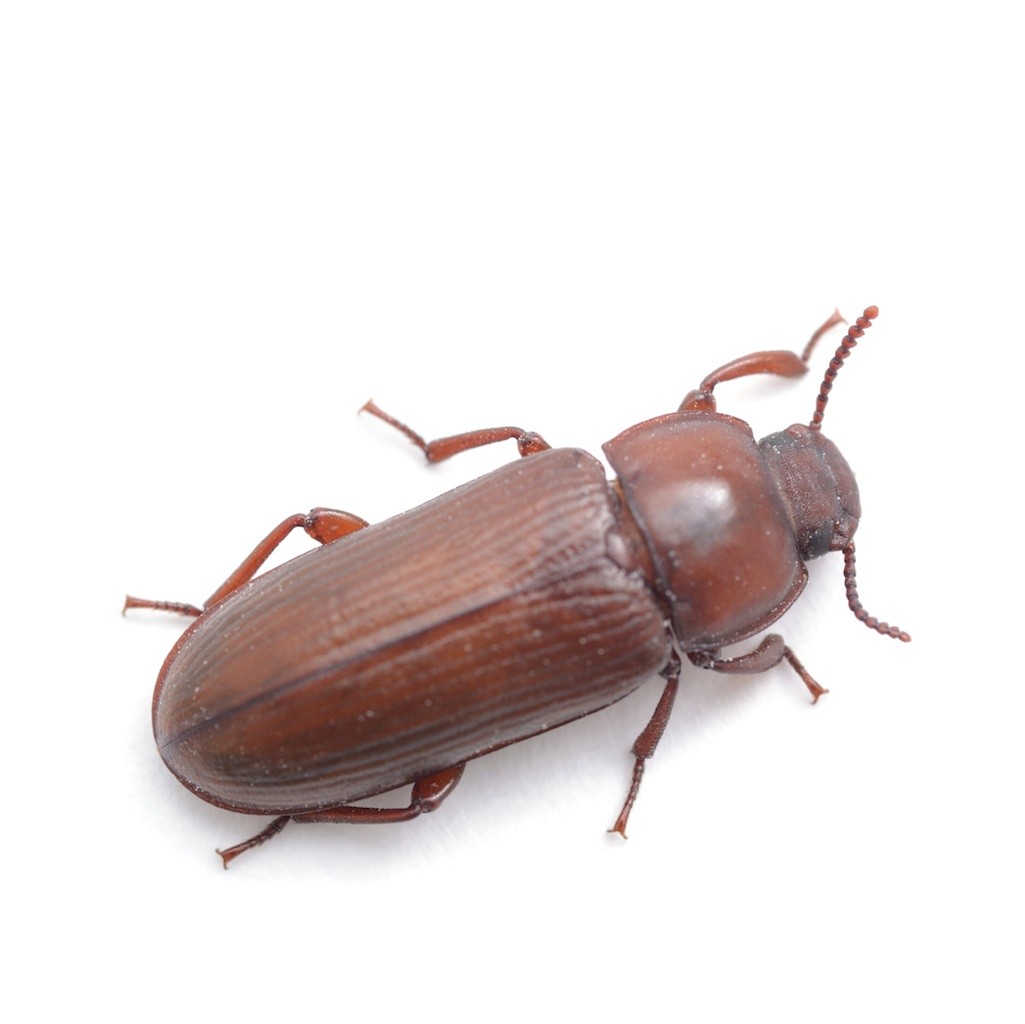 Additionally, the thorax of the Red Flour Beetle has curved sides whereas the Confused Flour Beetle has a thorax which is straight.
And though Red Flour beetles commonly fly, you won’t see Confused Flour beetles take to the air. Though they have wings, its believed they do not fly.
Most important, however, is that control for all three species of these beetles is the same.
Also, though their biology is slightly different, these beetles will present a persistent and formidable foe once established in the home. This article will describe some basic biology of this insect and then detail what must be done to eliminate current and active infestations.
WHERE DO RED FLOUR BEETLES COME FROM?
Red Flour Beetles have been around a long time. They were very much a pest to civilization thousands of years ago. This is probably due to the fact that most ancient civilizations used flour as a main food ingredient. Red Flour Beetles thrive on the dust of flour though they will readily feed on just about anything found in the home intended for people or pets.
Generally found in the southern states of America, Red Flour Beetles tend to be more comfortable in warm climates since they can live outside the home. However, they can and do readily survive winters in the confines of any heated house. Once inside, they will readily feed upon pet food, cereal, pasta, spices, rodenticide, dried fruit and vegetables, eggs of other insects, nuts, grass seed and just about anything which can provide nutrition. Though they can be brought home with just about anything bought at the grocery store, Red Flour beetles exist in most local landscaping and from there can enter homes through door and windows during the warm months.
RED FLOUR BEETLE PROBLEMS
Unlike most pantry pests, Red Flour Beetles can find food which is well hidden and protected. Their strong chewing mouth parts will allow them to access food which is stored inside boxes and plastic bags. All that is needed is the scent of something worthwhile inside and they will make every attempt to find their way inside. For this reason they can target homes from outside by using their sense of smell.
Red Flour Beetles live a long time. Their average life is 3-5 years which is quite long for an insect so small. Adult females will lay a few eggs daily which will amount to 300-500 over their life time. Eggs will hatch in a couple of weeks and start to feed immediately. Larva will go through many instars or developing stages – as many as 20 – before they reach adulthood. The number of stages will depend largely on the sub species active along with local temperatures and food supplies. This process will take 2-4 months before the young instars reach adulthood.
HOW TO TREAT FOR RED FLOUR BEETLES
Whether they are brought home or enter from your yard, Red Flour Beetles are a nuisance once nesting inside. Like many other pantry pests, there are a few things which must be done to break their cycle once established.
To get control, you first need to empty all cabinets, shelves and closets where they have been seen or thought to exist. Any food stuff which has them active must be discarded in sealed plastic bags. This will help contain them until the garbage is picked up.
If you are unsure if something has activity, store it in a plastic bag and check it every week. If there are any Red Flour Beetles in the item they will try to get out within a few weeks. If some are found, throw it away immediately.
Since this pest is temperature tolerant, don’t waste your time trying to freeze adults, eggs or larva. Though you will kill active stages, the remaining eggs and pupae will hatch as soon as the item is warmed.
Once the infested areas are cleared, vacuum them. This will help remove eggs which are too small to see. Red Flour Beetles lay eggs with a glue like excretion which helps to attach them to surfaces where food is likely to be available. This helps to keep them in place and vacuuming will help reduce these numbers.
TREAT CABINETS AND PANTRY FIRST
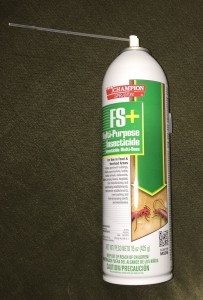
Once everything has been removed from the cabinets and they have been vacuumed, you can begin treating. The first product to start with should be an aerosol. FS MP AEROSOL is a fast acting easy to use product that’s ideal for small, isolated problems. It will kill active stages and kill new larvae and adults as they emerge in the weeks that follow the initial application. It comes with a straw tube injector making the treatment easy to apply. Use it weekly as needed until all activity stops. After that, once every few months to insure they don’t return.


Be sure to treat as many rooms as possible – not just where you think beetles may be hiding. Red Flour Beetles are small, fast and quick to hide when ever people are around disturbing where they have been feeding. Many will go unnoticed and missed so it is best to treat every cabinet to be sure you get proper coverage. Let the treatment dry for 1 hour and all dishes and food stuff can then go back away without hazard to people or pets.
BEST LIQUID SPRAY FOR RED FLOUR BEETLES
Once the cabinets and pantry areas have been treated, you may have to treat other areas of the home too. Laundry rooms, garages, basements and other areas where pet food and grain products like grass seed are stored are prime locations for Red Flour Beetles to target. For kitchens and pantries, aerosol treatments are easy to do and efficient. But for the entire home, it will prove both costly and time consuming to use an aerosol.
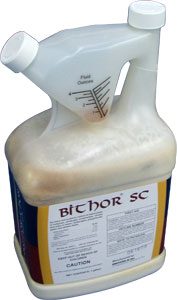
So if you have to treat the entire home, go with a liquid application of BITHOR. This material is odorless, mixes with water and can be applied to baseboards, cabinets, rugs and pretty much anywhere red flour beetles area active. Mix .75 to 1.5 oz per gallon of water and use the mixed gallon over 1,000 sq/ft. Focus on baseboards, furniture, carpets and anywhere activity has been noted.
For extra protection, add GENTROL EC to the tank mix. Gentrol is a growth regulator and will effectively prevent hatching larvae from growing into adults. The great thing about Gentrol is that it will translocate from where you spray it. This is a huge benefit for problems that are hard to isolate. Basically the Gentrol will move from where you spray to areas up the wall and even the ceiling. This way if any eggs are hidden out of site, they will be affected even if you miss them with the Bithor.
Gentrol is mixed 1 oz per gallon of water and like the Bithor, a mixed gallon of spray will cover up to 1,000 sq/ft.
You’ll need a good PUMP SPRAYER to apply the Bithor. This model is easy to use and has an adjustable nozzle that can be set to spray a wide fan pattern.
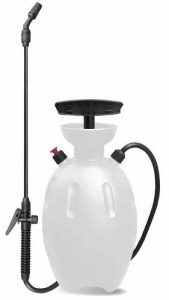
Liquid treating will prove to last longer compared to the aerosols but be prepared to treat at least once a month until the beetles are gone. Once the problem is under control, treat every 3 months to make sure they don’t return.
RED FLOUR BEETLE TRAPS
Lastly, you’ll want to set out some RED FLOUR PHEROMONE TRAPS in cabinets or pantries with activity. These traps use strong pheromones or sex attractants to lure adults. Once they crawl or fly into the holding tray, the thick catching oil will hold them for good. Set these traps in the back corner of any shelf or cabinet area. They’re quite discreet and easy to conceal.
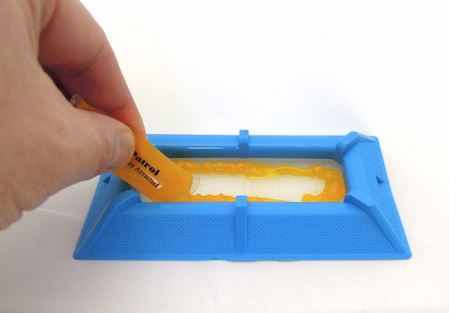
For open floor areas along baseboards and under furniture, the XLURE GLUE TRAP with its protective housing will be the trap of choice. These use glue instead of a liquid to catch and hold adult beetles so they’re less messy in active locations. This design is made for use in commercial processing plants, grain factories and other sites where there will be a lot of dust and debris. They’re much more sturdy and by design can be in a “dirty” environment and still avoid trap contamination. The plastic outer-body shell of this design keeps the glue from drying too quickly in dry environments yet it still works well at gathering red flour beetles.
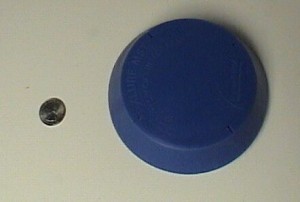
Either trap will remain active for at least 1 month but you should replace glue and lure sooner if they get filled with beetles or contaminated by water or dust. And even after the problem appears to be resolved, keeping a few in place to “monitor” the area is suggested. This way if you get another breakout, you’ll have a first line of defense in place as well as a way to locate the central nest site.
Red Flour Beetles can be a persistent pest once established in the home. To break their life cycle, you will need to remove any food which is infested. Next, clean and vacuum all cabinets or closets where they’ve been found. Treat with FS MP in the cabinet and Bithor in open areas of the home for long term, efficient control. Finally, set out traps in cabinets and pantries where activity has been noted. Be sure to keep the traps fresh so they’re always helping by catching adults before they mate and try to reproduce. This program will help to break the cycle so that it will eventually run it’s course and disappear.
CONTACT US
Give us a call if you need further help. Our toll free is 1-800-877-7290 and we’re open Monday through Thursday, 9:00 AM to 4:00 PM (Eastern Standard Time).
Email questions here: https://bugspray.com/about-us/contact-us
Order online and get a 5% discount! We ship fast with 99.9% of all orders shipping within 1 business day!!
Learn more about BUGSPRAY.COM and why it’s never been easier or safer to do your own pest control.
Please show your support for our business by purchasing the items we recommend from the links provided. Remember, this is the only way we can stay around to answer your questions and keep this valuable web site up and running. Thanks for your business!
DANTE ANDERSON says
What do I do there in every room and have been for months I spent 2 days striaght cleaning out everything and they came back like no tommroow even with us cleaning daily and putting bay leafs everywhere
Tech Support says
Dante,
.
Since many pantry pests eat bay leaves, we suggest you remove them ASAP. We also suggest you follow our detailed directions above.
.
So first, remove everything. Any boxed processed food like flour, cookies, cereal, pasta, etc. should be stored in a clear “liner” bag so you can “watch” to see if any live bugs emerge from the items. Plan on keeping them in the bag for at least 7 days; 14 would be better. During time you can remove them to consume the product but replace them until the 2 weeks are up. During the two weeks if you notice anything in the bag “moving around”, discard the items.
.
Second, get either our FS MP and treat all shelves, cracks and crevices thoroughly. It will kill all stages that might be hiding so in theory, a thorough treatment will eliminate the issue for good. But the FS MP does have an odor. So the good news is its not costly and it kills everything so fast working and a great problem solver. Bad news is it has an odor so you’ll need to aerate the space for at least a day before replacing items.
.
FS MP: https://bugspray.com/catalog/insecticide/aerosol/fs-mp-insecticide-15-oz-aerosol
.
Now if you are “okay” waiting a week or two for the pest’s cycle to “run out”, get our Mini Mister and Bithor. Use Bithor in the Mister will be super easy. Focus on all the same areas as you would be treating with the FS MP. Bithor is odorless and when applied with the Mini Mister, won’t make a mess. It won’t kill all stages though so that’s why it takes a week or two to complete the job.
.
Bithor: https://bugspray.com/catalog/insecticide/liquid/bithor_sc
.
Mini Mister: https://bugspray.com/equipment/foggers/mini-mister
.
If you use the FS MP, you can replace items after 1-2 day of “aeration”. If you use the Bithor, after 1/2 day.
.
With that being said, keeping the space empty a week to see if anything is still crawling around is a smart move. This way you can retreat if needed.
.
Technical Support
bugspray.com
ivan says
We are currently living in an apartment infested with Red Flour Beetles. I have informed the apartment manager of the Red Flour Beetles since I first noticed them several months ago. We are actually moving apartments since the manager has handled the situation horribly and refuses to do more to get rid of them. I have told her that the Red Flour beetles are coming from the attic through the popcorn ceiling. Is that common? She has hired her “own pest control” and both refuse to look at the attic. The pest control has treated the carpets and cabinets but refuses to listen to where I am telling them they are coming from. I even have videos and pictures of them coming in and out of the popcorn ceiling. Anyways, I do not want to transfer the red flour beetles into my new apartment – any advice on preventing that from happening?
Tech Support says
Not sure how you can stop any from transferring. Red flour beetles are quite small and can easily hide amongst your clothing and other items and once hidden, hitch a ride undetected during your move.
Additionally, their eggs are quite small and barely detectable. So another way the problem can follow you would be if just one adult was to lay eggs on something you moved. These eggs could easily hatch and if the larvae find an adequate food supply in your new apartment, the problem would then develop all over again.
But there are two things about your observations which cause me to raise an eyebrow regarding just what this pest might be.
My first concern is why do you have a ceiling made of popcorn? Since red flour beetles love corn, this would no doubt be an area of concern and any legitimate pest control service company would realize this and make sure its properly treated. Additionally, I find it hard to believe any apartment complex would allow food grade construction material to be used inside their apartments. This no doubt would be a high pest risk material to use and something that should be changed for long term pest control considerations.
The second thing that causes some wonder is whether or not what you’re seeing are in fact red flour beetles. I say this because powderpost beetles look very much like red flour beetles. The difference between the two is that the powderpost beetles eat wood products and not what we consider food like the red flour species. And since powderpost beetles commonly live in ceiling tiles (or the wood structures above and installed ceiling), they will many times be noticed leaving ceilings like you describe. And if in fact you have this pest active leaving your ceiling, the treatments that have been done won’t help the problem.
So for now, my best suggestion to prevent any kind of transference is to first make sure the apartment you move to is properly treated before you move in.
To accomplish this task, it would be wise to treat it when its empty, before you move in. This way you’ll be able to thoroughly reach all the important areas of the unit. Get it covered with some Bithgor and Gentrol by spraying baseboards, carpeting, furniture, etc.
Next, spray all cracks and crevices with FS MP Aerosol. This way if any beetles come along with you during the move, they won’t stand a chance of getting established in your new abode. Now since this treatment will work for both red flour and powderpost beetles, it doesn’t matter which of the two species is active.
Here are links to these items in our cart. Please show your support for our business by purchasing the items we recommend from the links provided. Remember, this is the only way we can stay around and be here to answer your questions and keep this valuable web site up and running. Thanks for your business!
Bithor: https://bugspray.com/catalog/insecticide/liquid/bithor_sc
IGR: https://bugspray.com/catalog/insecticide/igr/igr-nylar
FS MP: https://bugspray.com/catalog/insecticide/aerosol/fs-mp-insecticide-15-oz-aerosol
shamsuddin shoro says
Nice knowledge. I have red bugs in 2 bed rooms. What should I do get rid of them?
Tech Support says
As explained above in our article, this pest is usually nesting in some kind of food item. But there are times when exactly their nest might be can be hard to determine. In fact, there are times when some can be brought into the home via some kind of food or piece of clothing and once inside, they will begin to forage around looking for a good nest site.
For situations like this, it’s best to do a general treatment to the baseboards and any furniture where activity is noticed. This will put into place an effective barrier so that any rogue beetles that start to forage won’t have a chance to get established.
So if you want to treat your two bedrooms and maybe an adjacent room or two, get some of the Bithor and do the treatment using a standard Pump Sprayer. Bithor is odorless and mixes at the rate of 1.5 oz per gallon of water. Once mixed, it can be sprayed pretty much anywhere inside the home.
Bithor: https://bugspray.com/catalog/insecticide/liquid/bithor_sc
Eliminator: https://bugspray.com/equipment/sprayers/eliminator-gallon-sprayer
Focus on baseboards, carpeting, under appliances, under furniture, etc.
Now if you’re finding them inside dressers or some other furniture which has drawers and other places for them hide, you’ll need to inspect these pieces carefully by removing items and cleaning them out first. Flour beetles can target clothing and other natural fabric so they might be living in a closet, a clothes dresser, on some furniture or curtains or maybe the carpeting. A good inspection can help identify the main nest site and this will give you a big edge for solving the problem if you can find any such sight.
Lastly, if the activity found is isolated to one general area or piece of furniture, some FS MP Aerosol might be all you need to treat. It’s ready to use and very convenient since there is no mixing involved so if you only have a limited area of concern, this would prove equally as effective as using the Permethrin but easier to apply.
Here is a link to this item in our cart. Please show your support for our business by purchasing the items we recommend from the links provided. Remember, this is the only way we can stay around and keep this valuable web site up and running. Thanks for your business!
FS MP: https://bugspray.com/catalog/insecticide/aerosol/fs-mp-insecticide-15-oz-aerosol