Thrips are tiny insects which have piercing mouth parts which can do damage to most any plant. If given the chance, they will take advantage of garden species as well as common landscape vegetation spreading disease and causing damage. Since they will readily live on just about any type of plant, it is important to control outbreaks when first identified to help keep damage and populations in check. A few thrips can easily go unnoticed; a large infestation can decide the local plants are not enough to eat and once they start stinging people and pets, you will surely know they are present.
Related articles: BITING FLIES DEER FLY FLEAS GNATS MOSQUITOES NO-SEEUMS
WHAT IS A THRIP
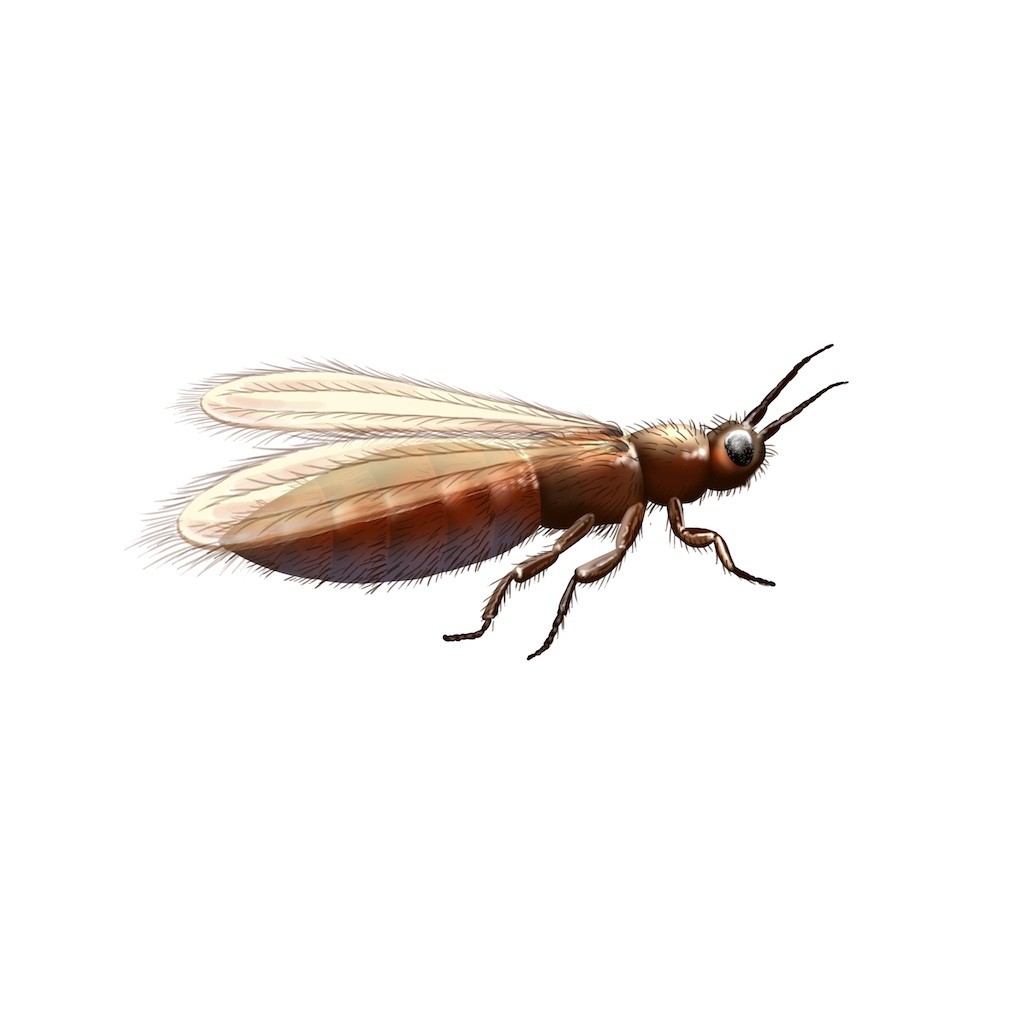 Thrips are small insects, measuring about 1/25 to 1/8 of an inch long. They range in color from clear to white to yellow to brown to black. It is generally believed local populations will take on a color similar to that of the plant they are mostly feeding upon. Although there are Tobacco thrips or Flower thrips, it is evident they are not specie specific and they can in fact live on just about any type of plant which is able to provide them with a source of sap, juice and water.
Thrips may or may not have wings but most stages do and these are clear and feather like. Thrips are mobile and will crawl, jump, walk and fly to any target they focus upon. Their light bodies and wing structure enable them to ride wind currents great distances allowing them to find new food and nest locations as needed. Though plants are generally where they want to be nesting, water and high moisture seem to be more important.
Its not uncommon for local activity to be centered around some area in the landscape holding water. This may serve as a prime reproductive ground for them to go through their pupal stage and to provide protection during times of drought or plant dormancy. This is more typical in the northern regions; in the southern growing zones thrips will remain active year round.
THRIP LIFE CYCLE
- The life cycle of a thrip is unique and fast. Eggs are laid on plant tissue and hatching young will immediately begin to feed on any part of the plant which presents sap and vital fluids containing nutrition.
- After a week or so, larva will pass through two stages having eaten during this time.
- Once the third stage begins eating will stop and at this stage some may even develop wings, fly off or simply crawl down into leaf litter and mulch to pupate. It is probably the hatching of the pupa which are most responsible for the cases involving biting thrips.
- The fourth stage, the pupa, is where they turn into fully mature adults ready to mate and reproduce. Females have the unique ability to lay eggs which will prosper whether they mate with a male or not. In general, eggs produced from fertile females will yield offspring of either sex; eggs generated by females which could not find males will produce nothing but males. This biased result insures the local population gets a good balance for the future since thrips develop so quickly.
 This whole process from egg to adult can happen in as little as two weeks depending on the species and the local environment. For this reason its important to realize just how quickly a few can turn into a few thousand and further explains why it is all important to head off these developing colonies and populations when first found.
THRIPS WILL CAUSE PLANT DAMAGE
Though rapid development of thrips by itself may not seem like reason to stop this small, innocent insect from having it’s time in the sun, the damage and discomfort it will cause is more than enough. Here are some of the common problems associated with having thrips active and living on plants in or around the home.
- The sucking and piercing mouth parts of thrips are enough to cause substantial damage to any plant. Young plants are more vulnerable and targeted more; older more established vegetation can be seriously damaged as well when a large enough population is feeding on vital sap – the life’s blood of any plant – during the dry and stressful hot season.
- Leaves of vegetation will turn brown and curl causing them to loose their ability to provide shelter and perform life sustaining photo synthesis. Defoliation can occur as well which can mean the certain death for some plants.
- The biting and sucking of thrips is responsible for the transmission of plant disease including many types of fungus and virus.
- Thrips will readily sting people and pets. Though not generally identified as a biting pest, thrips are readily attracted to people. This is thought to happen because people perspire. This moisture will readily attract thrips seeking a drink during hot dry spells. However, they will readily land on people once populations get large and begin foraging and migrating. As host plants get filled with thrips and sap begins to dry and deplete, thrips will begin to move away by flying, jumping and crawling.
DO THRIPS BITE PEOPLE?
Yes. Any time people are in close proximity to hatching thrip pupae, they will become targets as hungry thrips turn to anything in their way which provide nutrition. Stings will hurt and cause rashes. Its also believed the fourth stage of thrips, the pupa, will readily target people as they hatch. This is common in landscape which has high moisture. Well irrigated lawns, flower beds and gardens are prime targets for pupating thrips and when people move about in the yard they will in turn awaken the developing thrips causing them to hatch. At that time their first goal is to eat because they will emerge quite hungry.
If people are still present, they will become immediate targets. Since thrips are small, it s not uncommon for them to go unseen and many times misidentified as either a No-seeum, a mosquito or some type of biting fly. The fast flying Thrip is the common culprit and since they can pass through just about any window screen, they will readily find their way into homes. Once in the home, people and pets will become targets for food; potted plants will become the prime location for egg laying and reproduction.
If you’ve been targeted by thrips and find their bites to be itchy, BITE SWABS can be applied to the skin for itch relief.


For skin with long term damage, extensive scabbing or rash like patches, use GENES CREAM. Made with all natural ingredients, this formulation is designed to help relieve the itch and discomfort associated with thrip bites and in turn, allow for rapid healing.
REPELLENT PLANT SPRAY FOR THRIPS
For plants prone to getting infested every summer, treat them with PEST AWAY every 30 days to keep them insect free. This organic spray is made with plant oil and food grade actives which act as a repellent for certain insects including thrips.
The following “short video” (less than 60 seconds) summarizes how Pest Away works.
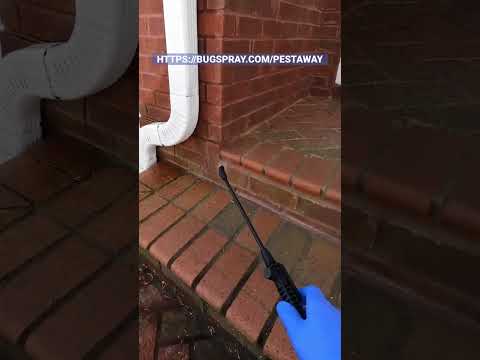
It’s safe to spray on plants like roses, privets, azalea’s and anything thrips like to infest. Pest Away will not kill insects and only repels them so once you get infested, you’ll be better served using one of the traditional sprays listed below.
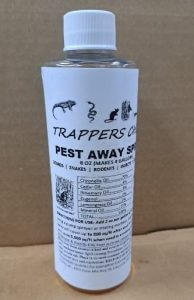
ORGANIC THRIP TREATMENTS
Thrips can be managed using a range of organic gardening approved products including traps and sprays.
THRIP TRAPS
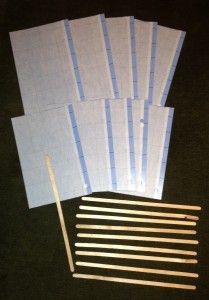
For random thrip activity in the yard, THRIP TRAPS can be placed where activity is noticed. They’ll readily attract and capture foraging thrips and in turn, reduce the activity. Space them 10 feet apart along flower beds, mulch lines or walkways.
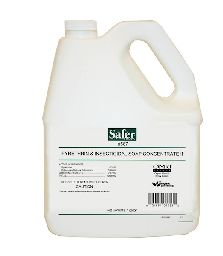
A longer lasting organic option is MULTIPURPOSE INSECT KILLER. Treatments using this concentrate will last at least a week and it’s water based so it won’t harm treated plants. Spray shrubs and garden plants too since its approved for use on fruit and vegetable producing plants.
GARDEN SAFE THRIP SPRAY
If you want something a little stronger and more traditional for the vegetable garden, go with VEGETABLES PLUS PERMETHRIN. This is a true insecticide which is odorless, easy to mix and works on just about any pest in and around the garden. Since it works well for whiteflies and aphids, Permethrin is a natural for plants which are subject to a wide range of pests including thrips. Most importantly, it is the strongest product available for use on fruits and vegetables so if you have a garden you are trying to protect, this is your best bet.
Mix 2 oz per gallon of water for maintenance spraying; 4 oz per gallon when treating established populations.
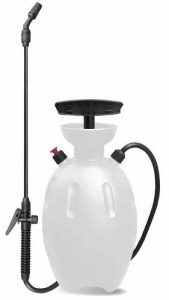
When using Multipurpose Insect Killer or Vegetables Plus, a standard PUMP SPRAYER will be needed.
STRONGEST THRIP SPRAY
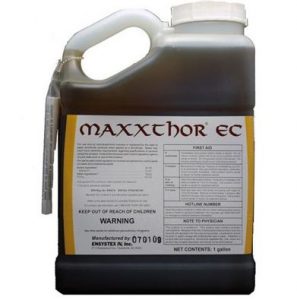
If you want the strongest thrip option available and don’t intend on treating plants to eat or plants which will produce fruits or vegetables, go with MAXXTHOR EC.
The following “short video” shows how to apply it using our HOSE END SPRAYER.
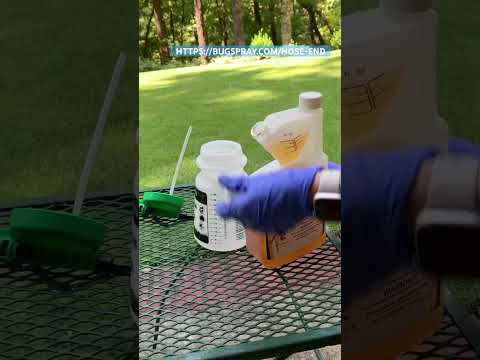
This concentrate will handle thrips well and a little bit goes a long way. 1 oz used in 5 gallons of water will cover up to 5,000 sq/ft.
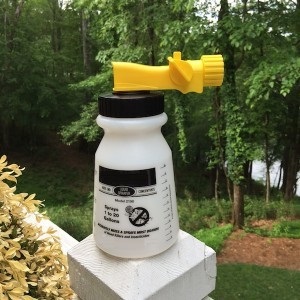
Use a HOSE END SPRAYER to apply the Maxxthor. Using the power of your garden hose will enable you get fast and thorough coverage.
SYSTEMIC TREATMENTS FOR THRIPS
For non-fruit bearing trees and shrubs, using a systemic will provide long term control from just one application. For most regions in the United Stated, just one application per year will usually do the job when using the right option.
One of the best is PROTHOR SC. To protect your trees for the whole year, use .2 oz per inch of tree diameter. So for if your tree is 10″ wide, use 2 oz in 5 gallon bucket with 3-4 gallons of water. Pour the solution around the base of the tree, close to the trunk, making sure it soaks in. Punching a few holes in the ground can help get it down fast.
For shrubs, add 1/2 oz to a gallon of water and use the gallon on plants with a 4 foot wide base. For a bush just 2 feet wide, 1/2 gallon of the mixed solution will be enough.
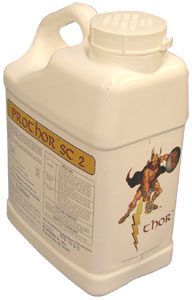
The great thing about Prothor is treatments will last a long time. Generally you only need to apply them once a year. Now they do take some time to “grow into” the treated plants. So if you want to knock down the current activity, lightly spray the plants foliage where insects are active. Prothor can be used as a foliage spray too.
THRIP SPRAY FOR INSIDE THE HOME
Once thrips get established out in the yard, they may find their way inside the home. You’ll know this is happening when people start getting bit. And if you keep plants inside the home, thrips will many times start to nest in the soil of these plants and become a permanent resident. And once this happens, they live, breed and bite all year long.
So if you’re finding thrips inside, get the outside treated as explained above. But what about inside the home?
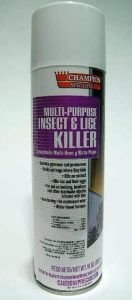
To kill adults flying around the home, use MULTIPURPOSE INSECT KILLER.
This aerosol contains permethrin as the active and is water based so it has no odor and won’t stain. Its perfect for treating the “air” as well as walls and ceilings.
The following “short video” (less than 60 seconds) summarizes why MultiPurpose is so good for use in the home.
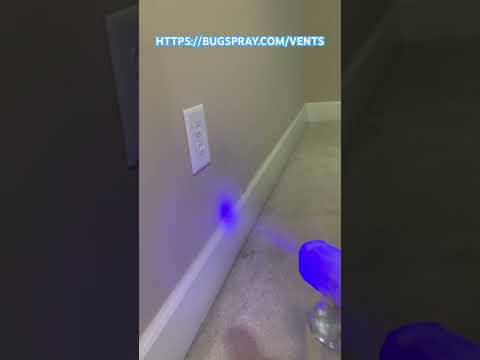
As you can see in the video above, Multipurpose is well suite for use in the home
It can be safely applied anywhere in the home and used as often as is needed. Expect to treat at least once a day to maintain an active population if they’re breeding in the home.
But if the problem is ongoing and the Multipurpose has to be applied daily for several weeks, consider installing some AEROSOL MACHINES. These devices are small (about half the size of a cigar box), are powered by batteries and will work automatically around the clock.
The following “short video” (less than 60 seconds long) summarizes how they work.
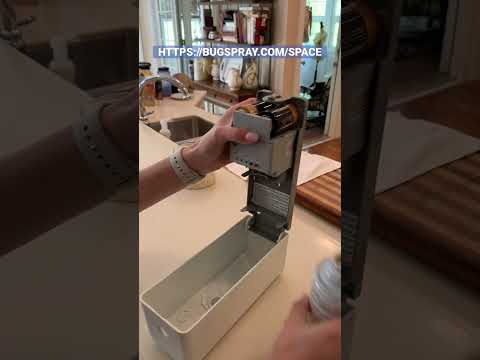
Set one machine out for every 600 sq/ft of room you want to protect. They should be placed on a shelf or hung on the wall at least 6-8 feet high.
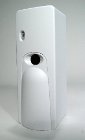
Inside the machine you’ll need to add a can of CLEAR ZONE. These cans will be releasing the same active in the Aquacide (pyrethrin) but since the machine will be doing this every 15 minutes, you’ll always have enough active ingredient working for you around the clock. This way the local thrip population will eventually be eradicated because hatching adults won’t be able to reach maturity.
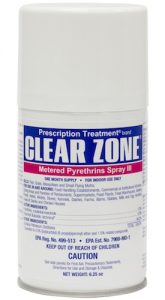
One can will last 30-45 days and should be replaced when empty so the treatments can continue uninterrupted.
BEST THRIP SPRAY FOR MARIJUANA PLANTS
With the legalization of medicinal marijuana, we frequently get asked for “pot safe chemicals”. The most common pests found on marijuna are thrips, whiteflies, symphilids, fungus gnats and spider mites. No doubt marijuana plants will readily attract a wide range of insect pests and many of these can prove devastating to the growers crop. So are there products specifically for use on marijuana?
Not really. You see, since there are countless thousands of plants, it’s simply not possible to list them all on any one specimen label. And since legally growing marijuna is just a fledgling business, it will take some time before the products on the market start to list this plant specifically.
So at this time the “strongest” chemicals are limited to non edible plants like ornamentals. Since these do not yield edible fruit or vegetables, the actives used on them can be long lasting. Such products (live Avid), should NOT be used on marijuana.
But anything approved for organic gardening or labels which are ORMI certified can be considered. These products typically have a short life on the plant and if the active ingredient isn’t “lingering” with persistent residue or residual action, there is no chance of exposure to people consuming the harvest.
In fact, one way to determine if a product might be leaving a long lasting residue or residual is to check the label to learn the “days to harvest” value. If this number is 1 day or less, it means the chemical being applied is essentially gone in one day.
And if a spray has a “one day to harvest” value when used on edible fruits or vegetables, its safe enough for use on marijuana. An example of such a product is the MULTIPURPOSE INSECT KILLER 567 (also listed above). Multipurpose Insect Killer is actually a combination of Soap and Pyrethrin so it’s fast acting yet very safe. Treatments won’t leave any residual (they’re gone within a day of being applied). Of course, the obvious problem with this feature is that targeted pests can come back which in turn means you’ll no doubt have to spray more frequently. But this is the trade off when using a concentrate safe enough for use on an edible fruit or vegetable plant.
Thrips are a common pest that will readily infest many plants in and around the home. Though small and easy to crush with your fingers, thrips are a persistent and annoying insect. Help prevent getting them on any sensitive plant because once you get them they can cause a lot of damage to host vegetation as well as spread disease. By keeping this small but troublesome pest under control you will assuredly keep local plants protected and not enable them to get so populated that they start stinging people.
CONTACT US
Give us a call if you need further help. Our toll free is 1-800-877-7290 and we’re open Monday through Friday, 9:00 AM to 4:00 PM and on Saturday, 9:00 AM to 2:00 PM (Eastern Standard Time).
Email questions here: https://bugspray.com/about-us/contact-us
Order online and get a 5% discount! We ship fast with 99.9% of all orders shipping within 1 business day!!
Learn more about BUGSPRAY.COM and why it’s never been easier or safer to do your own pest control.
Please show your support for our business by purchasing the items we recommend from the links provided. Remember, this is the only way we can stay around to answer your questions and keep this valuable web site up and running. Thanks for your business!
Herb says
How about using an Aphid and Whitefly Trap? This product is a hanging strip, which eliminates Aphids, Mooches Blanches, Aphidens and THRIPS! Safe and effective.
Tech Support says
@Herb: No doubt glue traps should be used as we explain above. But don’t confuse them with “control”. Glue traps at best will catch some thrips and other garden pests. But rest assured there will be many more you don’t see or notice which will be causing untold damage if you don’t spray.
Organic Thrip Traps: https://bugspray.com/article/thrips#thrip-glue-traps
Herb says
I thank you for the help and will definitely spray. But tell me if you will. I had Thrips in Nov 2011. Since then the garden is empty. Should I spray before putting in a new crop?
@Tech Support:
Tech Support says
@Herb: As explained above, thrip pupae typically fall off plants onto the ground and from there will emerge the following spring to continue their activity. So in fact spraying early in the season when it gets warm is smart. In doing so, you’ll get them before they are able to establish themselves again and in some cases, avoid any problems for the season.
So for starters, the place to start is on the ground. This is where thrips originate and where most people forget to spray. So depending on where you reside, anytime from March to April getting the ground treated would be wise. This could be done with any of the organic or longer lasting sprays listed above but the Maxxthor Granules would be best suited because they’d last so long.
Maxxthor SG: https://bugspray.com/catalog/insecticide/granule/maxxthor-sg-granules
And once the plants start growing, treating once a month with one of the organic sprays would be fine for prevention to insure thrips don’t return. And of course, not spraying at all is an option but realize that if you don’t spray and thrips do come back, you’ll be forced to treat a whole lot more compared to the preventive treatments.
Linda says
I have a problem with thrips in the plant room. I grow about 300 African Violets in a specially constructed addition to the home. It has it’s own air/heating system separate from the rest of the house. All violets are grown under lights on 7 1/2 stands, three shelfs each. I have used aged Conserve sprayed three times at weekly intervals but still have the darned buggers. Since I compete at the regional and national level showing the violets, as well as hybridize them, I need effective control which will not harm the flowers or show residue on the leaves.
Tech Support says
This is an easy one. First of all, Conserve uses Spinosad which is not a traditional insecticide. Basically it’s a biological which is a pest management product group that gained momentum some 15-20 years ago as a “safe and effective” alternative to traditional pesticides. Back then we were commonly using very strong and highly concentrated products that were essentially “overkill”. These products could kill a plant when sprayed because they had solvents and caustic carriers that were rough on many plants besides being smelly, hard to mix and difficult to apply. Because of these shortcomings, the biological pest control product groups seemed like a valid way to manage pests with less overall impact to the plants being treated, the environment around the treatment locations and people doing the treatments.
But in the last 10 years there has been a surge in the latest generation of insecticides that are far less concentrated and use a mode of action that is very different from what was popular 20 years go. Prothor is one of these new products. Prothor is a systemic and though you can spray it onto most any plant, it works best when injected or drenched into the soil where it can be absorbed by the plants roots. Basically treatments will last a long time and once the active works it’s way into the plant, thrips, white flies, aphids or any other plant feeding pest will die if they attempt to feed upon the plants foliage or honeydew. Prothor is easy to use and very cost effective. Give it a try and give up spraying anything on your violets; I’m 100% sure you’re plants will be healthier and happier.
Prothor: https://bugspray.com/catalog/insecticide/liquid/prothor-sc
cristina says
These bugs are all over our yard. They bite like crazy. How do I find their nest? I want them gone! My baby likes to play outside but not with them biting her all the time. Please help!
Tech Support says
If you review our article above, you’ll learn thrips nest in the ground. They prefer mulch like pine straw, wood chips or grass clippings but really, anything moist will do just fine. So when treating you don’t look for nests but instead use a “shotgun” approach and treat as much of the yard as possible.
So based on the facts of your situation, you’ll first need to apply the Maxxthor Granules throughout the entire yard.
Maxxthor SG: https://bugspray.com/catalog/insecticide/granule/maxxthor-sg-granules
Next, you should spray over the top with the Maxxthor Ec.
Maxxthor EC: https://bugspray.com/catalog/insecticide/liquid/maxxthor-ec
Treatments will work fast and you should see results in 1-2 days. Now how often you’ll need to treat will vary from yard to yard but in most cases you should expect to spray every two weeks till they’re gone. And once they’re gone, monthly applications will keep them away during the warm seasons. Good luck!
lisa says
I have had thrips on my white rocking chairs on my deck last summer and now they have returned once again so to sit in the chairs is impossible. I don’t see them anywhere but on the rockers. If you could please recommend on how to get rid of them and keep them away I would appreciate it. I have small children so don’t want to use anything harmful or that will ruin the chairs.
Tech Support says
Thrips are commonly drawn to surfaces that harbor or grow algae and mold. Lawn and deck furniture – especially white pieces – tend to grow these micro organisms which in turn will lure thrips to feed. And once the thrips start using the furniture for this reason, people won’t be able to enjoy sitting on them anymore because you’ll likely get stung as the thrips attempt to feed on you. The good news is this is easy to fix.
First and foremost, none of the products mentioned in this post or in our article pose a safety hazard to you or your family when used in accordance to their labels (basically the way we instruct you on how to use them). And with that being said, you can safely treat the furniture and the yard for thrips which is clearly needed.
Second, though treating the chairs will help, ideally you need to go to the source of the problem which is no doubt the landscape. In most cases where thrips are infesting furniture, we find the homeowners are not treating their yards on a regular basis which in turn allows pests like thrips to get so populated that they migrate from the yard to the home.
Now the first stage of these infestations is seeing thrips on the outside of the home. Common places they’ll start showing up are on decks and porches. And at this time it would appear you’re seeing what could get a lot worse because if you don’t start handling the outside infestation, they will likely start moving inside.
So first and foremost, you should treat the yard with some Maxxthor Granules. Focus applications to the grass, flower beds, mulch areas, etc. Basically anywhere moisture resides is where the thrips might be hiding and nesting. These area’s are important to treat if you wish to take car of the problem.
Maxxthor SG: https://bugspray.com/catalog/insecticide/granule/maxxthor-sg-granules
Next, spray the entire landscape with some Maxxthor EC. Spray down the entire landscape, including your plants, for quick thrip control.
Maxxthor EC: https://bugspray.com/catalog/insecticide/liquid/maxxthor-ec
As for the furniture; spraying it lightly with Multipurpose Insect Killer will keep them off. Treatments should last a few days if you did nothing at all but spray the furniture. But if you treat the outside turf as I detailed above, what you’ll find is that you may not have to treat the chairs at all because once you control the source of the thrips, you won’t be seeing many (if any) around the home.
Multipurpose Insect Killer: https://bugspray.com/catalog/insecticide/aerosol/multi-purpose-insect-killer-10-oz
stacie says
I have these insects throughout my back yard but concentrated to my pool. How can I safely get rid of them around the pool?
Tech Support says
As our article explains, thrips fly well. And they’re attracted to moist environments. So when you allow them to exist in close proximity to any pool, it’s only a matter of time before anyone around the pool sees them and they start to become a nuisance. And it sounds like this is currently happening at your house.
So to stop the unwanted activity, you’ll need to treat the entire area around the pool. You don’t say how much land you have but lets say your house sits on 1/2 acre. Well for starters, you’ll need to treat all the lawn, flower beds and mulch areas with the Maxxthor Granules. This treatment will take away any nest sites you might not be seeing that thrips like to use on the ground.
Maxxthor SG: https://bugspray.com/catalog/insecticide/granule/maxxthor-sg-granules
Next, you’ll need to spray over the top of the granules along with all the plants, shrubs, bushes and basically any plant that’s growing close to the ground. Since thrips will commonly attack and nest on most any type of plant found in the landscape, you need to consider every plant on your property as a possible host plant. Depending on how many plants and how much turf you have to treat, the use of a concentrate will do the job and Maxxthor is best.
Maxxthor EC: https://bugspray.com/catalog/insecticide/liquid/maxxthor-ec
Hose End Sprayers: https://bugspray.com/hose-end
In summary, treating with the granules every 60 days and spraying every 30 days will keep all pests under control including thrips. But the key is thinking big. This means treating the entire yard (lawn, flower beds and mulch) along with all the ground cover, shrubs, small trees, bushes, etc. And you should do this throughout the warm months. By following this routine, you’ll eliminate the thrips around the property and in the end, this will stop them from being active around the pool.
Bonnie says
What colors are these? I got bit twice by the black bugs shown in the picture inside but have also been bitten many times outside by even smaller orange bugs that look the same shape from what I can see. The orange ones are about the size of three pen dots lined up. Can you help? Thank you!
Tech Support says
Thrips are usually light to dark brown. They can be white or black too. But the big thing is that they can fly. As for the orange ones you claim you saw outside? Maybe Spider Mites or Clover Mites.
Spider Mites: https://bugspray.com/articles99/spidermites
Clover MItes: https://bugspray.com/articles98/clovermites.html
Since all can bite or sting, any of them could be what you claim was biting. However, neither of the mites can fly which would be the big difference between them and the thrips.
Now if what you’re asking for “help” is how to treat, that would be fairly easy. For any of these, an outside granule treatment to the entire yard including mulch, flower beds and lawn areas with some Maxxthor Granules would be the first thing needed.
Maxxthor SG: https://bugspray.com/catalog/insecticide/granule/maxxthor-sg-granules
Next, spray over the top with Maxxthor EC using our Hose End Sprayer:
Maxxthor EC: https://bugspray.com/catalog/insecticide/liquid/maxxthor-ec
Hose End Sprayer: https://bugspray.com/equipment/sprayers/20-gal-hose-end
The key with all these pests is to saturate the turf as well as the plants since any of them can live on shrubs, bushes and other plant life. So which ever spray you get, be sure to treat the outside landscape heavy and you’ll see an instant reduction. And over time, the granules will provide long term prevention.
Don says
I thought I had a Thrip infection on my southern pea crop until I read your answers to other readers. I have similar size black bugs that cover some of the pods entirely. The residue on the pods and on my hands after picking peas is rust colored to reddish. These bugs have not stung or bitten me. Do you think I have thrips and if not do you recommend the same treatment? Thanks: Don
Tech Support says
It’s tough to say for sure what you have. There are so many garden pests that can infect crops like southern peas and I’m afraid the list of options are just too long to narrow efficiently. But I am confident that if you treat them with either the Vegetables Plus or Multi Purpose Insect Killer, you’ll get positive results.
Vegetables Plus Perm: https://bugspray.com/catalog/insecticide/liquid/veg-plus-10-perm
Organic Insect Killer: https://bugspray.com/organic/liquid/multi-purpose-insect-killer-24-oz
The difference between the two is that the Vegetables Plus is longer lasting and will provide a good residual lasting a week or more. The Multi Purpose is an organic spray and as such, won’t be nearly as strong in the long run but it will knock them out and off your plant so it can be equally as effective. You’ll just need to use it more frequently since it only lasts a day or two.
Andy says
How do you get rid of them on the house? We have something in our house that is biting or stinging only me. It’s grey and looks almost like a gnat, but it appears to jump rather than fly. Could these be thrips?
Tech Support says
Sounds like Fleas or Springtails. Check out this information and then once you know for sure what you have, follow the articles advice:
Springtails: https://bugspray.com/article/springtail
Flea Article: https://bugspray.com/article/fleas.html
Melissa says
Hello – I had a springtail nightmare earlier this year caused by rotting wood underneath doors and windows. All of that is in the process of being replaced. In addition to the springtails, I have found quite a few thrips – six spotted and black hunter – in the basement and garage. There is quite a bit of old mulch and weeds around the front of the house – all of that will be removed and rock put down in its place. No vegetation whatsoever will be within 2 feet of the house where the yard starts. I will use what is suggested for the yard – is this ok to use this time of year?
As for the house – what is good to start killing these stinging bugs? I had to move out because of the population of the springtails and have 3 to 4 weeks before I move back and moisture issues are repaired. Any advice?
Tech Support says
First, I suggest you read our Springtail control article. It will highlight why this pest can be persistent and thus require an ongoing treatment program to control local problems. For your situation, applying the Maxxthor Granules to the turf and spraying over the top with Maxxthor would be a great way to control both springtails and thrips and I recommend doing this right away. And continue treatments through most of the winter since the springtails will remain active alongside homes since the soil can remain plenty warm for them.
Now next spring you’ll need to pick up treating and continue all year too. Both pests can take awhile to depreciate so if you don’t follow the routine, either could linger and be present a lot longer than you’d like – even with the moisture issues resolved.
Springtails: https://bugspray.com/article/springtail
Maxxthor SG: https://bugspray.com/catalog/insecticide/granule/maxxthor-sg-granules
Maxxthor EC: https://bugspray.com/catalog/insecticide/liquid/maxxthor-ec
Now for the inside; I suggest you apply Demise Dust to any exterior wall void you can. This might be easy to do since it sounds like you’ll have these areas open and accessible while the repairs are being done. This dust is highlighted in our springtail article and works great for any pest that wants to live in voids.
Demize Dust: https://bugspray.com/catalog/insecticide/dust/drione-demise-dust-6-oz
I also suggest you treat all cracks and crevices with FS MP aerosol. This would be best for around windows, door frames and other gaps where springtails or thrips might target as good nest sites.
FS MP: https://bugspray.com/catalog/insecticide/aerosol/fs-mp-insecticide-15-oz-aerosol
Lastly, to knock out the current population of thrips, I suggest some Flying Insect Killer machines to be installed. These are great for situations where some type of “automatic” mechanism is needed. Basically they send out a quick .25 second blast of pyrethrin based insecticide. This is safe enough to use in commercial kitchens since it doesn’t leave any kind of residual. But it does work well on flying insects like thrips.
The blast can be set to go off every 15 seconds and for the average home, setting out 3-4 will usually get good enough coverage so that anything flying around will be killed.
Aerosol 1000: https://bugspray.com/equipment/foggers/aerosol-dispenser-1000
Inside the machines, install Purge or Clean Air cans and you’ll have a great way to knock out anything flying around in the home. Given the level of moisture you talked about, I expect there could be many other things thriving like fungus flies, fruit flies, drain flies, etc. This will handle all of them fine and cans will last a month.
Clear Zone: https://bugspray.com/catalog/insecticide/aerosol/clear-zone-metered-insecticide.html
Jaclyn says
I have worm like maggots falling from my trees. Do you think it could be thrips?
Tech Support says
Not likely. The maggot stage of this pest is very small. And since they resemble so many other infant stages of insect, it’s not practical to try and determine what species of insect you might have based on just the larvae alone.
All that aside, I suggest you treat the plant with some Maxxthor. It’s super effective on all maggots and will surely knock them out which in turn will prevent them from getting better established. I’d treat the plants you see them on, any plants close to the ones with activity as well as any that you want to protect in the area. I’d also spray the ground under these trees.
Here is a link to this item in our cart. Please show your support for our business by purchasing the items we recommend from the links provided. Remember, this is the only way we can stay around and keep this valuable web site up and running. Thanks for your business!
Maxxthor SC: https://bugspray.com/catalog/insecticide/liquid/maxxthor-ec
Tamra Murray says
Please help! I live in Calgary, Canada so thrips are not a common problem here. We bought gladiolas and orchids – put them in our bathroom- then there were piles of tiny bugs! Both me and my cat started being bitten. I even have combed them from my hair. Nobody else in the family seems to be affected. I had an entomologist at our University identify it for me. He did not id the species- just said how surprised he was that I have thrips! Now I can’t get rid of them! What do I do? Local exterminators say they are not a “registered” pest here and won’t spray for them. Can they survive freezing? What do I spray? Where would the eggs be hiding? All info is appreciated!
Tech Support says
If you review our Thrip article above, you’ll learn they live on plants and in the soil below them. So if you have potted plants, they’ll reside on the plant and in the potted dirt used in the pot. Now since they can live in such an environment, thrips will many times make their way as far as a potted plant may be shipped. And this can be well outside their “normal” range.
To cure the problem, you should first make sure the plant soil is healthy. Potted plant soil will many times drop in PH to levels of 6.5 or lower. This is perfect for thrips and needs to be “fixed” prior to treating. A balanced and healthy pH will be 6.5 – 7.0 and when kept in this range, makes it hard for nuisance insects and fungus to live.
So to get your ph checked, get a PH Meter. They’ll give a good reading within seconds and can be used over and over so you won’t have to worry about the PH getting too low too fast.
PH Meter: https://bugspray.com/equipment/testing/phmoisturelight-probe
If it turns out your pH needs to be adjusted, read our pH Control article for details on how to do this.
Soil PH: http://www.soil-ph.com/soil-ph
Next, for the thrips, you’ll need to get some Prothor. It can be applied to the plant directly as well as the soil in the planters. Prothor will kill off the current thrips as a contact kill and once applied to the soil, it will then be absorbed by the plants root system and work as a systemic for long term control. The great thing about Prothor is that once it gets absorbed into the plant, it will last 3-6 months. Apply it 1-2 a year and you’ll be able to knock this problem out for good.
Prothor: https://bugspray.com/catalog/insecticide/liquid/prothor-sc
Anonymous says
What can I use on my hibiscus that can kill thrips and aphids at the same time?
Thank you,
Ofelia
Tech Support says
If you review our article above, you’ll see we have a couple of options listed and they all will work for either thrips or aphids. No doubt the Maxxthor would be the strongest option.
Maxxthor EC: https://bugspray.com/catalog/insecticide/liquid/maxxthor-ec
We also have an organic option listed which won’t work nearly as good but can do the job. The big difference will be in the longevity of the treatments. So with the Maxxthor, the treatments will last several weeks meaning you won’t use nearly as much. The organic Multi Purpose Insect Killer will only last 1 week at most. That means you’ll probably have to spray weekly till the problem is gone if go this route.
Organic Insect Killer: https://bugspray.com/organic/liquid/multi-purpose-insect-killer-24-oz
Anonymous says
Do thrips feed on lawn grass and damage lawn grass in the same way they damage ornamentals, fruits and vegetables?
Tech Support says
They can. So if you suspect you have nesting thrips in the yard, it’s important to treat as much of the landscape as possible. And a good choice for treating is the Maxxthor listed above.
Maxxthor EC: https://bugspray.com/catalog/insecticide/liquid/maxxthor-ec
Hose End Sprayers: https://bugspray.com/hose-end
andy says
I have mostly gravel in my backyard with some flower, plant and vegetable beds (2-3 months away from any produce). Do I need to apply thrip treatment just for the plant, flower and vegetable beds or the gravel areas as well? I was thinking of following this treatment unless you suggest otherwise.
Maxxthor SG: https://bugspray.com/catalog/insecticide/granule/maxxthor-sg-granules
and
Maxxthor EC: https://bugspray.com/catalog/insecticide/liquid/maxxthor-ec
Hose End Sprayers: https://bugspray.com/hose-end
Tech Support says
It’s hard to say for sure how large of an area the thrips might occupy. Generally they’ll go anywhere they find moisture and food so no doubt the garden, flower beds, grassy areas and mulch are all prime locations. And if it’s moist under the gravel, treat it the same to insure nothing is living in the area. Just one location missed or overlooked that’s harboring thrips can prove annoying.
Tom says
Thrips are attacking my tomato and pepper seedlings. Can I use diatomaceous earth to kill them?
Tech Support says
No. First, diatomaceous earth is highly repellent. That means once applied, the thrips will merely feed elsewhere. And when this happens, they’ll simply move to another plant or worse yet, start targeting people in the area.
Second, diatomaceous earth is a dessicant. As such, it dehydrates everything it’s applied to. This will no doubt rob your tomato and pepper seedlings of valuable moisture which in turn will cause plant stress or worse, a poor yield or even death.
But what would be okay to use is Insecticidal Soap. It’s organic, won’t hurt the plants and can be used daily if needed.
Soap: Insect Soap: https://bugspray.com/organic/liquid/insecticidal-soap
But most important, you need to get the areas around the garden properly treated using some of the products listed above if you want this problem resolved for good. In most cases, properly treating their likely nesting areas in the yard will yield a permanent result. And once you control them in their nest sites, you won’t have to spray the plants anymore which is ideal and better for the plant and it’s yield.
https://bugspray.com/article/thrips#organic-thrip-control
Please be sure to show your support for our business by purchasing the items we recommend from the links provided. Remember, this is the only way we can stay around and keep this valuable web site up and running. Thanks for your business!
Naz says
I am working in a tissue culture lab and our cultures in a particular growth room are badly infected with thrips. I could not figure out the source of this contamination. We used Maxxthor to kill the thrips on the surfaces. But inside the culture bottles, I do not know how to treat it. I still can see thrips crawling. Can you please suggest me the best way to get rid of it? Will I have to loose all my cultures in the affected growth room?
Tech Support says
First you need to find out for sure if what you’re finding are thrips. There are many other insect pests it could be and one of the most common ones we see mistaken for thrips are book lice. Knowing the species for sure will help you identify the source of the problem so this would prove helpful. You see, once you know for sure what they are, you’ll be able to target possible source sites. For thrips, it would most likely be a plant. Maybe one that’s potted or just outside the structure. To learn more about booklice, refer to this article:
Booklice Control: https://bugspray.com/article/booklice
For booklice, anything inside could serve as a main nest site including books, boxes, storage rooms, bathrooms, etc.
Another symptom that might help identify the culprit would be whether or not people are being bit. If you have thrips, surely someone would be bitten on regular basis. But booklice don’t bite so if no complaints are being reported, I’d start thinking they might be booklice and if that’s true, the source of their nest could be just about anywhere.
Now my guess is regardless of what they are, you must have a local problem and something used in the culture had eggs on it which were activated when brought into the growth room. Eggs can easily be missed but once they have the conditions needed to hatch and grow, a local problem could develop.
Now since you said you used some Maxxthor to treat, my guess is you’re willing to do whatever you need to do to solve this problem. And if this is true, I recommend you start by first finding out exactly what this pest is.
Next, once you know what it is, you can narrow the locations of where they might be living and if you’re able to either find more and discover a place that is likely responsible for said problem, start treating the area with aerosols instead of liquid sprays. These formulations will cover larger areas, be easier to apply and overall prove to be a more effective way to proceed.
I also suggest you manage the problem by inspecting and spot treating at least twice a week to start; weekly once you know nothing bad is developing and then ultimately, going even longer in between inspections and treatments if you’re comfortable with the results of your effort.
And the best product for this is Multipurpose Insect Killer.
Multipurpose is great for space spraying large open areas. But if you spot a problem area, do a thorough crack and crevice application with the FS MP Aerosol. It will provide residual which the Multipurpose can’t so for some areas, Maxxthor will be the better option.
Here are links to these items in our cart. Please show your support for our business by purchasing the items we recommend from the links provided. Remember, this is the only way we can stay around and be here to answer your questions and keep this valuable web site up and running. Thanks for your business!
Multipurpose Insect Killer: https://bugspray.com/catalog/insecticide/aerosol/multi-purpose-insect-killer-10-oz
Maxxthor EC: https://bugspray.com/catalog/insecticide/liquid/maxxthor-ec
barrow907 says
I just noticed some tiny brownish bugs about a week ago on my kitchen counter. Then found some in my sugar and underneath our cutting board where we keep our sugar and fruits and veggies. There were about 50-75 of those tiny bugs underneath the cutting board. I sprayed Clorox all over my kitchen counter and in the cracks of my tile thinking I killed all of them. But once the Clorox dried about 10 – 15 of those tiny bugs would show up again. I’ve been killing them on contact as I see them – I noticed they come out from the cracks in my tile and in between the counter and the oven. I’ve even vacuumed the cracks and corners but they’re still showing up. I have 6 six children ranging from 15 years old to 4 months old. How can I get rid of these bugs for good?
Tech Support says
I can’t say for sure what they might be since I don’t have a specimen. But there are many pests currently active and based on the description you’re providing, I’m confident they’re NOT thrips.
As explained above, thrips fly, typically live outside and won’t congregate on food we eat or crawl around on countertops like you report seeing. So what might they be?
Well, they could be some kind of pantry pest like a beetle or weevil. Or they could be a small ant. But since you believe they’re coming from a wall void, they could be an “outside” pest thats migrating inside.
Now if they’re constantly going to food (like sugar, fruit, cereal, etc.) or if it appears they’re coming from any stored food (like cereal boxes, pasta, flour, etc.), we should be able to narrow the list of what they might be.
But if they only appear to be coming from the wall void and once on your countertop, they’re not targeting any food or other item, I would say they are most likely psocids or springtails.
Psocids and springtails are commonly active in the summer and thrive when it’s moist and humid. They typically live in the ground around homes but when their populations get excessive, they’ll migrate up the homes siding and eventually get inside reaching living spaces.
Now with both pests, they’re usually seen in more than one location. In other words, its not likely you’d only be seeing them in the kitchen.
So for now, I suggest you do a thorough inspection of the home inside to see if they’re active elsewhere. Next, go outside and walk around your home looking to see if you can spot activity on your homes exterior siding or on the ground.
Lastly, the only course of action I would recommend now would be to apply some Phantom aerosol to all the cracks and crevices where you see them active. You should also treat all similar locations throughout the rest of the room to make sure you don’t miss any potential nest sites.
This will insure they’re not nesting anywhere inside these hidden spaces (whatever they might be). With any luck, the activity you see will be coming from these spots and the Phantom will take care of it for good since it can handle most any insect. Phantom is odorless and goes on “dry” making it a good choice for use inside the home.
But if you find a lot of outside activity on the home and the insects you see out there are the same as what you’re seeing inside, you’ll need to do some outside applications with the products we have listed in our Springtail article to take care of them for good. And this is because both psocids and springtails come in from outside so only when you deal with them out there can you stop them from getting inside.
Lastly, all these products can be safely used around in the home and in the yard as explained here:
Product Safety: https://bugspray.com/about-us/who_is_bugspray.html#safe_for_the_home
In summary, if you’re lucky, treating the cracks and crevices with Phantom will take care of the problem. But if they turn out to be psocids or springtails, you’ll need to do some outside applications to get the problem under control.
Here is a link to this item in our cart. Please show your support for our business by purchasing the items we recommend from the links provided. Remember, this is the only way we can stay around and be here to answer your questions and keep this valuable web site up and running. Thanks for your business!
Phantom Aerosol: https://bugspray.com/catalog/insecticide/aerosol/pt-phantom-14-oz
Here are links to the information we have online for psocids and springtails:
Psocids: https://bugspray.com/psocids
Springtails: https://bugspray.com/article/springtail
mohammed says
We found a lot of thrips inside tissue culture tubes. It causes a big problem for us. We tried a lot of mechanisms but nothing changed. Many pesticide were used and we sterilized everything but its still there. Please help….
Tech Support says
Mohammed,
Because thrips fly, spraying liquid will not work unless you identify the source. And if they’re coming in from outside, the source will be unlimited. So in many cases, the best (and only) way to control them is to space spray. This can be done by manually spraying 2-3 times a day using Aquacide aerosol.
Aquacide Aerosol: https://bugspray.com/catalog/insecticide/aerosol/aquacide-aerosol-20-oz
Aquacide uses pyrethrin as the main active and will kill all flying pests immediately. And by treating several times a day, you should be able to stay ahead of the activity so it can’t be successful. Its easy to administer and is very much like spraying hair spray. Labeled for sensitive areas like restaurants, the main active will not pose a hazard to people or plants.
For a more permanent solution, install Aerosol Machines fitted with Metered Insecticide. These operate automatically (default setting is a one second blast every 15 minutes) and refills last a month or more. Use one machine for every 400 sq/ft or 6000 cubic feet of open air space. This way you don’t have to do anything; the machine runs by itself and will do around the clock. This has proven to work very well for thrips, mosquitoes, moths, gnats and more.
Aerosol 1000: https://bugspray.com/equipment/foggers/aerosol-dispenser-1000
Metered Air: https://bugspray.com/catalog/insecticide/aerosol/clear-zone-metered-insecticide.html
Give us a call if you need more help. Our toll free is 1-800-877-7290 and we’re open 9:00 AM to 4:00 PM Mon-Thur, Eastern Standard Time.
Jonathan
Customer Care
https://bugspray.com
1-800-877-7290
PS: Please show your support for our business by purchasing the items we recommend from the links provided. Remember, this is the only way we can stay around and be here to answer your questions and keep our web site up and running. Thanks for your business.
LeAnn says
Have read the suggestions to get rid of thrips, but I keep seeing that they like moisture, my yard is crazy infested but I have a pretty good sized creek that runs on the back of my property, is it going to do any good to treat my yard?… also I see that ur suggested products are pet friendly, but my dogs love to chew on grass, will the product be safe if they ingest it by chew/eating the treated grass
thank you
Tech Support says
LeAnn,
First, thrips don’t travel too far from where they’re nesting to find food and nest. So in theory, they should want to live by the creek you reference. But if their numbers get too excessive, they will migrate elsewhere which is clearly happening now. But these areas can be managed and since the treatments will repel them, you should be able to get many weeks of control as long as you treat a couple of times a month.
Second, the “pet friendly” treatments like the Vegetables Permethrin or the Bithor won’t pose a hazard to your dogs even if they ate some treated grass.
Vegetables Plus Perm: https://bugspray.com/insecticide/liquid/veg-plus-10-perm
Bithor: https://bugspray.com/catalog/insecticide/liquid/bithor_sc
Technical Support
U-Spray Bugspray
http://www.bugspray.com
1-800-877-7290
PS: Are you signed up for our informative twice a month Pest Report Newsletter? More info here: https://bugspray.com/bugspray-pest-report