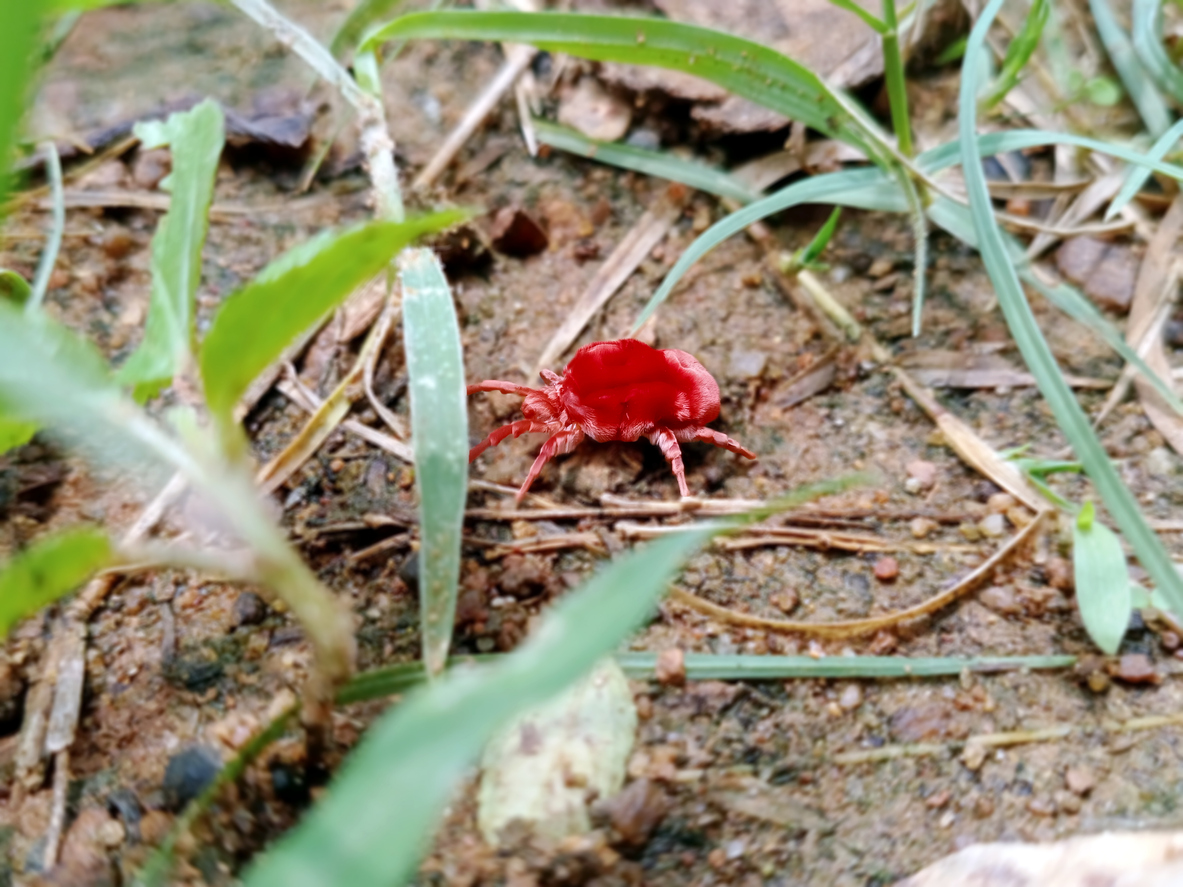
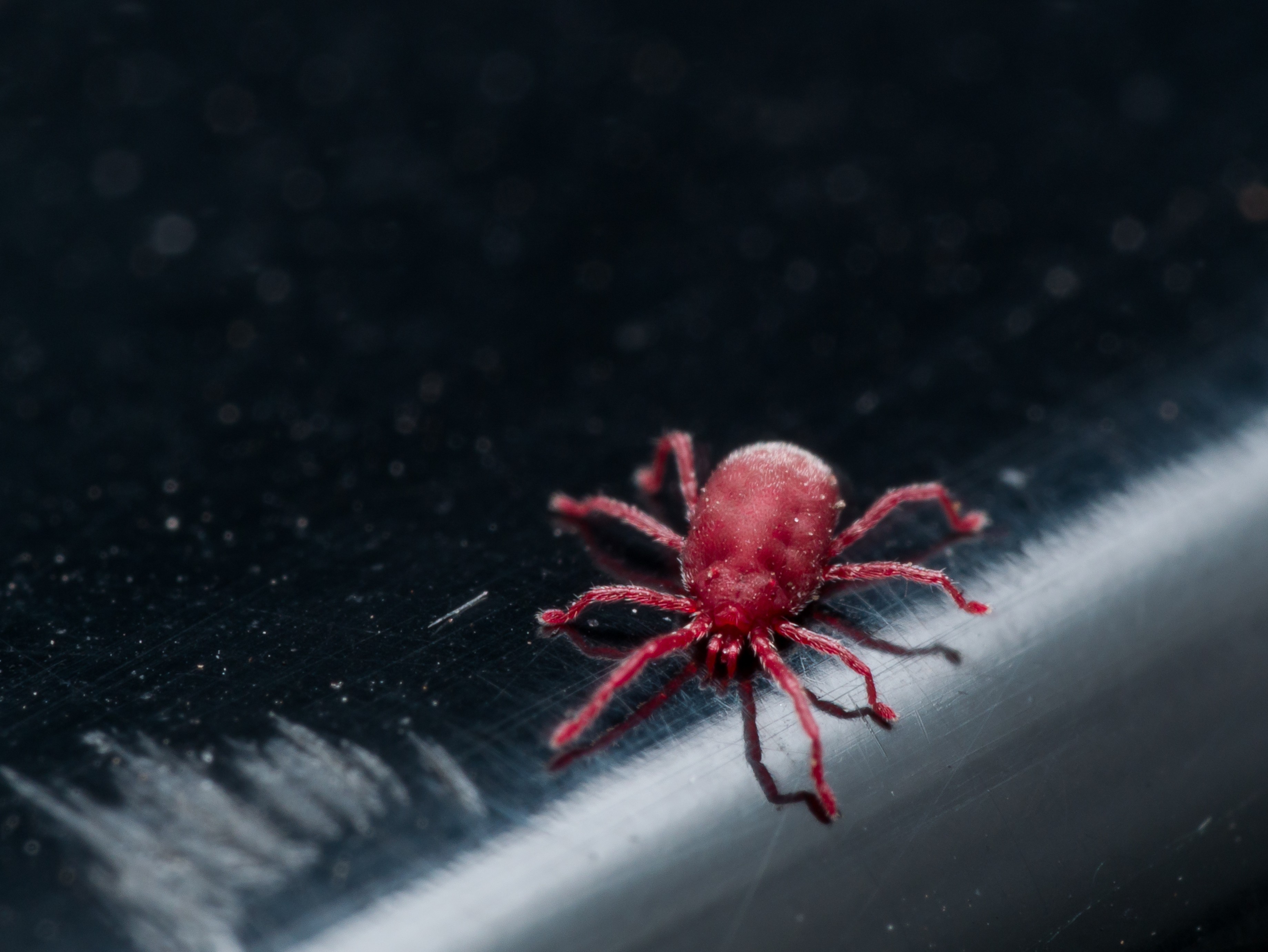
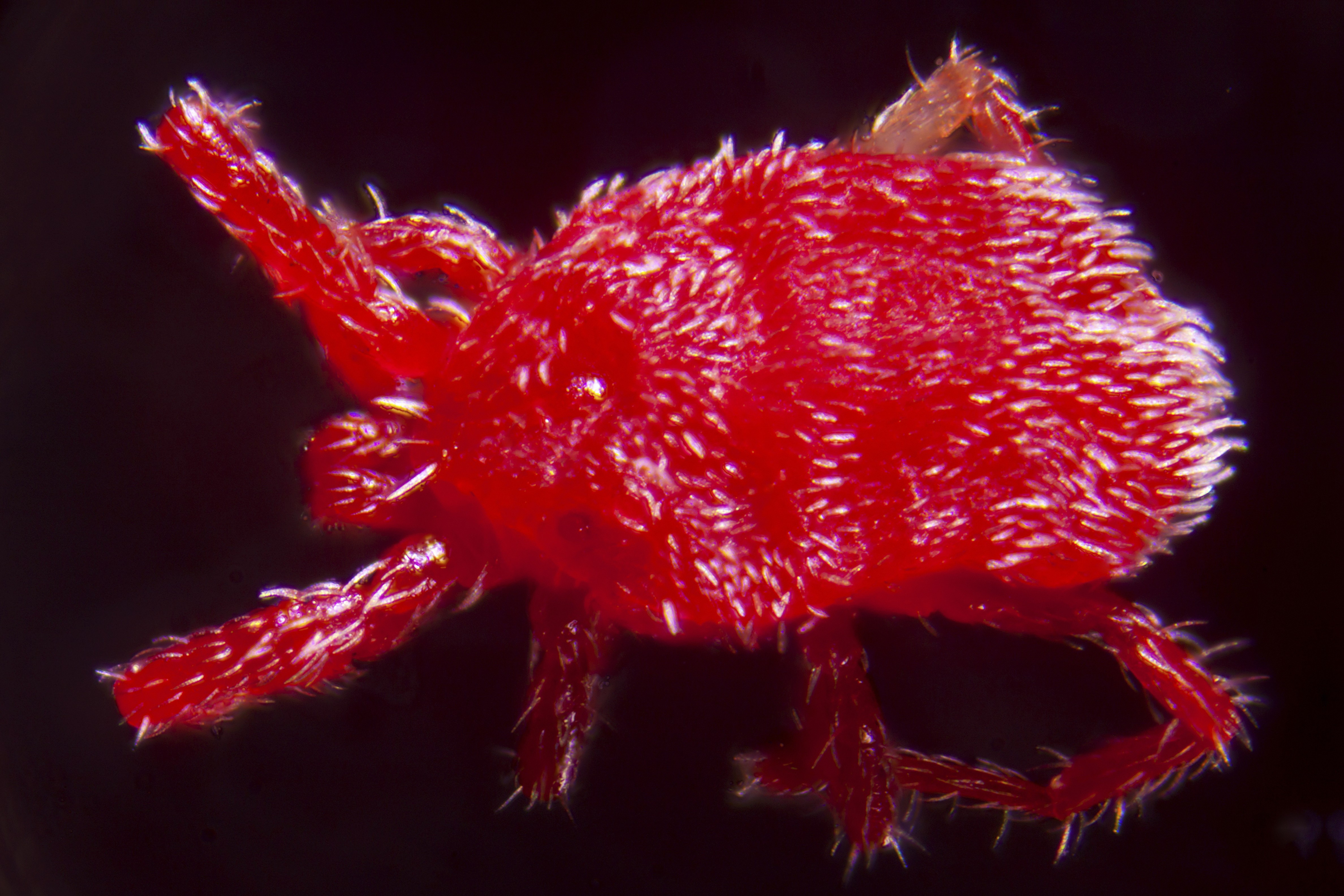
Chiggers are pests in the mite family which are prevalent throughout the southern part of the United States. They are red, tiny like a spider or clover mite, and smear red when crushed. Chiggers are different from both spider and clover mites in that they like to feed on flesh. They will readily bite dogs, cats, livestock, birds, people or just about any animal they can find. Chiggers live on the ground, around shrubs and plants and basically anywhere vegetation is able to protect them from direct sun.
Chiggers definitely prefer the shade and moist areas but can forage great distances if need be. Unlike most small mites, chiggers are able to move quickly. They are able to sense movement from afar and will not hesitate to go after it. For this reason pets can get chiggers simply walking throughout the yard; people can get them playing golf, working in the garden or during a picnic.
Related articles: BED BUGS CLOVER MITES ITCH MITES SPIDER MITES
CHIGGER BIOLOGY
Chiggers spend the winter lodged in the soil a few inches deep. When spring arrives, adults emerge to lay eggs in the same areas where they hibernate. Eggs will hatch in a short while every spring to release the larval stage. This is the stage which feeds on mammals. Chigger larvae requires flesh and will feed on just about any mammal available it can find. This larval stage is a bit smaller compared to adults and hard to notice.
HOW TO SOOTH CHIGGER BITES
Once a target is found, the young chigger will attack. First, it will crawl over shoes, socks and pants attempting to find meat.
Chiggers are small enough to fit through the mesh of most any fabric. This enables them to penetrate socks or pants quickly. Once on the skin, they will try to locate a place where they feel secure. This is usually just under the sock, around the waist band of underwear or anywhere clothing is tight. At this point, they will either puncture the skin or use hair follicles to get food.
Chiggers have a special fluid which liquefies flesh enabling the chigger to “suck” it’s meal. During this time, you would expect to feel an itch where they’re active. Their digestive fluids usually irritate our skin and creates a red blotch. In a day or two, this area may develop a blister.
The best product to use on a new bite is CHIGGER BITE SWABS. This ointment will take the “itch” away and promote healing.


For for old bites slow to heal, GENES SOOTHING CREAM can help. It uses all natural ingredients and can be applied daily for immediate relief.

CHIGGER REPELLENTS
Since chiggers will readily climb over clothing to get to your flesh, use PERMETHRIN AEROSOL on shoes and pants. Permethrin is odorless, easy to mix and works well at keeping many pests off you when afield.Spray clothing in the morning just prior to going afield. Treatments will last 6-8 hours so taking the can with you might be needed.

CHIGGER LIFE CYCLE
Once chiggers feed, larva will drop off the host and go through a period of development where they become adults. This cycle will occur from early spring all summer long. During this time chigger nymphs will be busy feeding and adults feeding on plants waiting for the mating season. The mating season will start in the fall when they will get active looking for a mate, laying eggs and preparing for the soon to arrive winter.
During this time, mature adults will seek organic matter on which to nest. Beds of chiggers will form as fall turns to winter. For this reason hunters seem to experience a surge in bites when they go afield chasing game in the autumn. Just before the first freezes of winter, adults will dig into the ground and stay protected from freezing temperatures, rain and sow.
In the spring, the cycle will start anew. In some regions, warm temperatures and high humidity allow the chigger to complete several cycles a year. This creates multiple “feeding seasons” during the year. Depending on the weather and local temperatures, it may feel as though they’re active all the time. Other seasons may prove to have little chigger activity giving the impression they’ve disappeared. Rest assured they will be back!
BEST CHIGGER LAWN SPRAY
Chigger control starts with identifying where they are nesting or where they are coming from to enter your property. Nests are typically around the home in pine straw, wood chips, mulch areas, grass, over grown wild areas, briar patches, or anywhere ground cover is thick, shade abundant and moisture available. English ivy, poison ivy and junipers will all provide great protection for nesting chiggers but so too can the thatch from freshly cut grass. Since these locations may be all over the property, chigger control is best done by treating everything. The good news is positive results may be achieved when using the right product.
BEST LIQUID SPRAY FOR CHIGGERS
So for an active chigger infestation, MAXXTHOR EC is super effective. It contains a new active so chiggers have not had a chance to develop resistance.
The following “short video” (less than 60 seconds long) summarizes how to use this in our Green Topped Hose End (the same process will be used for the Yellow Topped Hose End seen below).

And a little bit goes a long way. You only need to use 2.5 oz per 8,500 sq/ft. Treat every 2 weeks when chiggers are active and expect to do 3 treatments over the course of the first month to knock out an active problem.

To get the most of your treatment, add SPREAD-X BOOST to your tank mix along with the Maxxthor. Boost is an adjuvant, also known as a wetter spreader or spreader sticker. It basically makes water and the mixture more “slippery” so you get better coverage. Treatments will spread 2-3 times wider and penetrate deeper.
The following short video summarizes why Boost can help deliver your treatment to where it matters the most. And this is extra helpful when treating turf and plants for pests like chiggers. They like to “hide” on the bottom side of leaves where your spray won’t normally reach. But with Boost helping the spread, you can increase your chance of reaching the most remote locations they like to utilize.
Add no more than the rate you’re applying the Maxxthor so in this case, if you’re adding 2.5 oz of Maxxthor to the hose end sprayer, add 2.5 oz of Boost too before adding water. If you’re adding Maxxthor to a pump sprayer at the rate of .25 oz per gallon, use .25 oz of Boost.
And don’t spray in the middle of the day; treat late in the day close to sunset so the treatment can dry without direct sunlight. UV light on the Boost can stress plants if the temperature is 85 degrees or higher so treat 2 hours or less before sunset to reduce sunlight stress.

Though you can use a standard PUMP SPRAYER to do the application, this will generally not use enough water unless your yard is very small (like 1,000 sq/ft or less). But a good HOSE END SPRAYER will use enough water to distribute the active, cover all plant surfaces and do so efficiently using the strength and power of your garden hose.
When using our sprayer, you’ll want to add 1 oz of chemical to the sprayer and then fill it with water to the 5 gallon line. Next, hook it to your hose and distribute the entire amount over 5,000 sq/ft.

BEST FOGGING SPRAY FOR CHIGGERS
For large lots of 1/2 acre or more, get our BITHOR and apply it with our MISTING MACHINE.
Bithor is odorless, not as strong as the Maxxthor since its water based but you’ll use less AND its labeled for use in a fogging machine which means you can cover the same area with half as much chemical.
Bithor will kill on contact and provide 2 weeks of protection so plan on using it more frequently as well.
Mix 1.5 oz of Bithor per These are devices which will convert the liquid to a “mist”. By applying a mist, you’ll use a lot less chemical and more importantly, you won’t miss any of the key areas chiggers might be hiding.

A good machine for this task is the BUGSPRAYER FOGGER. This machine holds 1 gallon of water and if you add 1.5 oz of Bithor EC to the tank, you’ll have enough material to spray 10,000 sq/ft. Using a hose end, you’d need 2 oz of Maxthor and 10 gallons of water so as you can see, the mist blower will use less chemical and a lot less water.
The following “short video” (less than 60 seconds) shows how our fogger works for use around the yard.
What’s most impressive about the fogging machine is that it will give you greater coverage with less work. The fog will spray out 30+ feet and will effectively “blanket” all the vegetation you spray. This is super important when treating for chiggers. By fogging, you won’t miss any part of the plants they could use to roost or nest.
Our Fogger holds just one gallon of water and its powered by electricity so you won’t need to do much work when using it around the home. Just add water, some Bithor, plug it in and start treating.
Plan on treating every 2 weeks for the first month to knock out active problems but once they’re gone, treating every 30-60 days should keep them from coming back.

Large property owners should consider using a BACKPACK MIST BLOWER. Using this fogger will save even more time and chemical. Typically you can treat a whole acre with just 2-3 oz Bithor and you’ll be able to do so in just 5-7 minutes. This unit is gas powered and will project the mist 50+ feet. It has a 3 gallon tank and you’ll be completely independent of all hoses and cords using it so you can most anywhere. This makes the Backpack Mist Blower a useful tool for any large property owner wanting to treat an acre or more.

BEST INSIDE SPRAY FOR CHIGGERS
For small amounts of activity in the home, FS MP AEROSOL is well suited for reaching them where they might be entering. It features a deep penetrating chemical structure which reaches hard to access spaces chiggers like to use for nesting.
The following video details why FS MP is so good for perimeter invading pests.
Each can comes with a straw injecting tube as seen in the video above; use it to treat around windows, baseboards and any crack you can find where you see them active.

For large areas, spray BITHOR using a good PUMP SRAYER to treat carpeting, crawlspaces and other areas they might target. Typically when they get inside, they’ll be focused in one room or one area so the aerosol can be enough. But if they’re all over you’ll need to be more thorough focusing more on surfaces out in the open.
Bithor is labeled for all sensitive areas like carpeting, furniture and even bedding. It will kill them quickly but like Maxxthor EC, you’ll need to use it once every two weeks for the first month to ensure you kill all activity.
Add 1 oz of Bithor to a gallon of water and use the mixture over no more than 1,000 sq/ft of surface area. Bithor is odorless and safe enough to be sprayed on carpeting, couches and even mattresses where chiggers might be nesting.
Use a good PUMP SPRAYER to apply the Bithor. Set the nozzle on a full “swath” setting when spraying carpets to ensure it covers a wide 3-4 foot band.

CONTACT US
Give us a call if you need further help. Our toll free is 1-800-877-7290 and we’re open Monday through Thursday, 9:00 AM to 4:00 PM (Eastern Standard Time).
Email questions here: https://bugspray.com/about-us/contact-us
Order online and get a 5% discount! We ship fast with 99.9% of all orders shipping within 1 business day!!
Learn more about BUGSPRAY.COM and why it’s never been easier or safer to do your own pest control.
Please show your support for our business by purchasing the items we recommend from the links provided. Remember, this is the only way we can stay around to answer your questions and keep this valuable web site up and running. Thanks for your business!
Donna Ashmore says
Where do I find “Maxxthor” and “Bithor”?
Tech Support says
Maxxthor EC: https://bugspray.com/catalog/insecticide/liquid/maxxthor-ec
Bithor: https://bugspray.com/catalog/insecticide/liquid/bithor_sc
mark says
Have you seen them under screened in decks? We recently cleaned and scrubbed our screened in deck and have gotten them.
Tech Support says
I’ve seen them under, on and in screened in decks. And I’ve seen them in homes too. Basically any perimeter pest can get into homes if their population grows large enough. And from what you’re finding under your deck, it would appear this is beginning to happen around your home.
To prevent an active infestation inside the home, I suggest you start treating with the Maxxthor mentioned above. This should be sprayed over all your landscaping as well as the home’s exterior and under the screened in porch. Next, treat the inside space of the porch with FS MP. You may want to spray the baseboards in there too with the Bithor. It’s odorless can be used throughout the home safely.
Here are links to these items in our cart. Please show your support for our business by purchasing the items we recommend from the links provided. Remember, this is the only way we can stay around and keep this valuable web site up and running. Thanks for your business!
Maxxthor EC: https://bugspray.com/catalog/insecticide/liquid/maxxthor-ec
FS MP: https://bugspray.com/catalog/insecticide/aerosol/fs-mp-insecticide-15-oz-aerosol
Bithor: https://bugspray.com/catalog/insecticide/liquid/bithor_sc
Jane Sexauer says
I have a black lab, about 80 lbs.. what can I spray directly on him to prevent them from biting him?
And what product can I use on my grass to try to control them?
Thank you,
Jane
Tech Support says
Go with the Maxxthor listed above in our article. It covers large areas efficiently and is very active on chiggers.
Maxxthor EC: https://bugspray.com/catalog/insecticide/liquid/maxxthor-ec
For the pet, go with the Multi Purpose shown above. Its easy to apply, odorless and gentle on the pet.
Multipurpose Insect Killer: https://bugspray.com/catalog/insecticide/aerosol/multi-purpose-insect-killer-10-oz
Bill Spencer says
I have 5.5 wooded acres and both my wife and I have gotten bit by the chiggers! We don’t plan to clear this land so what is the best solution to treat this land and what time of year is best? This is an hour from Atlanta.
Tech Support says
Bill,
Go with the Maxxthor EC listed above in our article. If you spray it as a liquid, you’ll need just 4 oz per acre. But for 5.5 acres, I suggest you get the Mist Blower. I use it to treat my acre lot and can do so in less than 5 minutes. And I use a lot less chemical as you would too. Basically you’ll only need 2 oz per acre with the Mist Blower and you could treat the entire area in 30-45 minutes no problem.
Maxxthor EC: https://bugspray.com/catalog/insecticide/liquid/maxxthor-ec
Mist Blower: https://bugspray.com/equipment/foggers/solo-mistblower-backpack
As for when to treat? Chiggers are most active in the fall as they are preparing for the colder winter season. For this reason they’re quite vulnerable and easy targets. That’s why the fall is the best time to go on the offensive and treat.
Technical Support
U-Spray Bugspray
http://www.bugspray.com
1-800-877-7290
Little Lou says
We live in a 2 story apartment building in the Blue Ridge GA mountains. My son is constantly being bitten by what our dermatologist believes are chiggers inside and outside of our building. What can we use inside the apartment to get rid of the chiggers? You have given some excellent advice on products to use for preventing bites when one is outdoors.
Tech Support says
Lou,
In the article above you’ll see there is a section detailing how to treat for chiggers both inside and outside the home. As you can read above, for the inside you’ll need to spray using the Bithor concentrate. This needs to be done once a month using 1 gallon of mixed material for every 800 sq/ft of floor space treated. You’ll need to focus on problem areas like carpets, furniture, drapery and area rugs.
Next, you’ll want to supplement the liquid treatment with the listed Multipurpose aerosol. This can be used as often as is needed so applying some 1-2 a day is not uncommon. The Multipurpose won’t provide the long term residual like the Bithor but it will kill on contact which will prove helpful for problematic areas where the pests come back after a day or two. Its also well suited for flooring you can’t liquid spray like hardwoods or tiled floors.
More on these treatments can be read above here:
https://bugspray.com/articles98/chiggers#inside-the-home-chigger-spray
Lastly, the listed products can be seen in our catalog here:
Bithor: https://bugspray.com/catalog/insecticide/liquid/bithor_sc
Multipurpose Insect Killer: https://bugspray.com/catalog/insecticide/aerosol/multi-purpose-insect-killer-10-oz
Give us a call if you need more help. Our toll free is 1-800-877-7290 and we’re open 9:00 AM to 4:00 PM Mon-Thur, Eastern Standard Time.
Jonathan
Customer Care
https://bugspray.com
1-800-877-7290
PS: Please show your support for our business by purchasing the items we recommend from the links provided. Remember, this is the only way we can stay around and be here to answer your questions and keep our web site up and running. Thanks for your business!
Johnnie says
Is there a certain type of material we can use for our outside chair cushions so that chiggers can’t/wont nest on the chairs?
Tech Support says
Johnnie,
Yes and no. So yes, there we have sprays which will deter chiggers from the area and even kill them if they go there. But will it be strong enough to do what you hope? Probably not.
So first, we have a couple of options you could safely apply to the cushions to both kill and keep them away. Above in our article did you see the Permethrin Aerosol? Commonly used on clothing to keep chiggers off you when you afield, this same form can be used on cushions. We also have it in liquid form so you can mix it with water and spray them down. And though both will kill chiggers when you spray and keep killing for a week or so, I’m not sure that will provide the kind of control you want. Let me explain..
Insecticides don’t kill insects on contact once they dry. So when you spray, you’ll quickly kill whats on the cushions at that time. Now when more crawl up onto the cushions, they’ll feel the chemical and get agitated and move around. This allows them to pick up chemical and within 1-2 days, they’ll die. But for 1-2 days they will be active, biting anyone that sits on the cushions, so effectively the problem won’t be “solved”. Of course I’m assuming you don’t want chiggers on your cushions, correct?
And if that’s true, then what should be done is a thorough spraying of the patio, deck and yard with the Maxxthor EC listed above in our article. This will kill them in the area surrounding the cushions. And results will be instant. Once they’re gone from the area, you won’t have any to get up and on your cushions so the problem will be gone. In fact, you won’t have to spray the cushions either if you go with the Maxxthor EC in the surrounding areas.
Long story short, chiggers (and other crawling pests like ants, roaches, spiders, ticks and more) only go on furniture and the sides of our homes because they are able to exist in the yard/ground surrounding these objects. So if you spray around the home on the ground, you won’t get them on the homes siding. And if you spray around the furniture, you won’t get them on the furniture or in the cushions.
Remember, chiggers can’t see and they certainly don’t know what a “cushion” is. But they are programmed to continuously expand their territory by foraging out from where they are already successfully living. So once they’re happy and thriving in the yard surrounding the furniture and home, its just a matter of time before some get onto these man-made objects too and present a more direct conflict with those of us who want to be in these areas.
Technical Support
U-Spray Bugspray
http://www.bugspray.com
1-800-877-7290
PS: Are you signed up for our informative twice a month Pest Report Newsletter? More info here: https://bugspray.com/bugspray-pest-report
France says
Great knowledge and good help to get rid of very annoying insects like chiggers.
Thank you
Jan says
Can I add anything to the wash to help repel chiggers? We currently have only cold water where our washing machine is located, so the hot wash fills cold, but protecting our clothing from picking up chiggers may go a long way toward preventing bites and infestation in our home.
Tech Support says
Jan,
Get some of our “cold water laundry additive” featured here:
Laundry Additive: https://bugspray.com/catalog/insecticide/additive/allersearch-laundry-wash-24-oz/
It specializes in removing all kinds of allergens including insects.
Technical Support
800-877-7290
Jay says
I have chiggers on the concrete areas of my patio and even on my upstairs patio. I do not see them in the grass. Should I use this to treat the concrete?
Tech Support says
Jay,
Use the Maxxthor above. It will kill immediately and keep them away from the area once you kill off any that are nesting there. Plan on useing 3-5 gallons of mixed spray initially and then half as much every time they return. So for the first few weeks, you may need to treat 2-3 times a week to get rid of the active ones.
https://bugspray.com/articles98/chiggers#best-chigger-lawn-spray
Technical Support
http://www.bugspray.com
800-877-7290 Ext: 2
Arnold says
I have a propane fogger that does well to kill mosquitos with “fogging” insecticides. Can I use any of the products listed in this article in my fogger? If so, should I use them in concentrated or diluted form?
Tech Support says
Arnold,
If you read through the article above, you’ll see we recommend the Maxxthor for outside. Well that product can only be sprayed, not fogged or misted. However the Bithor can go through your machine fine and is what we’d recommend for sure. And same with the Essentria but it won’t be nearly as effective compared to the Bithor.
Tech Support
Zlatka says
We are looking for treatment against chiggers that will not harm our honey bees. We have four hives in our yard and chiggers are not only in the grass, but on our concrete patio, driveway and walkways. Is there a solution to get rid of the chiggers, but not to harm the honey bees?
Thank you, Zlatka
Tech Support says
If you scroll “up” to our article, you will see the Maxxthor EC is listed as the spray for the grass, home siding, plants, etc. It will kill chiggers on contact and its highly repellent to insects so in general, insects, including bees, will typically avoid areas where you spray the Maxxthor. So as long as the bees aren’t active on the surfaces where you spray it, they should be fine. I’d keep an “untreated zone” of 20 feet around the hive too. This will insure you don’t contaminate them. Also, do not spray when its windy.
https://bugspray.com/articles98/chiggers#best-chigger-lawn-spray