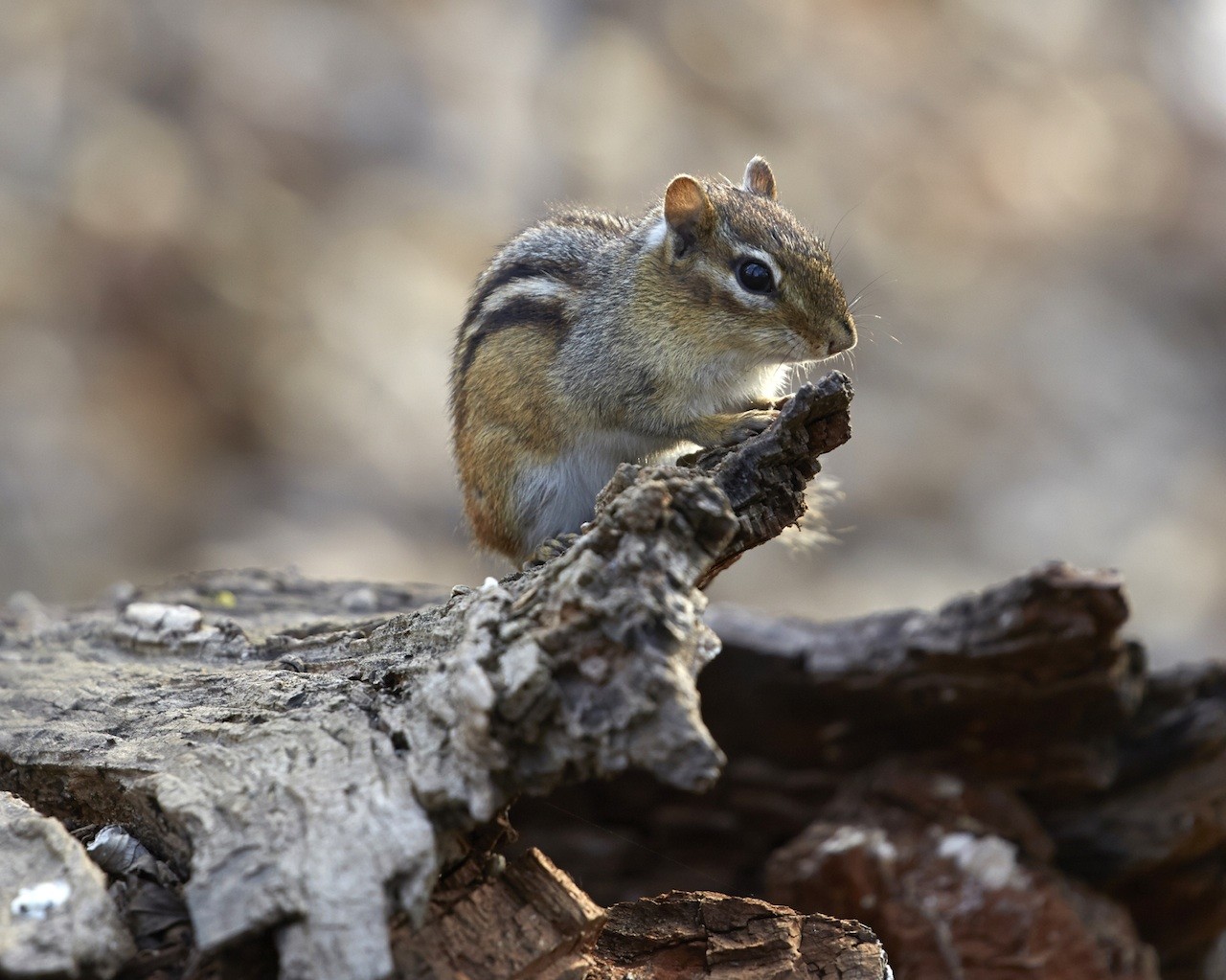
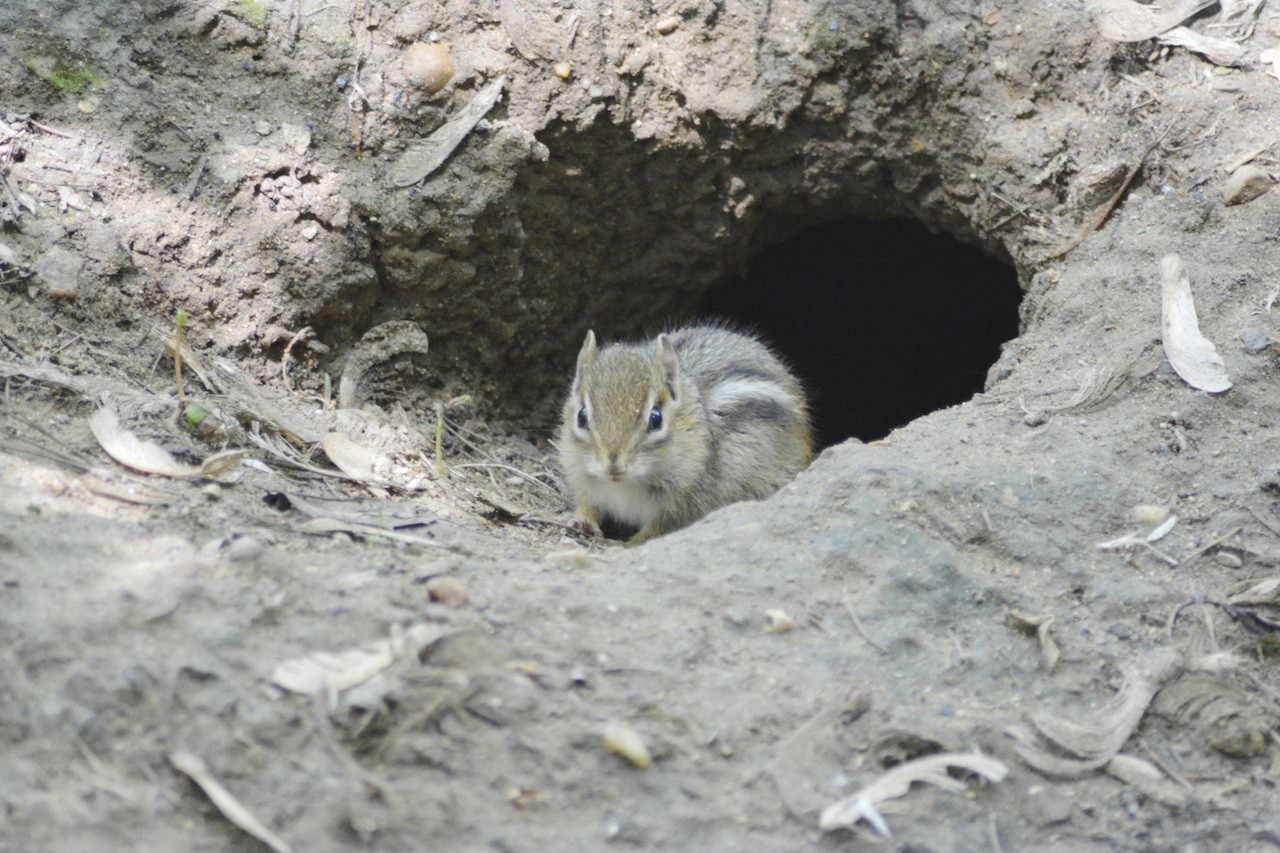
Chipmunks are small animals that resemble grey squirrels. Their bodies are tan/brown with dark or light stripes running down their back. These dorsal stripes vary with the species. The two main species are the eastern and western chipmunk. Eastern chipmunks have three dark stripes while the western species has five. Both are small only reaching 8-10 inches at maturity. Either can hibernate, but western chipmunks seem more likely to stay active all year. Both species breed in the spring and summer months. Gestation usually takes one month and litters may have 2-8 young. The eastern species seems to be more likely to have more than one litter a year, although either species may have several if the conditions are right.
CHIPMUNK BIOLOGY
Chipmunks are ground dwellers. They are active during the day and move around cautiously and tentatively. Chipmunks exist in all 48 of the main states of America and seem to be thriving more now than ever. As with other animals, chipmunks have been able to take advantage of suburban areas. They can exist alongside man in parks, wooded lots or in our yards. The rule is simple; if there is a supply of food around your property then expect to have some chipmunks moving in as neighbors. Chipmunks have a large list of food on which they will readily feed. This list includes slugs, snails, insects, small birds, eggs, mice, seeds, fruit, vegetables, seeds, flower bulbs, and pet food. They seem to have an endless appetite and will hoard food if given the opportunity. Homes with pet food, bird feeders, nut trees, gardens, flowers or an abundance of insects are likely to have chipmunk activity. In most cases, the first signs of chipmunks are welcomed. These small animals are both cute and innocent looking. Most people like to watch them as they forage for food and move about in the yard. But don’t let their harmless looks charm you. Chipmunk infestations can quickly grow out of control and once established, they can be difficult to remove! Watch to online video to see just what one looks like.
CHIPMUNKS CAN CAUSE ALL KINDS OF PROBLEMS
Chipmunks can be a problem several ways. Each case is different, but they all start the same. One day, a chipmunk is seen foraging in the yard. The homeowner leaves the animal to do as it likes not realizing what will happen. Soon, this one chipmunk becomes many. This increase in population leads to problems from the chipmunks behavior. If you have chipmunks in your yard, here are some of the problems you might expect to have happen.
1) Chipmunks eating garden vegetables and fruits
2) Chipmunks eating from bird feeders.
3) Chipmunks chewing on cable lines, air conditioning pipes and electric lines.
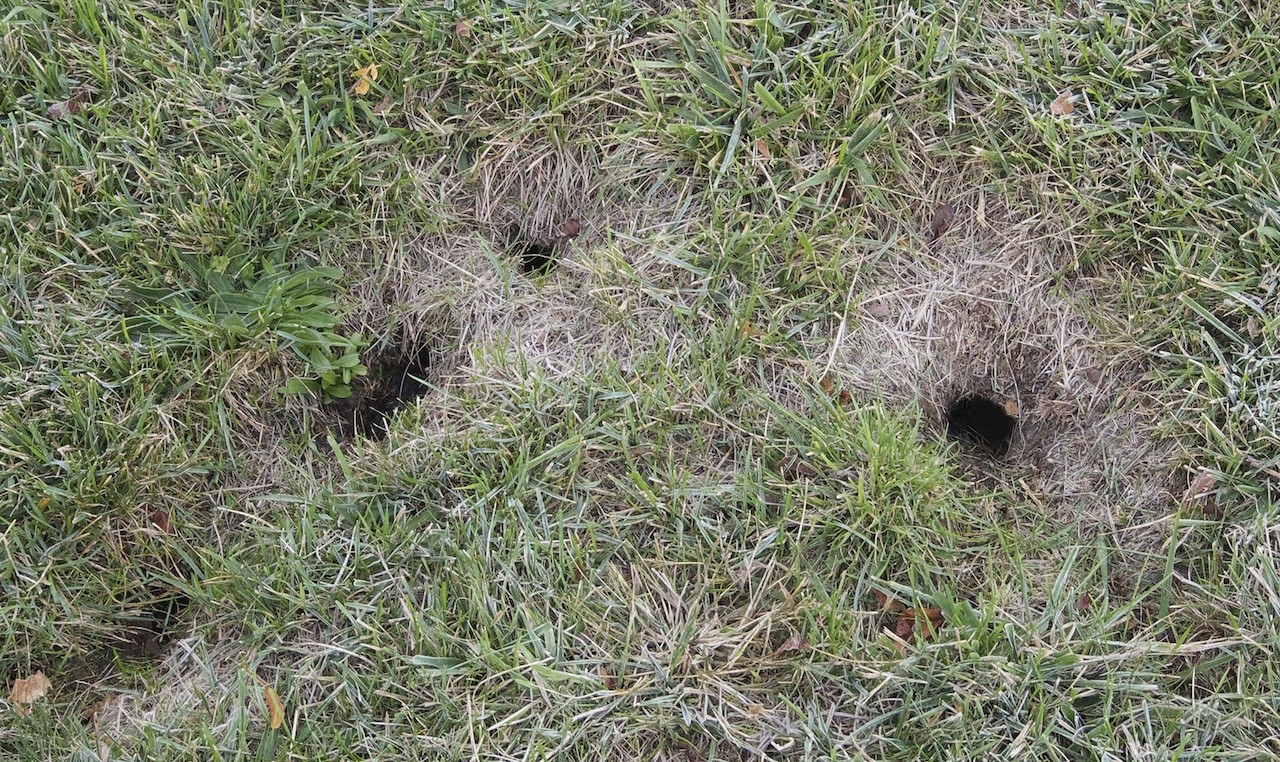
4) Chipmunks burrowing into the ground which leads to water undermining patio slabs, driveways and foundation walls. This undermining will eventually lead to water getting inside your home, cracked cement slabs and broken driveways.
5) Flowers, bulbs and other plants being eaten or dug up.
6) Flea problems developing on the chipmunks and then ultimately becoming for pets and people.
7) The possibility of diseases such as plague, Rocky Mountain spotted fever or the Powassan virus to be transmitted to you or your family increases with these animals being around.
8) Flower beds, retaining walls and trees have been tunneled and burrowed into leading to water problems. For flower beds and trees, this excessive water will lead to fungus and water rot. This ultimately will lead to the plant becoming diseased or sick. Retaining walls which are tunneled through will become weak and damaged leading to repair quicker than normal.
9) Burrows made against the home will lead to a quicker breakdown of any termiticide barrier.
10) Snake infestations. Chipmunks will inevitably attract snakes which will come looking for the chipmunks for food.
11) Chipmunks hoard food which will attract mice, voles and other vermin.
WHAT WON’T WORK FOR CHIPMUNK INFESTATIONS
1) Baiting with “Poison Peanuts” or other Rodent bait. Chipmunks are fussy and only seem to like tasty and selective foodstuff generally not available in a “bait” form.
2) Flushing water or gasoline down their burrows. Putting gas down their burrows will sterilize the ground and the chipmunks will simply avoid treated areas. Since their burrows usually go 20-40 feet, it is not likely that you can reach them with either gas or water. Don’t waste your time or money.
3) Cats and dogs. Although your cat or dog may occasionally kill one or two, more will quickly occupy the vacated area. Typically, the chipmunks which inherently are coy enough to escape the pets reproduces and their offspring inherit these same qualities which allow them to survive as well.
4) Moth balls. As the name implies, this product is for moths – not chipmunks. Although they smell to people, don’t expect them to do anything to chipmunks. No one knows where this old wives tale originated but you can rest assured it will not chase away chipmunks.
CHIPMUNK SOUND REPELLER
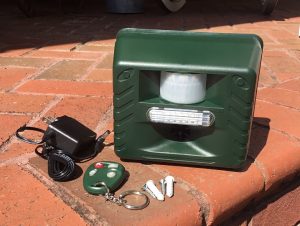
Another effective repellent is to install our unique SOUND REPELLER. This machine uses ultra sound by default to chase small animals like chipmunks. In most cases, this sound alone will be enough to keep them away. But it also has a predatory animal audible sound. This sound you can control which can be dialed up as needed (or totally off). This sound will scare them away instantly when activated but even the ultra sound alone is strong enough to chase them away.
This short video (less than 60 seconds long) shows how our Ultra Sound Repeller works:
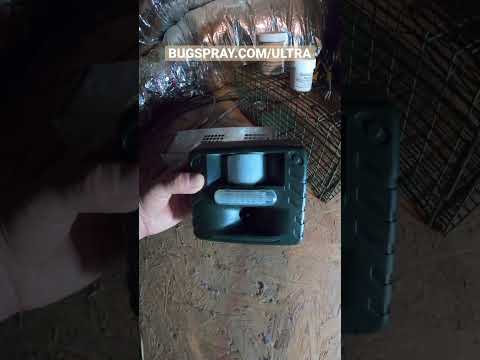
Refer to our product page for complete device details since it has many options. But here is a quick summary of why this unit is a good option and well suited for certain animals like chipmunks.
- It uses ultra sound to repel animals and chipmunks do not like this sound.
- It has a wireless remote control so you can turn it off/on as needed from afar.
- It has a day time only, night time only or 24 hour a day setting so you can have it active when needed. For chipmunks, it should be turned to operate during the day.
- It has the optional audible sound setting which should be used if you must rely on the motion activated setting.
- It includes an AC power supply so if you can run it by plugging it into a power outlet, you can let the machine constantly chase off invading chipmunks. Using it this way will give you coverage up to 70-80 feet away.
- It can also be powered by batteries which can last several months. The only tradeoff using it this way means you will need to have it activate via motion only or else the batteries will run out after a few days if you leave it “always on”.
If the above video wasn’t informative enough, this next one is a lot longer but provides all the details you’ll need to know:

Our sound repeller can be used to chase away active chipmunks. Plan on using one machine per 4,000 sq/ft of area. And since it will only impact animals in front of the device, you need to make sure you have a clear unobstructed view of the area you want to protect when setting up the machine. This usually means keeping it 1-2 feet off the ground.
Units should be placed 1-2 feet above ground and pointed in the direction where animals are entering as well as “over” the turf you want to protect. 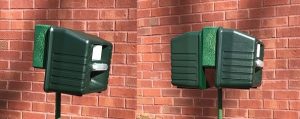
For easy installation, MOUNTING BLOCKS are handy. They can accept 1 or 2 repellers (picture to the right) and have a 1/2″ hole on their bottom so they will easily fit over a 1/2″ piece of rebar or any other wood or plastic stake. Ultra Sound Repellers will work fine by themselves as long as you have a good place to set them up. But we highly recommend getting the Units with Mounting Blocks in the kits we offer. Mounting Blocks allow you to place units anywhere and they will save time too.


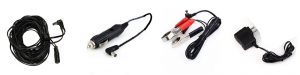
We also feature several accessories for our sound repeller including POWER CORD EXTENDERS (33 FEET AND 66 FEET), CIGARETTE LIGHTER POWER ADAPTER, ALLIGATOR CLIP POWER CORD and AC POWER SUPPLY REPLACEMENTS.
LOW PROFILE SOUND REPELLERS
For a more “discreet” installment, our line of sonic sound ground stake repellers is probably your best bet for long term control. Once installed, you’ll be able to keep away chipmunks for good. We feature two units; one is strong enough to use as a barrier along property lines to keep foraging chipmunks looking for homes away from your yard. The second unit is much stronger incorporating ultra sound along with the standard vibration and sound our basic unit provides. But the deluxe unit is strong enough to be used directly in active chipmunk tunnels so you can actually chase them off your property.
There are lots of these units on the market these days but most are under powered and won’t be strong enough to handle the job when it comes to chipmunks. But the science is proven. Basically ground burrowing animals like chipmunks will avoid dirt under construction or where they hear ongoing “noise”. For this reason, devices which intentionally send out sound waves can be used to both chase away chipmunks and keep them from entering your property in the first place.
So are they strong enough to get rid of the chipmunks already in your yard? Absolutely. But only our deluxe model (the second one below) should be used when you have an existing population.
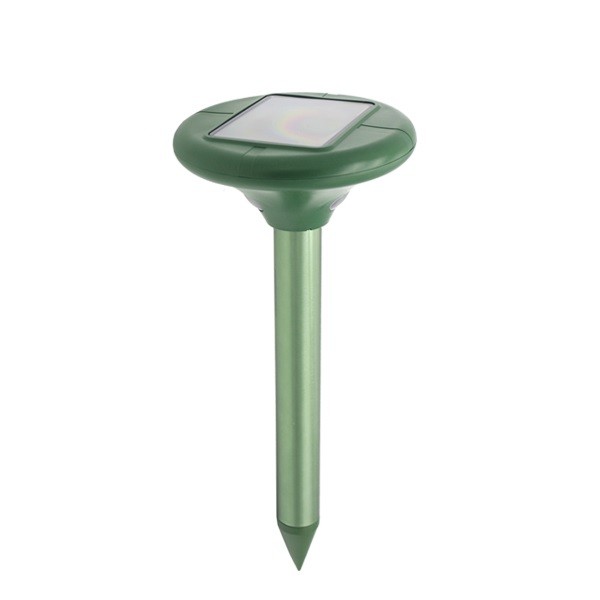
DELUXE SOLAR POWERED CHIPMUNK REPELLER
So if you have active chipmunks centered on your property, say in a garden or flower bed, our DELUXE CHIPMUNK REPELLER will be needed. This model is one of kind and not available elsewhere. True, there are models which looks like it. But they don’t have all the features our units have which are needed for certain animals like prairie dogs, ground squirrels, chipmunks and voles.
It uses the sun to charge an on board replaceable battery so it runs on its own, around the clock. And it releases a vibration that will both move the ground and create a sound wave that will “rattle” chipmunks so they want to leave. But our deluxe model incorporates other sounds making them well suited for control of existing problems if the active burrows are not being used for nests.
This short video (less than 60 seconds long) shows how our Ground Stake Repeller works:
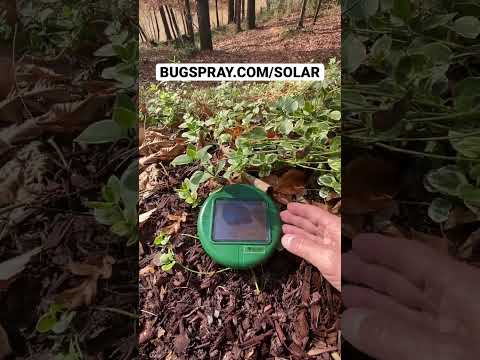
As stated, this unit will vibrate several times a minute constantly rotating the sound cycle. But it also sends out “ultra sound”. In general, ultra sound won’t help fight true under the ground dwellers like moles since they’re down in the ground and well protected. This is why all the other units like this on the market don’t include ultra sound. But for animals that like to forage up out of the ground (like chipmunks), ultra sound is helpful and for the most part, a necessity if you’re trying to treat an active problem.
If the above video wasn’t informative enough, this next one is a lot longer but provides all the details you’ll need to know:
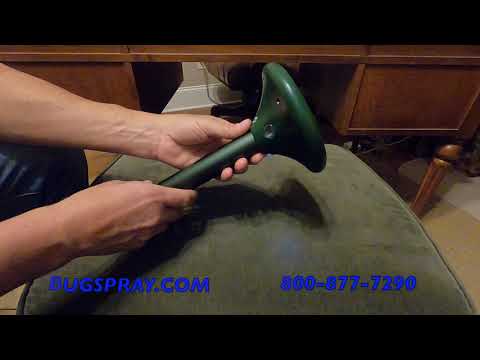
In addition to the ultra sound being sent out, it also uses LED bulbs located just underneath the controller head. These light up when its dark which effectively give the units an “evil” look at night. Small animals that like to forage on the ground at night will look up and see these discreet lights and perceive it to be a predator. This in turn will make them uncomfortable and nervous. Combined with the ultra sound, the vibration and the audible sound, the deluxe repeller is powerful enough to be used in the middle of a an active chipmunk tunnel. Chipmunks will routinely have tunnels they use for a quick escape that aren’t actually nest tunnels. Place our repeller into these areas to start the purging process.
So to start, only deploy units directly in active tunnels and nests. Do not install units along property borders for the first two weeks. This will give the visiting animals a way to escape. After two weeks, if you still have activity in the tunnels with repellers installed, you’ll need to use the GASSERS listed below to make the tunnels unusable for them. Once gassed, fill in the tunnel entrances with dirt and monitor them for another two weeks. IF the holes reopen, gas them again until they leave for good. In most every case, one treatment will do the job for good but wait two weeks before relocating the repeller further out.
Coverage for these units can vary. So for loamy soft soil, plan on getting 4,000-5,000 sq/ft of coverage. But for hard pan, 6,500 to 7,500 sq/ft per unit is to be expected. Along property borders, place units every 45-50 feet.
Setup by letting the head unit charge for 1-2 days prior to setting them out in the yard. This way they go afield under full power making them best suited to get the job done. For more detailed directions on how to set them up, download our SETUP DIRECTIONS.
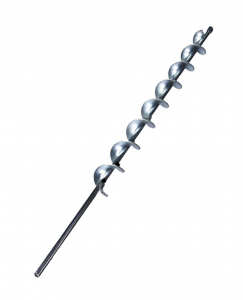
Regardless of which unit you get, you need to properly prepare the ground by drilling a smooth hole for them to fill. The hole must be the proper depth and width. Our SOIL AUGER is perfectly designed for the task.
This short video (less than 60 seconds long) shows how to use our Earth Auger:
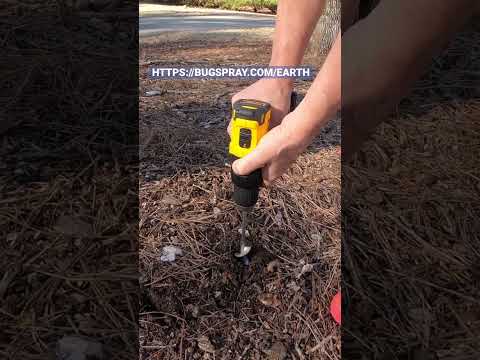
Simply attach it to your favorite hand drill and take it out to the yard for the task at hand. Holes can be drilled in 10-20 seconds and will be just right. Plan on making them about 9 inches deep as units need to be installed so 1-2″ stick out to keep the head unit off the ground.
CHIPMUNK GAS STICKS FOR TREATING BURROWS
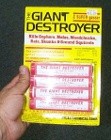
If you have several burrows throughout your yard but are not quite sure where the chipmunks are active, the use of GAS STICKS might help. These are sulfur gas smokers that have fuses. To use, light the fuse and then place the smoker down the burrow.
The intention of this method is to either kill the chipmunk nesting chipmunks or to repel them from the burrows by overloading it with the bad smell of sulfur smoke. It usually takes 1 gasser to treat the average burrow but for large tunnels, two might be needed.
For small limited tunnels, this can be extremely effective. But if the burrows go deep or run through a large area, it can be hard to get proper coverage. Basically if you don’t get the smoke to fill every part of the burrow, the chipmunks will usually move to another part where there is enough air for them to survive.
The following video shows how to use our gas sticks.
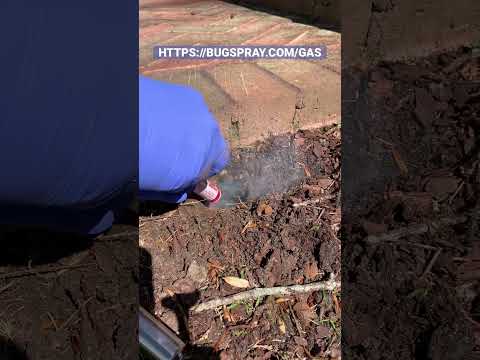
So for this method to be effective, you need to be sure all entry and exit holes to the burrows are closed. Do this by covering all holes with rocks and dirt. If the holes to the burrows are sealed and the gas is able to fill their tunnels, it will kill them.
The 4 pack is usually enough to treat up to 2-3 dens; expect to use two sticks per den for every den that has 2-3 entry/exit holes. Also, using these in conjunction with our DELUXE SOUND REPELLERS listed above is surefire way to ensure they don’t come back.
LIVE TRAPPING CHIPMUNKS
The most practical and effective method for controlling a chipmunk problem is to live trap. Chipmunks are easy to catch and can be caught with little effort. The use of a live trap is humane and they won’t become afraid of it.
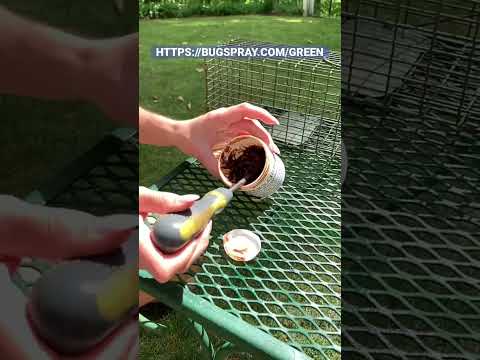
This short video (less than 60 seconds long) gives you a brief overview of our Pecan Paste and why its so amazing at luring nuisance wildlife to traps:

——————————
Simply place the trap by their burrow or under plants, trees or bird feeders where you’ve seen them active. Use any of the food stuff you know they are eating as bait and you will quickly catch foraging animals; if you’re not sure what it is they’re eating locally, go with MIXED BIRD SEED with TRAPPERS CHOICE PECAN PASTE. The aroma is very attractive to chipmunks and they’ll find your offering quickly.
Expect to use 1-2 teaspoons per set.

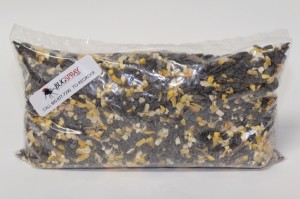
Apply 1-2 teaspoons of the paste on the trip pan of the trap and smear it across the metal plate. Now add seed to the back of the trap, behind the trip pan, as well as to the middle and front entrance. This video shows how to make a great trap set for chipmunks.
As explained in the video, the Pecan Paste is what will get them to the trap and once they arrive at it’s side, they need to see something in the trap which will make them want “in”. A good amount of seed placed in the back, behind the trip pan is important for success.
But as explained in the video above, it’s many times not enough by itself. Place Pecan Paste on the trip pan and you’ll get far faster results.
Chipmunks have a keen sense of smell so make a set that takes advantage of this trait. By drawing a “line” using both lure and seeds, you’ll enable them to find their way exactly where you want them to go. And don’t forget to line the bottom of the cage with some pine straw or something else that’s around the set location to cover the metal wire. Making it more like the ground they’re walking on will increase the odds and speed at which they enter which in turn will lead to a faster catch.
BEST CHIPMUNK LIVE TRAPS
When it comes to choosing a live trap, there are several that can do the job. But if you want a trap that will last 10 plus years and work for a wide range of animals, get the LT5518. Its definitely the best chipmunk live trap around and is what we call “commercial grade quality”. These traps are used by professionals, built to last, easy to set and spring loaded.
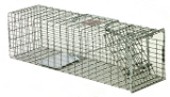
The LT5518RD features a rear sliding door which makes for easy baiting and animal release. The following video shows this trap in action as it catches a typical chipmunk after making a set detailed in the video above.
As shown in the above video, a good trap set placed out in the right area will lure any chipmunk. Once they arrive to the trap, its best if you have it set in a way that will help “funnel” them to enter. Once caught, you’ll want to relocate them at least 5 miles away before releasing them; 10 miles to be sure they don’t return. Chipmunks can travel several miles and in rural areas, they’ve been known to travel great distances.
LOW COST CHIPMUNK LIVE TRAP
For anyone on a budge, the 5X5X16 GREEN LIVE TRAP is a great option for small animals like chipmunk.
This trap blends into the natural landscape well and isn’t easy to see.
The following “short video” (less than 60 seconds long) gives a good summary of how this trap works and why its such a good value.
But its not nearly as good quality wise and in many cases, will require some tweaking to get the trip mechanism to work smoothly. It’s definitely our “economy model” but for a small problem or when the budget has limited resources, its a decent choice to consider.
Roy says
Will pecans work if you don’t have pecan paste?
Tech Support says
Roy,
You can try. Bottom line is the “smell” of our Pecan Paste does two things. First, its super strong so it can attract targets from afar.
Second, since its smells so strong, animals can tell its highly nutritious compared to “regular” nuts so they’re more willing to enter a trap (take a chance) as the payoff is better.
Step Trapping can help but the bottom line is simple, the Pecan Paste will get them into your trap way faster compared to using just nuts alone.
Step Trapping: https://bugspray.com/catch-rat-not-going-into-trap.html
Pecan Paste: https://bugspray.com/traps/lure/pecan-paste
Technical Support
http://www.bugspray.com
LinC says
Customer recommendation: Trapper’s Choice Pecan Paste is the best chipmunk bait on the planet! Last year we caught 60 chipmunks in our backyard using two wire traps and the paste. (If you think you have three chipmunks, you probably have 20.) Thanks, guys.
Tech Support says
Thanks for the feedback! No doubt we agree 🙂
Here are links to these items in our cart. Please show your support for our business by purchasing the items we recommend from the links provided. Remember, this is the only way we can stay around and keep this valuable web site up and running. Thanks for your business!
Pecan Paste: https://bugspray.com/traps/lure/pecan-paste
LT 5x5x18: https://bugspray.com/traps/cage/live-trap-5-x-5-x-18
CR says
I have 2 dogs that roam the property, supposedly hunting down chipmunks, but that isn’t working very well. One is a miniature daschund (7 lbs) and the other is a sheltie. They are both chow hounds and are constantly looking for something to eat, which is what leads to my question. Will the pecan paste be attractive to the dogs as well? And can the dogs, especially the little one, get into the rat zapper and get a shock or worse?
Tech Support says
No doubt the Pecan Paste will be attractive to your dogs. It’s actually attractive to people based on what many of our customers have told us but you shouldn’t eat any even though it smells great. But getting back to using it where you have pets; no doubt they’ll want to get into your placement. For this reason, there is no way you can any kind of poison in the yard. That leaves either live traps or zappers.
Live Trap: https://bugspray.com/traps/cage/live-trap-5-x-5-x-18
Rat Zapper: https://bugspray.com/traps/electric/rat-zap-ultra
Now you should be able to configure either in such a way to make a set and still keep the pets away. I would say the way to achieve this would be to use cinder blocks. They can be set around either a live trap or a zapper (inside a Rats Nest) and if you leave a large enough space between blocks, chipmunks will be able to gain access fine. Now are your dogs strong enough to move cinder blocks? That’s something you’ll have to decide but it would be tough.
Lastly, the shock from a Zapper would no doubt hurt either dog. But it wouldn’t be able to kill them unless they kept their paw inside it and they have a weak heart. A squirrel is about as large of an animal it can kill and even that is pushing it. And in order to kill a squirrel, it has to be in the trap for 30-45 seconds. Now your 7 lb’er is way bigger than the average squirrel so he should be okay if he did put his paw inside and set the trap off. But he would most likely immediately remove it and from what we’ve heard, dogs that do this once usually learn to stay away for good so it rarely happens twice.
N'oreaster says
The Rat Zapper works better than anything I’ve tried; I empty it a couple of times a day. And the chipmunks all look so peaceful!!
TT says
Do I need to lure the chipmunks into the Rat Zapper with Pecan Paste?
Tech Support says
Great question. In fact you don’t have to use the Pecan Paste but it can be a huge help. The scent and smell is just so strong, chipmunks can’t resist it and the Pecan smell will get them to the device that much quicker thus yielding faster results.
Pecan Paste: https://bugspray.com/traps/lure/pecan-paste
But if you know what it is the local chipmunks are most attracted to and what they’re normally feeding on, you can try using that as the attractant.
Kay says
I’m live trapping; how far do I have to take them so they don’t return? Thanks!
Tech Support says
As explained in our article above, at least 5 miles away to insure they don’t come back.
Steve Reed says
@Tech Support: How far do I have to relocate the chipmunks when live trapping?
Tech Support says
Steve,
5 miles usually does it; 10 miles to be sure.
Technical Support
U-Spray Bugspray
http://www.bugspray.com
1-800-877-7290
Ayden says
I need to know how to catch them so tell us that and where to get the cages.
Tech Support says
If you review the article above, all the details are included on how to trap them using one of our live traps. There are video’s too on how to make the trap sets, etc. And here are links to where you can get the needed trap and lure.
Live Trap: https://bugspray.com/traps/cage/live-trap-5-x-5-x-18
Pecan Paste: https://bugspray.com/traps/lure/pecan-paste