Millipede invasions have long been a problem for many homeowners. Although these invasions seem more likely to occur in the spring and after heavy rains, they have been reported in every month of the calendar year. Thousands of migratory millipedes can create a mess. Once they die, expect a smell that can last for several weeks.
Related articles: CENTIPEDES EARWIGS PILL BUGS SCORPIONS SLUGS SOWBUGS SPIDERS
MILLIPEDE BIOLOGY
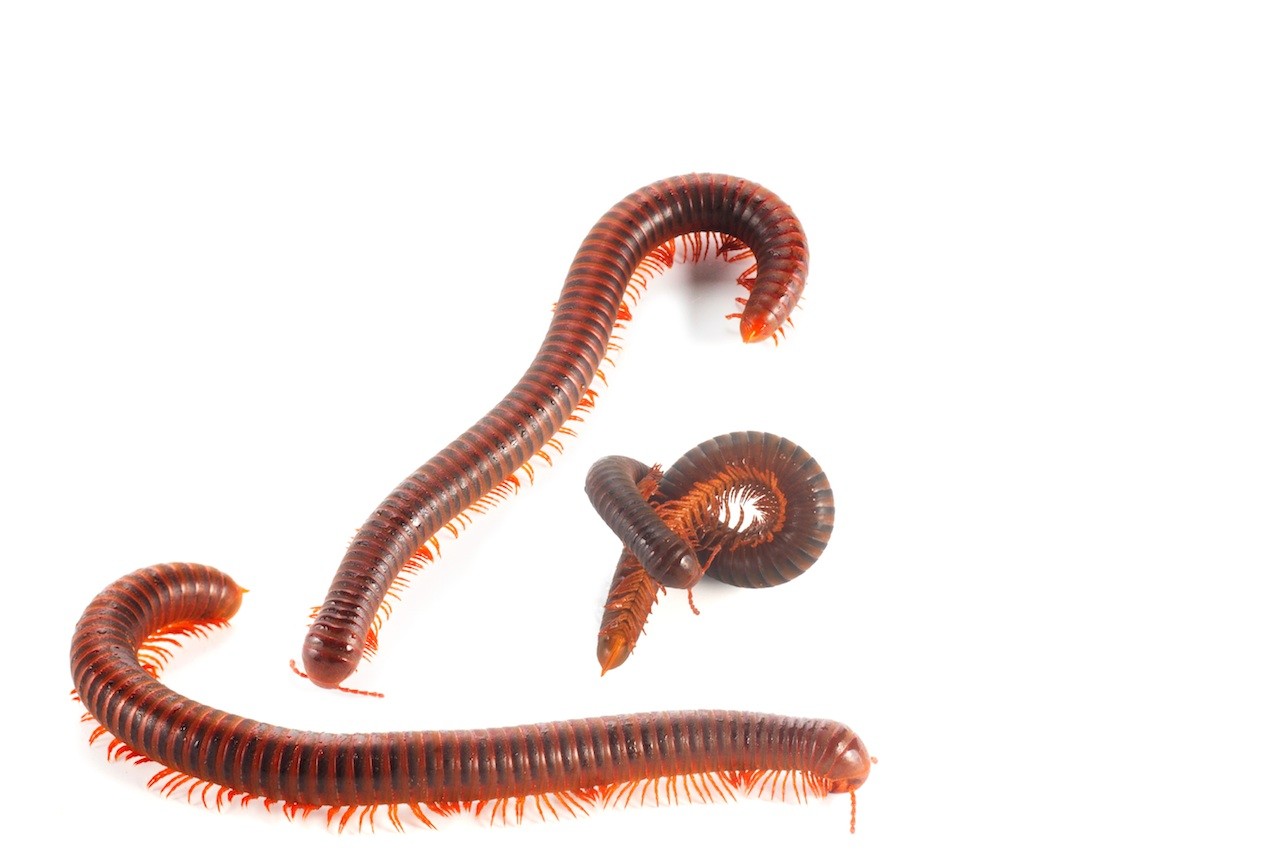 There are over 1000 species of millipedes in the United States. Most are slow crawling, appear to have hundreds of legs and will generally be gray to light brown or even orange in color . Most species take 1-2 years to reach reproductive maturity and can live 5-10 years. They love decomposing thatch, leaves and mulch. They will get nutrition from these locations and may choose a root system of a nearby plant on which to feed. When they breed, the eggs hatch larva which will feed right where they emerge. This leads to large populations or nests which can number in the hundreds. They will remain feeding as long as there is a food supply to support the nest. This could be for a year or two but at some point expect a migration.
MIGRATING MILLIPEDES
 Excessive rain, drought, over population or lack of food will cause them to migrate. This phenomenon can occur at any time of the year and may result in several thousand moving in a direction that is in line with your home.
The author has dealt with several infestations of millipedes that have numbered in the hundreds of thousands. Many customers routinely have so many they must use a gas powered blower to round up all the dead ones and will fill 10-20 hefty bags to haul them away. Infestations will routinely lead to thousands stacking up on or climbing up the side of a house. Though migrating millipedes will many times reach a certain height and stop, some will surely get inside too. But since they stink when they die, having them in the yard or worse yet in the home can present a wide range of problems. This will happen once they get up under a homes siding or inside since these environments rarely have enough “food” to allow them to live. Once they die in these areas, the odor issue can be disturbing requiring a whole other process explained in our ODOR CONTROL article.
HOW TO STOP A MILLIPEDE INVASION
Controlling millipede invasions involves a series of steps.
The first step is to identify nest sights. This will allow you to minimize the conditions these pests need which in turn will lead to less getting inside. Look to see where they are invading. In most cases, you will find them along one side or wall of your home.
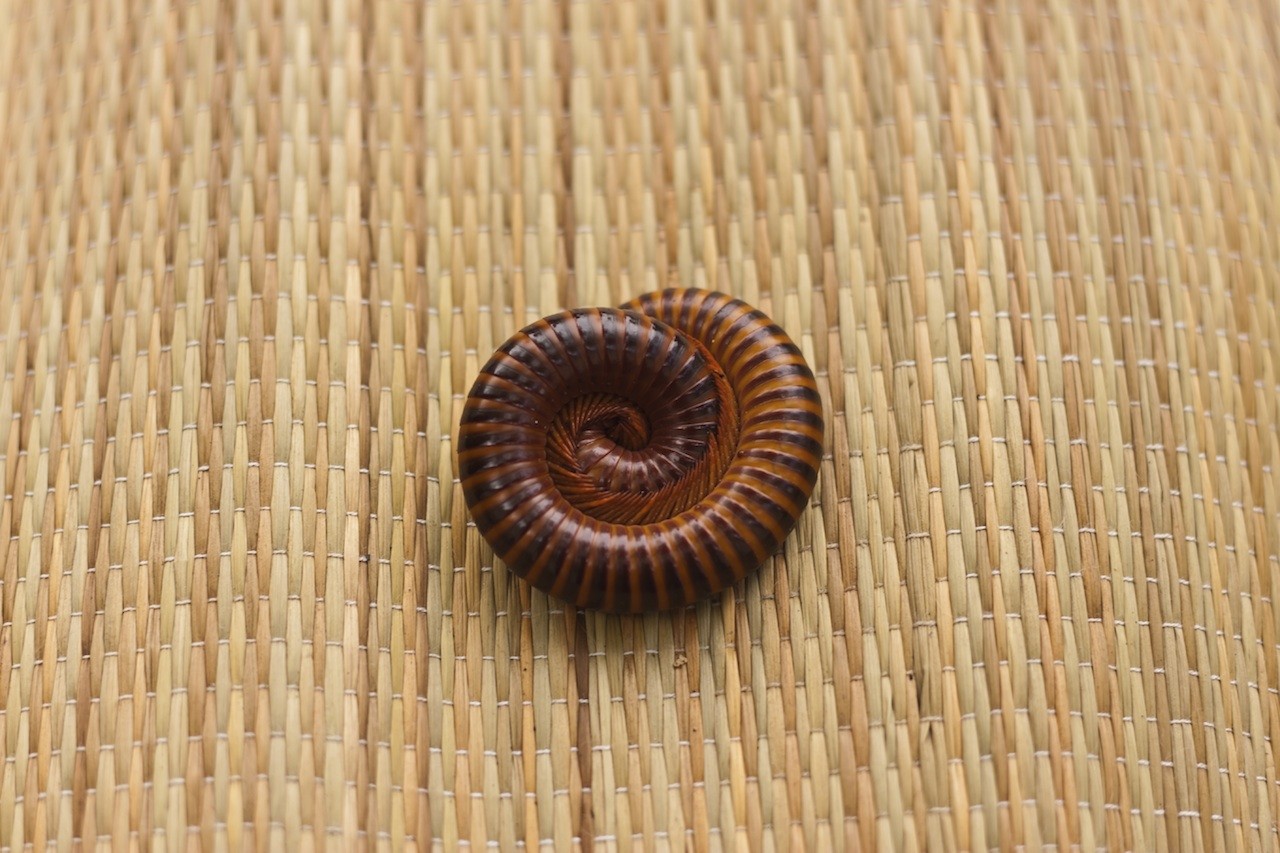 If you notice that pattern, look around this side of the property. Inspect nearby mulch, compost piles, wood piles, large rocks, pine straw, around sheds, cracks in cement walkways or driveways and stoops. Any of these locations can breed, feed and shelter these pests. If you know where they are coming from, you will be able to treat the area precisely and even remove excessive organic matter available for them.
Lastly, clean up leaves, grass clippings, compost piles and other organic plant matter. Replace old straw or hay which has decomposed. Move log piles away from the home. Seal cracks in cement which allow water to gather. Rake thatch buildup from your lawn. By reducing these conditions, you take away food and harborage these pests need for survival.
After conditions conducive to millipedes have been reduced, take a look to see how they’re entering and seal up entry ways to help keep them out.
HOW TO TREAT FOR MILLIPEDES
Now that you’ve cleaned up the yard and have insured the home is properly sealed to keep out invading millipedes, its time to treat. Migrating millipedes will move onto your home and start to nest, roost and invade if you don’t knock out the current infestation. This procedure will include the use of granules and liquid sprays. And it will take time. But after 2-4 weeks, the problem will subside if you apply enough product and after 1-2 months, it should be reduced to manageable levels. From there, treating quarterly should keep them at bay.
APPLY GRANULES AROUND THE HOME
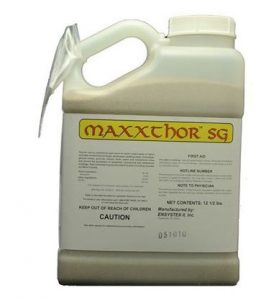
Since millipedes thrive under mulch, thatch, around plants and plant roots, you’ll need to cover your entire property with a good layer of MAXXTHOR GRANULES. This product is slow releasing but ideally suited for outside (especially under heavy thatch or mulch) and will permeate down to where the millipedes are reproducing and nesting. Keep in mind these are slow acting and should be applied monthly when millipedes are active.
Use 12.5 lbs per 10,000 sq/ft of yard. Thats about 1-2 lbs per side of the home so you should get 2 treatments from 1 jug. Apply them once a month when millipedes are active; every 3 months for prevention.


Broadcast the granules over mulch and turf. Millipedes could be focused under dead organic matter but will readily infest root balls too so leave no area untreated. Use a good GRANULE SPREADER to get even and uniform coverage.
BEST MILLIPEDE SPRAY
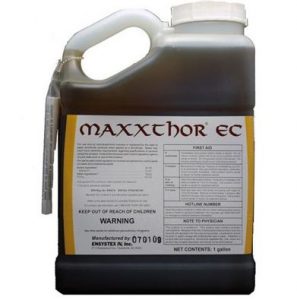
After applying a layer of granules to your turf, spray the same area as well as the sides of the home with MAXXTHOR EC. Use 2 oz Maxxthor for every 5,000 sq/ft.
To get the most of your treatment, add SPREAD-X BOOST to your tank mix along with the Maxxthor. Boost is an adjuvant, also known as a wetter spreader or spreader sticker. It basically makes water and the mixture more “slippery” so you get better coverage. Treatments will spread 2-3 times wider and penetrate deeper.
The following short video summarizes why Boost can help deliver your treatment to where it matters the most. And this is extra helpful when treating around homes with soil dwelling pests like millipedes.
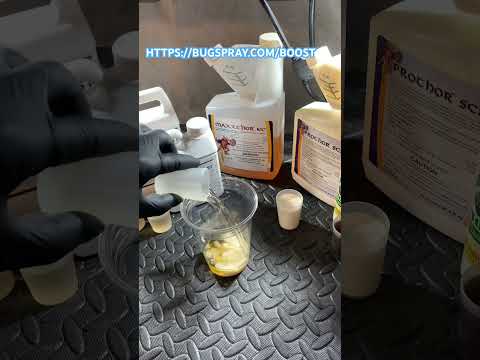
Add no more than the rate you’re applying the Maxxthor so in this case, if you’re adding 2.5 oz of Maxxthor to the hose end sprayer, add 2.5 oz of Boost too before adding water. If you’re adding Maxxthor to a pump sprayer at the rate of 1 oz per gallon, use 1 oz of Boost.
And don’t spray in the middle of the day; treat late in the day close to sunset so the treatment can dry without direct sunlight. UV light on the Boost can stress plants if the temperature is 85 degrees or higher so treat 2 hours or less before sunset to reduce sunlight stress.

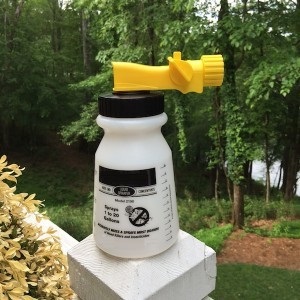
Use our 20 GALLON HOSE END SPRAYER to apply the Maxxthor. Basically you’ll add 2.5 oz of Maxxthor and then fill the sprayer to the 5 gallon mark with water to treat 5,000 sq/ft of turf.
Be sure to spray the sides of the home too covering as much of the siding as the millipedes are using. So if you see them climbing up 10 feet of the siding, treat up to 10 feet high around the entire home.
Expect to retreat as needed for the first month; this could be 2-3 times a week to hold off the invasion. But once under control, spraying every 2-3 months when you apply granules will be enough for preventive care.
ORGANIC MILLIPEDE TREATMENTS
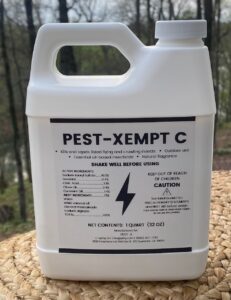
If you’re interested in using an essential oil concentrate, the only one we’ve found strong enough to deal with Millipedes is PEST-XEMPT C.
Using essential plant oils, Xempt C will kill millipedes when they’re directly sprayed. It will also keep them away by repelling them with its aroma. This smell is very “woodsy” and faint to people but insects will detect it and stay away.
Use 4 oz per gallon of water per 500 sq/ft. Apply it with any of the sprayer options listed above.


Spray as needed which might be as often as 2-3 times a week to hold off the initial invasions. But once under control, every 1-2 months for prevention.
When using the 20 GALLON HOSE END SPRAYER listed above, add 20 oz of concentrate to the sprayer, fill with water and spray the entire amount over 5,000 sq/ft of turf.
BEST MILLIPEDE SPRAY FOR INSIDE THE HOME
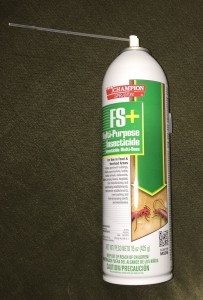
For in the home, your best option is the FS MP AEROSOL. This fast acting oil based spray should be applied into all baseboards where millipedes are known to like. Remember to keep the red straw in the crack as you treat so you deliver it where it maters the most.
FS MP will both kill on contact and repel them from coming inside. You can also take it outside to use up under home siding. Plan on retreating as needed which may be 2-3 times a week for the first 1-2 weeks.
MILLIPEDE CONTROL WILL TAKE TIME
Once you begin the process explained above, do not expect to see all the millipedes you find to be dead and gone in just a few days or even a few weeks. Most properties will take years to become infested and consequently, the treatments will take 1-3 months to penetrate all the areas where millipedes are nesting and thriving. For this reason one should compare results based on monthly activity and not daily or weekly reviews.
With that being said, the granules and liquid sprays will most definitely help you manage the activity so when they migrate, you shouldn’t have them living on the home or getting inside. But if you don’t treat the outside at least once a month, you’ll never reduce their numbers enough to stop them completely. That means if you want them gone for good, stay the course and don’t stop treating. In 3-6 months most populations will be dramatically reduced and if you keep on treating after they’re gone, you’ll never get them again.
CONTACT US
Give us a call if you need further help. Our toll free is 1-800-877-7290 and we’re open Monday through Thursday, 9:00 AM to 4:00 PM (Eastern Standard Time).
Email questions here: https://bugspray.com/about-us/contact-us
Order online and get a 5% discount! We ship fast with 99.9% of all orders shipping within 1 business day!!
Learn more about BUGSPRAY.COM and why it’s never been easier or safer to do your own pest control.
Please show your support for our business by purchasing the items we recommend from the links provided. Remember, this is the only way we can stay around to answer your questions and keep this valuable web site up and running. Thanks for your business!
Rick says
We bought our first home in Fort Worth Texas 6 months ago. In the last 3 months what we thought was just a weird appearance of a handful of millipedes has turned into 20 mins of sweeping up bugs before heading off to work and constantly throughout the evening. Everyday the problems multiply.
Thanks to this article, I’m fairly certain the large Crack and cavity under my driveway is their nest and aim to fill it ASAP, but as far as treatment I’m concerned about our 3 cats and 2 dogs who spend most of their time indoors (one of the dogs is older and having health issues). Is Maxthor safe to spray indoors around pets who spend the day inside or can you recommend something that might be safer without breaking the bank?
Tech Support says
Rick,
Maxxthor is actually labeled for use inside but we generally don’t recommend using it for two reasons. First, it has an odor. As an oil based spray, its as good as it gets for outside applications. But out there, odor goes away in an hour or two. In the home, it can linger. Its not a danger as much as just a bad oily smell, similar to WD40. So whats a good option for inside?
So first, the FS MP listed above is really your best option. It too has a slight odor but since you will only be treating cracks and crevices, there won’t be much odor present and any that is there will go away quickly. Certainly within a few hours, when normal heat or AC is running.
Now if you want something to spray inside, Bithor is your best option. Its odorless, labeled for use on carpeting and couches so safe when used properly even where people will be laying around.
Bithor: https://bugspray.com/catalog/insecticide/liquid/bithor_sc
But really what you need to do is hit that cement drive crack with the Maxxthor heavy as well as the surrounding turf. Any grass or ground cover is no doubt feeding them and so saturating the ground with both granules and spray would be best. And I’d even go to the extend of drilling through the slab and pumping the Maxxthor using our Slab Injector. It might seem like a lot of work but it would eliminate them from that location for good. More on this process can be learned about on our site here:
Cement Slab Treatments: https://bugspray.com/how-to-treat-cement-slabs
So for us, the outside treated with the Maxxthor is the way to start for sure. And then inside, at least the FS MP Aerosol. These two alone could stop the issue. But ultimately, you may need to drill the slab to end the issue for good.
Tech Support
Bugspray.com
Bob Shuler says
Hello, we have been getting millipedes in the garage under the door. We have red stone (B2) and no grass. One thing the septic tank is in front of the garage off to one side. Even without a lot of rain they are getting very active. Only a few appear in the sliding doors on the deck. Your suggestions. Bob.
Tech Support says
Bob,
Millipedes will thrive under cement since this area can harbor a lot of moisture. Add to it a close by septic tank system and you have prime millipede breeding ground. The main reason this happens is because of the ready supply of organic matter combined with the high moisture levels.
Now typically they’ll stay in the ground out of sight but if you aren’t doing any kind of preventive maintenance on the property (aka: spraying), their numbers will become abundant. And once they get too populated, they’ll start to migrate “up” and out of the ground. At this point its obvious they’re migrating and the symptom of this is you seeing them in the garage and surrounding area.
The good news is a thorough treatment with Maxxthor to the brick on the ground along with any side of the home they’re active and inside the garage will take care of them promptly. Now if you have any soil or exposed ground, get it treated with Maxxthor Granules first and then spray over the top with the Maxxthor XTS.
Maxxthor G: https://bugspray.com/catalog/insecticide/granule/maxxthor-sg-granules
Maxxthor EC: https://bugspray.com/catalog/insecticide/liquid/maxxthor-ec
Lastly, renew the liquid spray once a week until they’re gone; once a month to make sure they don’t return.
Technical Support
U-Spray Bugspray
http://www.bugspray.com
1-800-877-7290
Nan Parker says
Can the millipedes reproduce in the house? We have so many inside and never see them on the window sills or doors. Can they be coming from inside the walls through pipes around the toilet, etc.? Can they reproduce in carpeting?
Thank you.
Tech Support says
They can. Typically millipedes will exist alongside homes down in the ground, under mulch, around bushes and plants. They live just under the top soil feeding on organic matter like plants and vegetation but typically require moisture where they nest.
So if you have them living adjacent to the homes foundation and they are allowed to reproduce without any pest control treatment, they will grow in population rapidly and once this happens, you’ll start seeing them on the home and inside the house as they migrate looking for new nesting locations.
Now in general the inside of the average home will be too dry to support an active nest. But I have seen slab homes be moist enough and I’ve seen homes with enough moisture under rugs or in wall voids to harbor active millipede nests. Fortunately these problems are easy to control using the products listed in our article.
So if you want them gone, you’ll need to first apply the Maxxthor Granules around the home. Next, spray over the top of the ground as well as the homes foundation with the Maxxthor XTS. These outside treatments should be done at least once a month (sometimes more if the problem is bad) until they are under control. By controlling them outside, you’ll greatly reduce the amount seen inside and prevent future invasions as well.
Next, use the Maxxthor spray inside the home focusing on baseboards, around door ways, etc. And for any areas you can’t spray with the liquid, apply some FSMP aerosol for a quick kill and thorough treatment of any cracks or crevices where they might be nesting.
Maxxthor G: https://bugspray.com/catalog/insecticide/granule/maxxthor-sg-granules
Maxxthor EC: https://bugspray.com/catalog/insecticide/liquid/maxxthor-ec
FS MP: https://bugspray.com/catalog/insecticide/aerosol/fs-mp-insecticide-15-oz-aerosol
Use a good pump sprayer to apply the Maxxthor XTS.
Eliminator Pump Sprayer: https://bugspray.com/equipment/sprayers/eliminator-gallon-sprayer
Give us a call if you need more help. Our toll free is 1-800-877-7290 and we’re open 9:00 AM to 4:00 PM Mon-Thur, Eastern Standard Time.
Jonathan
Customer Care
https://bugspray.com
1-800-877-7290
PS: Please show your support for our business by purchasing the items we recommend from the links provided. Remember, this is the only way we can stay around and be here to answer your questions and keep our web site up and running. Thanks for your business!
Bruni says
We have a houseplant that is infested with millipedes. How can we treat the problem without killing the plant? Are these chemicals safe indoors in an apartment setting? Thank you.
Tech Support says
Most all of the products we have listed above can be used inside the home without undue risk or hazard to people, pets or any house plants. That being said, you won’t need much to do the job. Nor will you need a sprayer.
So to treat, mix 1/2 oz of Maxxthor to a gallon of water and then water your plants with the mixture like you would normally water them. The Maxxthor won’t impact the plants but it will take care of any insect pests like millipedes. This will be done as it percolates down through the soil.
I have used Maxxthor on my indoor plants to treat for aphids, fungus flies, mealy bugs and scale. And in most cases, the problem can be solved with just 1-2 waterings.
Maxxthor EC: https://bugspray.com/catalog/insecticide/liquid/maxxthor-ec
Maxxthor can also be used outside so if you find any nesting around the structure, be sure to treat them in these key locations. In most cases, indoor problems arise because the pest is getting inside so stopping them outside can really help.
Megan L. says
I have lived in my house 6 years. I work nights. I came home the other morning and when I was pulling up I thought I had black spots on the side of my house. When I pulled into the driveway I noticed more spots on my garage door. When I got close I realized it was hundreds of millipedes. I am only finding like 10 a day in the house but I’m really worried about the number on the outside of the house. They seemed to be even making it on the room. HELP!
Tech Support says
If you read the article above, you’ll learn that if left untreated, millipede populations around the home can get huge. And once they get huge, they’ll start migrating throughout the property every spring and summer.
During these mass migrations, anything in their way will get covered and ultimately, infested. So if you don’t start treating the outside area of your home as explained in our article above, it will only be a matter of time before you’re seeing a lot more than just 10 a day inside the structure.
Fortunately, the treatments we’ve highlighted above can be very effective. Basically it’s a combination of Maxxthor Granules and Maxxthor XTS. Apply the granules around the home treating mulch, flower beds, grass and basically, any kind of exposed ground you have on the property.
Maxxthor G: https://bugspray.com/catalog/insecticide/granule/maxxthor-sg-granules
Next, spray the same areas with Maxxthor XTS. Be sure to saturate the ground and the homes exterior too.
Maxxthor EC: https://bugspray.com/catalog/insecticide/liquid/maxxthor-ec
Lastly, repeat whenever you see them come back or at least once a month for the first year. With any luck, this pattern will kill off enough in the ground so the local population will drop to levels which prevent future migrations of this magnitude. And after the first year, if you’ve reduced them enough, you should be able to go 2-3 months in between treatments without having them get re established.
Chris says
Thanks so much for the information. Is Maxxthor safe for pets? I want to use as strong as a product I can to try to control/eliminate the problem without harming my dogs.
Tech Support says
All the products we sell can be safely used in and around the home and will pose no hazard to people or pets when used properly. We also have excellent safety video’s for all our products which explain everything you’ll need to know so you mix, handle, apply and store everything correctly. Each video is designed for the type of product like a granule or spray and can be viewed here:
Product Safety Videos: https://bugspray.com/safety-first-videos
Chris says
We have lived in our current home for the past 25 years. Within the past seven to ten years, we have been inundated with millipedes and can’t seem to get rid of them. They appear to be worse around the garage and foundation of our home (hundreds). Every morning we are cleaning up the dead ones. I do have a lot of shrubs/mulch around our house. Do you think this is contributing to the problem? We also live near a creek. Can this be contributing to the problem also? This year has especially been worse. We have been trying to control them with sevin dust, which seems to help the problem temporarily. They are also getting into the basement of our home.
Tech Support says
First, I suggest you review our article above which explains in detail how this pest can live in great numbers outside the home and from there, launch massive migrations which enable them to get inside. These migrations typically happen when it’s damp during the spring, summer and fall. Basically what you’re seeing are young adult millipedes leaving their nests seeking new locations to start new colonies. And when populations are dense, these migrations can involve thousands and thousands of millipedes making their activity messy and even smelly.
Second, no doubt vegetation close to the home can be a a big help to their cause as will mulch and thatch. And the nearby creek you mention could very well be the source of water enabling them to thrive even if you’re in a region that has a drought. The good news is you can knock them out if you treat with the products listed above and the most important ones for you will be the Maxxthor Granules and Maxxthor Spray listed above.
So to start the process, apply Maxxthor Granules over as much turf, mulch and flower beds as you can. Basically your entire property. And get used to doing this monthly for the next 6-12 months. This will really help reduce their numbers where they’re no doubt living and thriving.
Maxxthor: https://bugspray.com/catalog/insecticide/granule/maxxthor-sg-granules
Next, spray over the top of this same area with Maxxthor Concentrate. Use the Hose End Sprayer we have listed to insure good coverage.
Maxxthor EC: https://bugspray.com/catalog/insecticide/liquid/maxxthor-ec
Hose End Sprayer: https://bugspray.com/equipment/sprayers/20-gal-hose-end
If you stay the course as explained above, you will eventually reduce the local millipede population enough to where you will have very few if any getting on the home or inside. The key will be using the right products and using enough of them.
Molly says
We have property in the finger lakes and have been battling millipedes for the last three years. They usually disappear after a few weeks. This year they came early in the spring and won’t leave. They have moved from the basement to the first floor. I was told Talstar Pro would work, but I have sprayed three times and still have them getting in. We have sealed all cracks, only have fine gravel around the perimeter of the house. Help.
Tech Support says
Talstar can be effective but if you review our article above, you’ll learn that what you really need to do is get them in the yard, from where they’re migrating, and that it will take a lot of Maxxthor Granules first with either your Talstar or Maxxthor sprayed over the top. Additionally, you’ll need to spray the exterior of your home too. This process will involve using several gallons of finished product per application (like 3-5 gallons) so don’t be shy about applying it since a lot will be needed to control this pest.
Maxxthor G: https://bugspray.com/catalog/insecticide/granule/maxxthor-sg-granules
Maxxthor EC: https://bugspray.com/catalog/insecticide/liquid/maxxthor-ec
This should be done every month during the warm season which will depend on where you reside but in general, a good 6-8 months per year. Ultimately, if you treat enough outside, you’ll reduce their numbers in the ground so that when they start their migrating patterns, there won’t be that many making it to your home.
Lastly, spraying every crack and crevice inside the home with FS MP will help.
Here are links to these items in our cart. Please show your support for our business by purchasing the items we recommend from the links provided. Remember, this is the only way we can stay around and keep this valuable web site up and running. Thanks for your business!
FS MP: https://bugspray.com/catalog/insecticide/aerosol/fs-mp-insecticide-15-oz-aerosol
Hoy Chan says
I just moved into my new home about 3 months ago. Like everyone else in this forum, I have a millipede problem. I’ve tried using the Ortho Home Defense Spray and sprayed the outside of the home around the perimeters and inside the house. I don’t think the Ortho is doing any good. I sprayed one directly on contact and it looks like it was going to take it forever to die. The millipede ended up underneath my sandals after a few minute. Is there any other home defense beside Ortho? It also sucks because I have a deck right in my back yard connected to the home. What are your recommendation to getting rid of this creature and where do I start? Thank you. Neighbors don’t seem to have this problem besides me. Why?
Tech Support says
As explained in our article above, millipedes will live in the soil and over time get bunched up with dense populations that can reach hundreds of thousands in a very small area. Once they hit a certain level, they’ll start migrating up and out of the soil. During this migration, they’ll follow a very distinct pathway and no pesticide will be able to kill them quickly when they’re moving. It’s during these migrations that people find out they have a problem and obviously you’ve got a major one that must be treated thoroughly if you want the invasion to end.
For starters, give up using anything you can find at a local retail store. Those products just aren’t strong enough to handle millipedes. Instead, get what pest control companies use (the items we sell) if you want the best results – especially when it comes to millipedes.
Second, attack them where they’re living which is the soil around the home.
Now if you review our article above, you’ll learn exactly what the professionals use for millipedes and how to apply these items. As the article says, the best products to use is the Maxxthor Granules and Maxxthor Spray. So if you apply Maxxthor around your home every month and spray twice a month, you should be able to reduce the local numbers enough to where eventually you won’t be seeing any. But it will take time and it will take a lot of treating. Also, you will somehow have to get under that deck you mentioned because you can’t leave any area untreated around the home when it comes to millipedes.
Maxxthor G: https://bugspray.com/catalog/insecticide/granule/maxxthor-sg-granules
Maxxthor EC: https://bugspray.com/catalog/insecticide/liquid/maxxthor-ec
Echo says
The last 2 weeks I have noticed these milipedes in my cottage. This is the first time in 10 years I have ever seen these bugs in my place. The problem is since the weather has been so hot and humid the creek next to my place has really dried up. The other day I did apply boric acid around the inside walls of the entire place. What I do notice is they seem to come in the cottage more in the evening and early hours as the air conditioner seems to attract them. Not sure if that is accurate or just an observance. Because I do have a creek next to my home and a lake in the front, what do you suggest the best method of attack? Please help because I have the hebegeebies.
Tech Support says
Boric acid won’t work on millipedes so you might as well vacuum up all you’ve applied and start anew. And what will work is listed above. That would be the Maxxthor Granules applied to the turf and then a good spraying with the Maxxthor EC.
Maxxthor G: https://bugspray.com/catalog/insecticide/granule/maxxthor-sg-granules
Maxxthor EC: https://bugspray.com/catalog/insecticide/liquid/maxxthor-ec
Now if runoff from rain that comes down on your home will feed the treatment to the lake or the creek you mentioned, go with the Pest-Xempt C. It’s made from food grade actives and won’t hurt any water way in case the runoff is a concern.
Pext-Xempt C: https://bugspray.com/exempt/liquid/pest-xempt-concentrate
Lastly, the FSMP should be applied to any crack or crevice inside the home where you’re finding millipedes active. Additionally, baseboards can be sprayed with either the Maxxthor or the Essentria concentrate.
Worth mentioning is that the only trade off between the Maxxthor and the Pest-Xempt is that the Maxxthor will last 2 months per application where as the Pest-Xempt just a month.
Marie Grunden says
I have lived in my home for 20 years never had a problem with millipedes until 3 yrs ago. Then it was like I had millions of them. I had an exterminator come and spray which decreased the number greatly. Again this summer I am overrun with the millipedes. I think they are living in the dirt near my garage doors, its black shale type dirt that is moist most of the time due to an overhanging deck floor. What would be my best means of destroying these things?
Tech Support says
Start with the Maxxthor Granules. Apply them to the turf and do this monthly for the next 3-6 months. Next, spray over the top with the Maxxthor Spray and make sure to treat your foundation heavy too. Over time you’ll eliminate enough outside the home which will eliminate the ones entering.
Here are links to these items in our cart. Please show your support for our business by purchasing the items we recommend from the links provided. Remember, this is the only way we can stay around and keep this valuable web site up and running. Thanks for your business!
Maxxthor G: https://bugspray.com/catalog/insecticide/granule/maxxthor-sg-granules
Maxxthor EC: https://bugspray.com/catalog/insecticide/liquid/maxxthor-ec
Debra sturdevant says
Is the Maxxthor safe for pets who roam outdoors? We also have free range chickens who seem to dislike the bugs as well otherwise we would have natural bug control!
Tech Support says
@Debra sturdevant: Go with the Pest-Xempt C for outside the home. It uses food grade active ingredients which won’t impact animals that might feed on some.
Xempt C: https://bugspray.com/exempt/liquid/pest-xempt-concentrate
Tech Support says
@P.T.: First and foremost, odors can have a wide range of impact on people. Decaying odor, like that released from dead or migrating millipedes, has been reported as making people feel ill. But it’s not lasting or unhealthy and though annoying and in come cases nauseating, it will pass.
As for odors from pesticides; these can be more hazardous if someone is exposed to certain products for extended periods of time. This can happen when treating with aerosols inside the home. This is also why we recommend most treatments for millipedes to be done outside and in fact, very little if anything should be applied inside even if you’re seeing some like you describe. Stick with the “vacuum only” approach inside and spraying outside which in the end will work fine.
By using this approach you’ll both minimize and even eliminate exposure to the people living in the home and in fact you’ll even solve the problem faster. The main reason for using this approach is to address the millipedes where they are living. As explained in our article above, millipedes thrive under grass clippings (make sure you’re removing and recycling grass clippings! This is a major contributor of millipede problems), lawn thatch, pine straw and other mulch. And if you leave the millipedes to live as they please, they will populate to extreme numbers eventually migrating all over the property. And it’s this migration that leads to them getting inside homes. Based on the millipede live cycle, it only makes sense to get them where they’re nesting and this means mostly if not only outside treatments are needed.
So for now, I suggest applying Complete Insect Killer Granules to the lawn and mulch areas of your property ASAP. Millipedes will feed year long and though they tend to slow in the winter, mild temps mean they’ll be more active which in turn leads to bigger numbers and larger migrations come the spring following a mild winter. I have family in upstate NY and they are reporting a mild winter which leads me to believe the millipede migrations this year will be big.
After applying the granules, spray over the top with Cyonara RTS. This will provide the quick kill needed to knock down existing millipedes. The granules will provide 1-2 months of protection so if you treat now, you’ll want to do another application around the end of March and then again in the beginning of May. Treating for millipedes during the first six months of the year can really cut down on how many you see so the time to strike is now. With any luck, you won’t see them the second half of the year if you do a good job now.
FYI, I’m listing different granules and liquid from our article because the Maxxthor isn’t registered for sale into your state but the Complete and Cyonara will work just as well. And they’re odorless so they’re better suited for use around your home. Here are links for these two:
Lawn Granules: https://bugspray.com/catalog/insecticide/granule/complete-insect-killer-granules
Cyonara RTS: https://bugspray.com/catalog/insecticide/liquid/cyonara-32-oz-rts