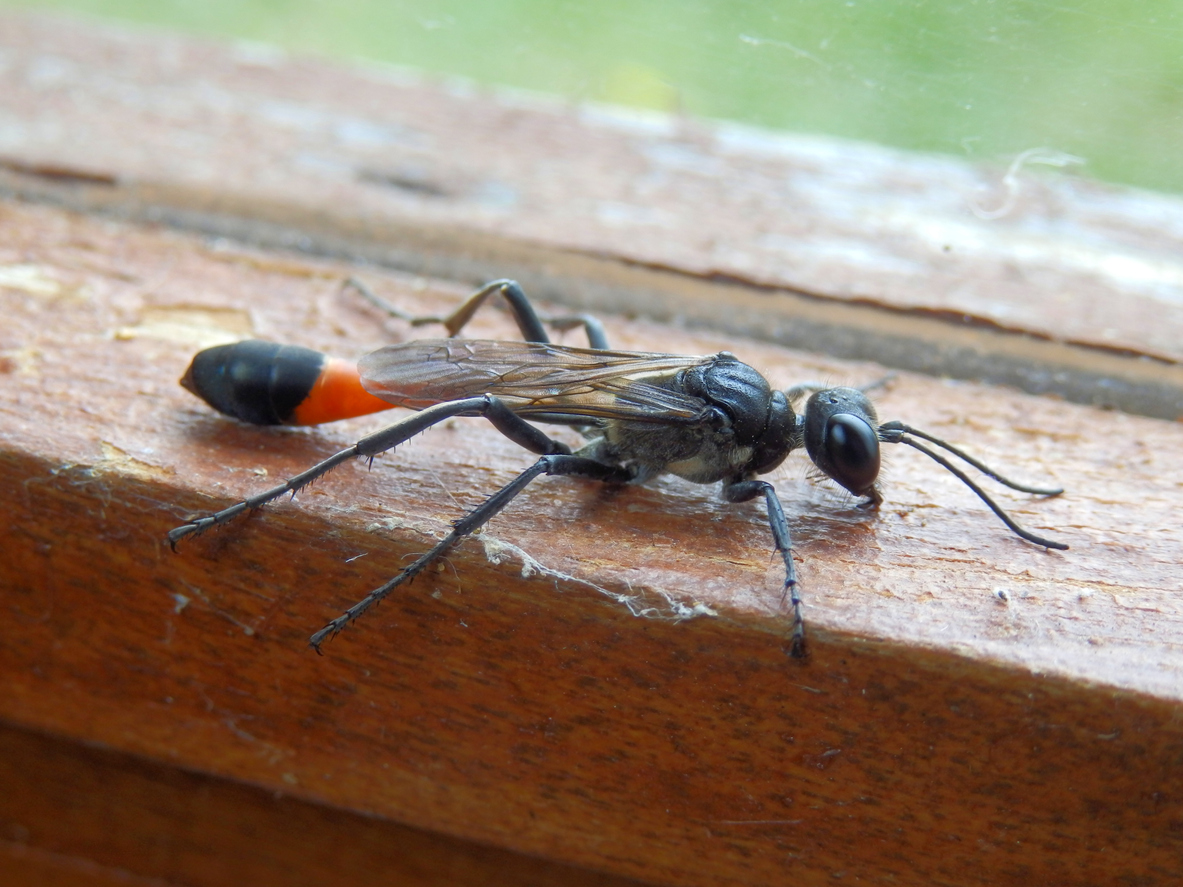
Every spring and throughout the summer months, many different species of wasps and bees will emerge from lawns and turf. They have been in the ground all winter developing in the third stage of being an insect called the pupa. As the soil warms, pupa hatch. Adult bees and wasps will emerge, begin to look for good nest sites and quickly dig their new homes.
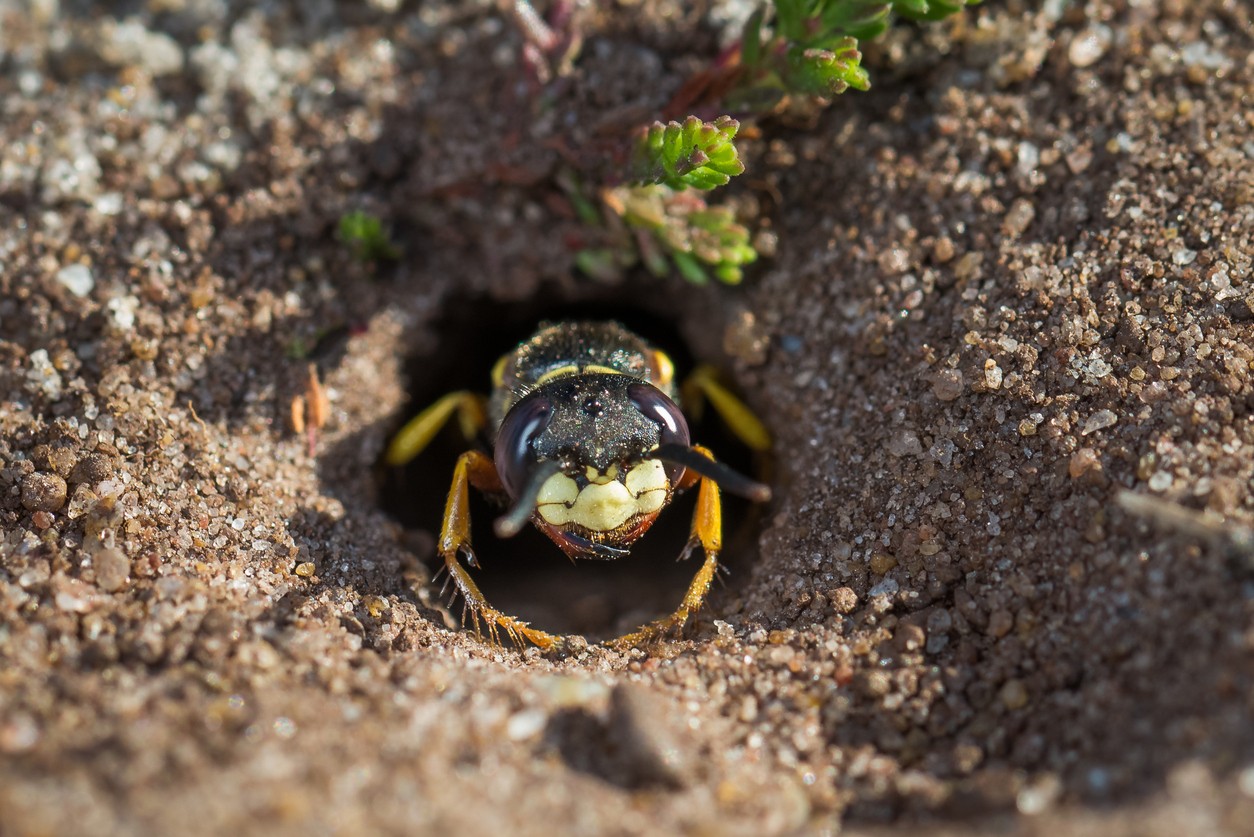
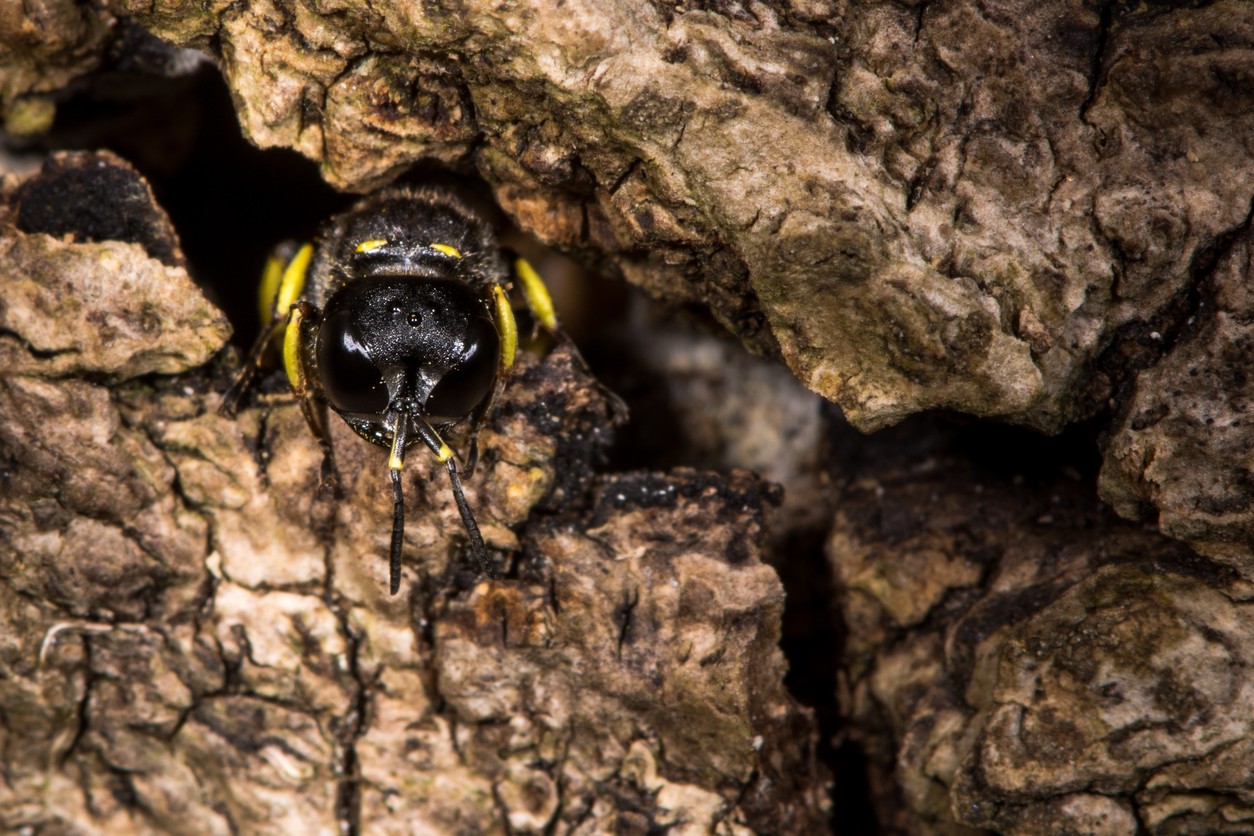
Digger wasps come in all sizes and colors. Some are yellow and black striped, black, blue, brown, white and orange, yellow, and probably mixes of all these colors. In general, they will use the same area of the yard over and over until you get rid of the local population. Because the young are deep down in the soil developing most of the year out of sight, its easy to misunderstand where they come from and how to best control an active population. This article will help explain their behavior as well as list the best products available for controlling an active or on going problem.
DIGGER WASP BIOLOGY
Most all of digger wasps have common behavior which make them easy to control and understand.
- Nearly all are solitary. Although it appears you have thousands of “nests” in the yard, in fact they are all independent nests owned by different wasps.
- Most like to fly around their “airspace” at different times of the day or season. This may have something to do with mating, air temperature or simply staking territory.
- Most are not too aggressive, but stay clear of them. One never knows if they may be allergic to a certain sting or venom. Don’t let children or pets play around nest sites.
- The first year these pests start to nest in a yard, they usually go unnoticed. It is easy to miss a few holes. Every year this will grow exponentially. Within 3-5 years, expect to have several thousand!
- Although nests may be under pine straw or wood chips, most species prefer to dig on bare ground between grass and plants, through cement mortar joints and even under walkways. Holes are easy to mistake for worm castings and usually come from hatching pupae down in the ground left from the previous seasons egg laying.
- Most are predatory feeders foraging for grubs, small flying insects and ground dwelling pests. It’s not uncommon for nest sites to be established in a yard which has little food supply. Because they can fly, food can be found in adjoining property. Nest locations may only be taking advantage of the free place to live without offering any help in controlling your pests! Once food is found, it is stung to death, brought back to the nest and buried. Eggs will be laid on it, in it or close to it so that hatching larva will have a ready food supply.
- Some are pollen or other organic food feeders; not all are predatory.
- Most nest sites tend to be where sunlight, moisture and soil density meet some requirement they like. Once a nest site is started, expect it to expand each year and become larger and larger. Although nests are abandoned each year, the same area will be used. This happens because digger wasps leave special pheromones used to mark good locations for making nests. These scents will attract new queens looking for good nest sites as well as keep hatching young around. New nests will be made adjacent to old nests and most old nests fill in over the winter.
- Expect populations to vary from year to year, based on things such as the severity of the past winter, local insect levels, rain patterns, humidity and temperature.
- Most live a full year, emerging from pupa stages in the spring, building nests, laying eggs and then dying in the fall. Their offspring will emerge next year to continue the cycle.

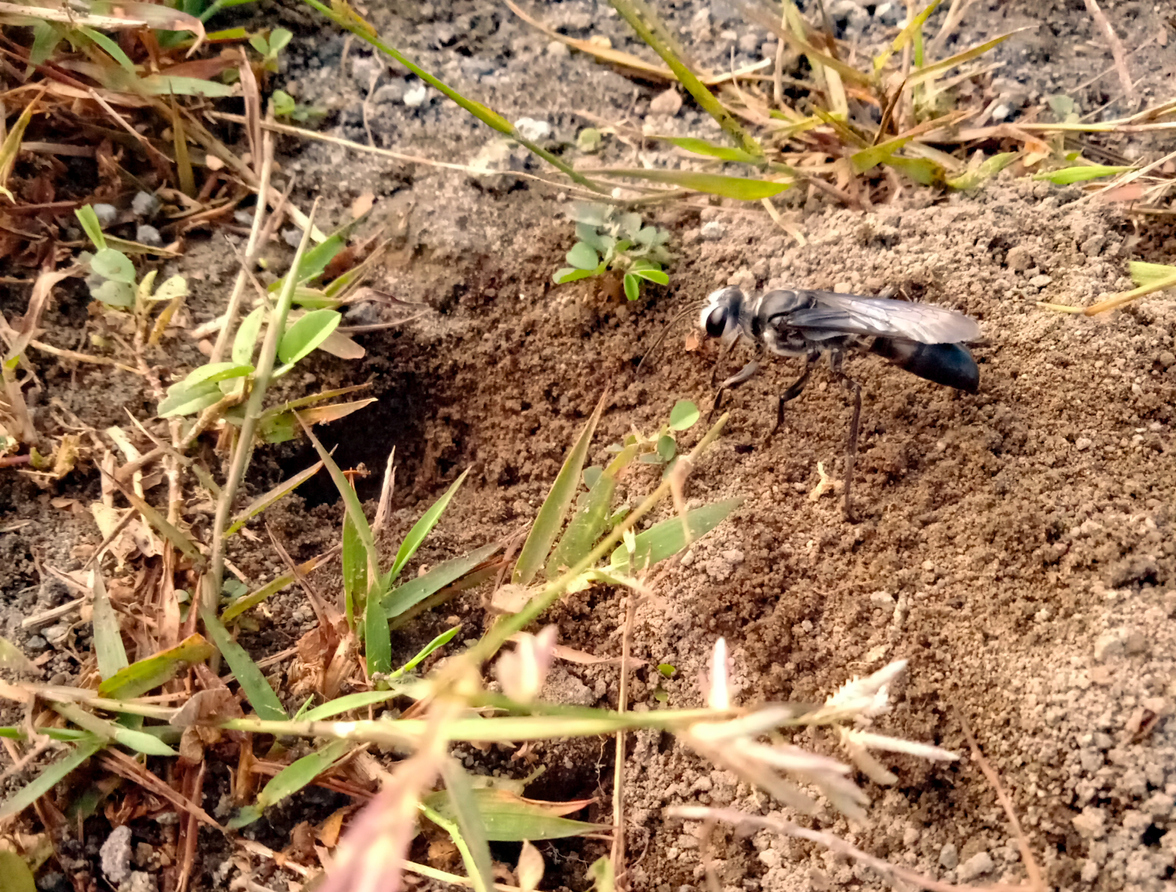
Digger wasps are not desirable pests for several reasons.
- Most people fear their presence. Although they usually will leave you alone if you don’t bother them, nests pose a hazard when built in play areas of the yard.
- Infestations will start small and rapidly grow. If you have a nest or two, expect to have several more in the next year. This will quickly grow out of control if left alone to develop and eventually render the yard unusable.
- Nest sights will become unsightly. It is not uncommon for thousands of holes to be created within a few thousand square feet.
- Large nest sites are scary when the species nesting goes into their hovering activity. During these times, you will expect to have thousands of them flying low to the ground, around 1-3 feet high, simply flying in circles. Be sure to keep children and pets away during this activity.
- In every case, small infestations will eventually get too large and move into areas of the yard where you don’t want them. Be sure to prevent this by taking care of initial infestations before they grow.
Once you have found the general nest sight, control is easy to do and very effective. All you need to do is treat an area slightly larger than where they are nesting. Here are your options based on level of activity and area to be treated.
DUST DIGGER WASP HOLES FOR IMMEDIATE CONTROL
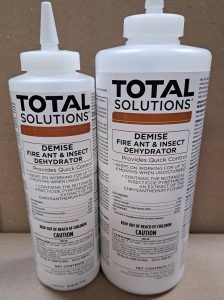
The fastest way to kill an active nest is to dust it with DEMISE DUST. This dust works as a desiccant and will dehydrate all active stages in a few minutes. Treating any hole is simple and takes just 3-5 seconds. Most holes require 1/4 oz of dust if not less so just a few “puffs” and the hole will be properly dusted.
Demise is perfect for this need and can last long enough to kill hatching eggs emerging during the summer and fall. A small jug of Demise will treat 25-50 holes; the large size 75-150.


You will need a good HAND DUSTER to apply the Demise. This one will work well and though it can hold 3-4 oz, we recommend only filling it half way to get it to work best.
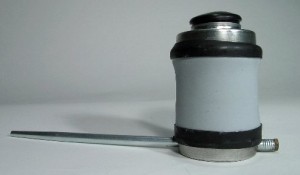
For best results, dust holes in late evening, just before dark. Don’t panic if anything comes flying out. Wasps which get dusted will generally try to flee the nest but they will be totally blind and not able to defend themselves so if they are able to fly, they will take to the air and leave never to be seen again. But often times they can barely crawl out of the nest and if they do get out, its not unusual to see them die right there on the ground.
One of the big benefits of using Demise is that it will help absorb digger wasp odor and pheromones which indirectly helps by preventing new wasps from finding the area.
WATCH FOR NEW NESTS AND DUST AS NEEDED!!
When dusting new holes in the yard, its important to understand that every day there will be pupae hatching replacing the wasps that die from your treatments. This happens for about 2-4 weeks every spring and early summer. Basically there are a bunch of pupae in the ground from last years nests which over wintered. These pupae will release the adults every spring and summer and when they emerge, their goal is to mate and continue their species by creating new nests in your yard.
So when you dust, you will be killing the currently hatched population. The dust will take effect immediately but in general, its not uncommon to see new holes within 5-7 days as more pupae hatch. THIS DOESN’T MEAN THE PREVIOUS TREATMENT DIDN’T WORK; IT JUST MEANS YOU NEED TO DUST AGAIN!!
HOW TO TREAT LAWNS OR MULCH WHERE NESTS ARE NOT VISIBLE
Digger wasps love to make nests in pine straw or wood chips making it impossible to see the actual nest. Thick thatch can also cover their entrance holes making for ideal cover and protection. But if you can see wasps hovering just over the ground in certain areas of the yard, watch carefully and you’ll probably see some going down and into the ground.
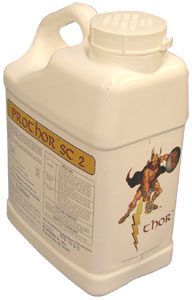
For such areas, dusting can be near impossible. Fortunately we have a spray that can really help. PROTHOR is a new generation, slow working non-repellent chemical which means the digger wasps won’t know its been applied. By spraying over these areas, you’ll put in place a barrier that will kill them in 2-4 days following the treatments.
Commonly used on turf for controlling a range of grubs, Prothor is odorless and essentially not detectable by insect pests. Plan on using .5 oz per 1,000 sq/ft of turf. Spray in the evening, just before dark, and plan on making 3 treatments in a row over the same area, three evenings in a row.
The following video gives a good summary on what to expect when using Prothor so what it to be best prepared for the followup needed when dealing with a bad problem.

If it rains that’s fine but don’t treat if its raining; just skip that evening and treat the next available evening. Treating 3 times ensures you get proper penetration and coverage since foraging wasps will “carry” the active down into the nest affecting all developing members deep inside the tunnels.
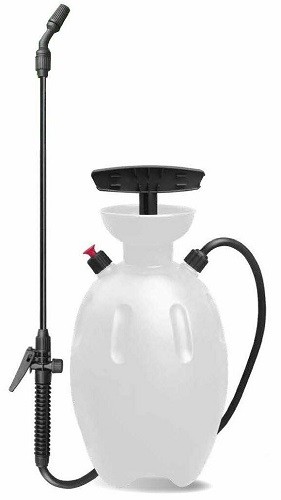
Apply Prothor using a good PUMP SPRAYER. Remember, 1 gallon of mixed material for every 1,000 sq/ft.
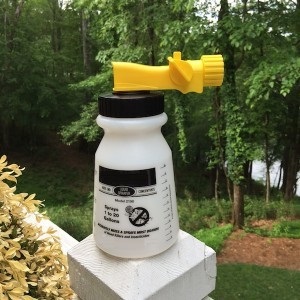
For large yards, use a good HOSE END SPRAYER. Using our sprayer, you’ll need to add 2.5 oz of Prothor to the tank and then fill it with water to the 5 gallon line. Next, hook it to your hose and apply the contents over 5,000 sq/ft of turf.
DIGGER WASP PROBLEMS CAN TAKE TIME TO RESOLVE
Digger wasps will return to good breeding grounds from year to year because they can “smell” such locations; lawns with problems will need a thorough dusting and/or spraying at least one year to knock out the current activity. Moving forward, spraying Prothor in early spring will ensure new nests don’t form.
Also remember digger wasps can “flare up” in the fall. This is especially true if you have a warm summer or if you reside in a mild region. These fall flare ups are related to hatches deep down in the ground as a direct result of early spring egg laying. So if you notice some coming back in the fall, get out there and treat them too. Fall is an important time to treat because late summer treatments will be killing adults which are trying to lay more eggs. This means you can have more of an impact on breaking their cycle with these late summer applications.
Digger wasps will commonly infest most any yard. If left alone to grow and grow, their nest sights will soon take over a huge amount of your property. Their activity is unnerving to people and pets and though they tend to avoid confrontation, they can sting.
CONTACT US
Give us a call if you need further help. Our toll free is 1-800-877-7290 and we’re open Monday through Thursday, 9:00 AM to 4:00 PM (Eastern Standard Time).
Email questions here: https://bugspray.com/about-us/contact-us
Order online and get a 5% discount! We ship fast with 99.9% of all orders shipping within 1 business day!!
Learn more about BUGSPRAY.COM and why it’s never been easier or safer to do your own pest control.
Please show your support for our business by purchasing the items we recommend from the links provided. Remember, this is the only way we can stay around to answer your questions and keep this valuable web site up and running. Thanks for your business!
Barb says
We have these in the yard where we keep turkeys. They turkeys are pets and will not be eaten, but will the Demise dust hurt them?
Tech Support says
Barb,
It will not pose a hazard to your turkeys or family. In fact Demise is labeled for use on the top of turf for pests like fleas and can be used people and pets are active. In this case, you’ll be dusting down holes so if done properly, there will be nothing up top for them to touch anywhere. But even if they did it will not do anything to them.
Technical Support
U-Spray Bugspray
http://www.bugspray.com
1-800-877-7290
Brandon Kester says
This is great because my family has a lot of Digger wasps every year so know that I found a solution my family can have more friends over!
Becky Brooks says
This information was helpful. My neighbors have had these for the last 3 years. They hired a pesiticide company for 2 years that didn’t sovle the problem so they decided to stick with irrigation. They found a home remedy using amonia. But more came back, I just found 2 nests in my yard. These wasps are the biggest wasps I’ve ever seen, and they are not aggressive but I’m allergic to bees and have always gone barefoot in my yard so now I’m concerned. I have 2 dogs who dig as well…and they chase bees….so I need to know what to do. My neighbors heard these infestations last 7 years so they think it will end in a few years. Is this true, or will they continue to get worse if we don’t act more comprehensively across all neighboring yards (where children play in the grass a lot)?
Tech Support says
Digger bees and wasps will get worse year after year if left to do as they wish in your yard. And since they appear throughout the United States, you can’t worry about neighboring yards or fields; focus on keeping your yard free from nests as this is a reasonable goal and easy to accomplish. And in doing so, you can provide a wasp/bee free environment where you can walk barefoot, let your kids play and your pets wander without need for concern about them getting stung.
Now if you have true digger bees or wasps, you’ll notice 50-100 active nests at any one time. And the residents of these nests will be small. These nests are easy to control using the methods listed above.
But based on your report that the wasps you see are the “biggest” and that you only have two nests in your yard, I’m willing to bet you have cicada killers and not common digger wasps or bees.
Cicada Killers are still wasps but because of their size, require a slightly different approach when wanting to treat. In our experience, the Demise Dust method is best. More details on how to do this can be found here:
https://bugspray.com/articles99/cicadakillers#cicada-killer-dust-treatments
The video in our article (follow the link above to see the video of us treating a nest) shows just how easy it is to do the treatment and if you act now, you should be able to knock them out for good before they take over your lawn. As our article explains, a yard will commonly get 1-2 the first year, 5-10 the next year and 25-50 the next year, etc. In other words, things can get out of control quickly if left untended.
As for infestations lasting 7 years? There is no information to substantiate that claim. What we know is that cicadas (the food on which cicada killers breed on) will be active every year to some degree. No doubt there are cicada cycles (some are every few years, some every 7 years, some every 14 years, etc.) where they appear more in one year compared to other years. But because they will be active every summer, so too will cicada killers. And in years where there are more cicadas, the cicada killers will be more active too.
Here are links to the items you’ll need to control this problem promptly and easily. Please show your support for our business by purchasing the items we recommend from the links provided. Remember, this is the only way we can stay around and be here to answer your questions and keep this valuable web site up and running. Thanks for your business!
Demise Dust: https://bugspray.com/catalog/insecticide/dust/drione-demise-dust-6-oz
Hand Duster: https://bugspray.com/equipment/dusters/crusader