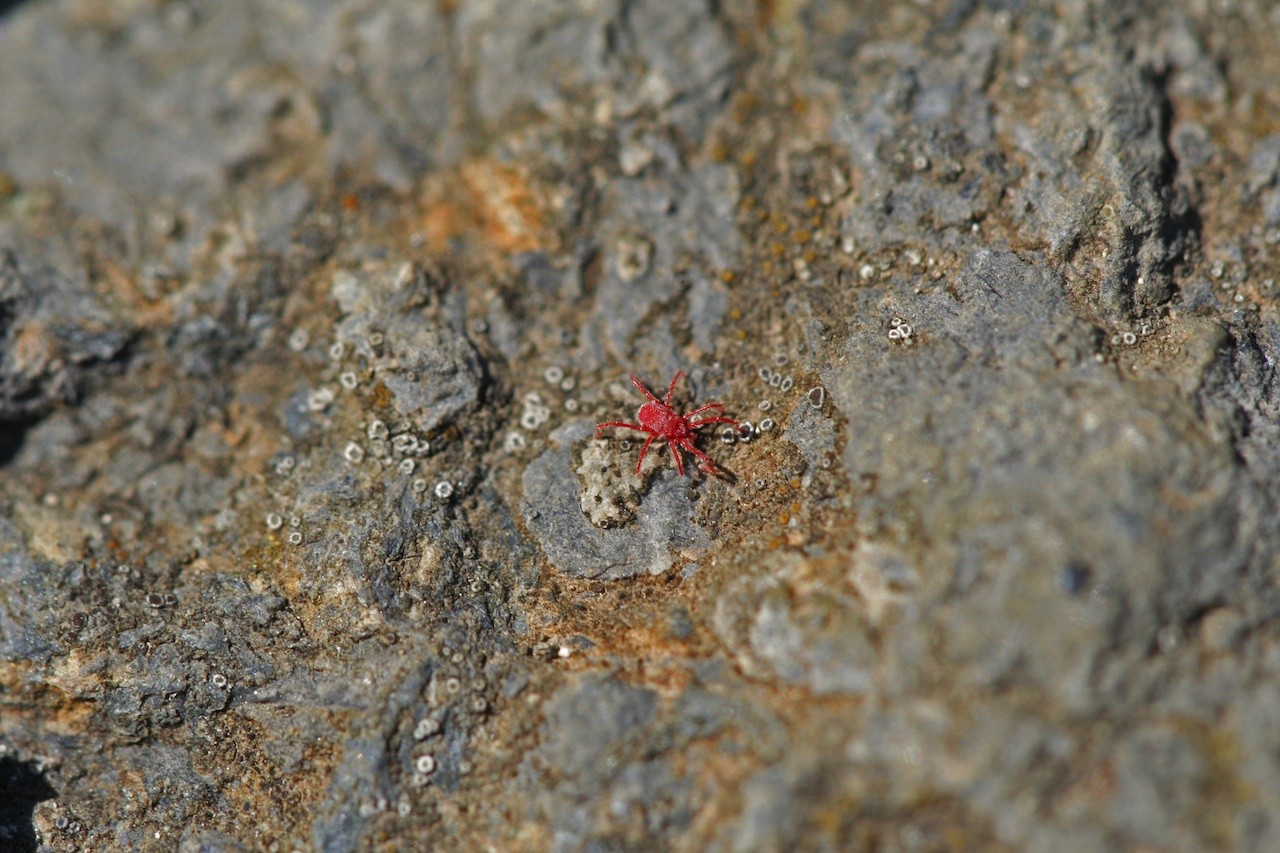
Spider mites are small, light brown to bright red arachnids which exist throughout the United States. They are very small – smaller than a poppy seed – and are many times confused with clover mites or chiggers. Unlike clover mites or chiggers, most all spider mites will turn bright red in color making them both “messy” and highly visible.
Related articles: CHIGGERS CLOVER MITES DUST MITES STRAW ITCH MITES
SPIDER MITE HISTORY
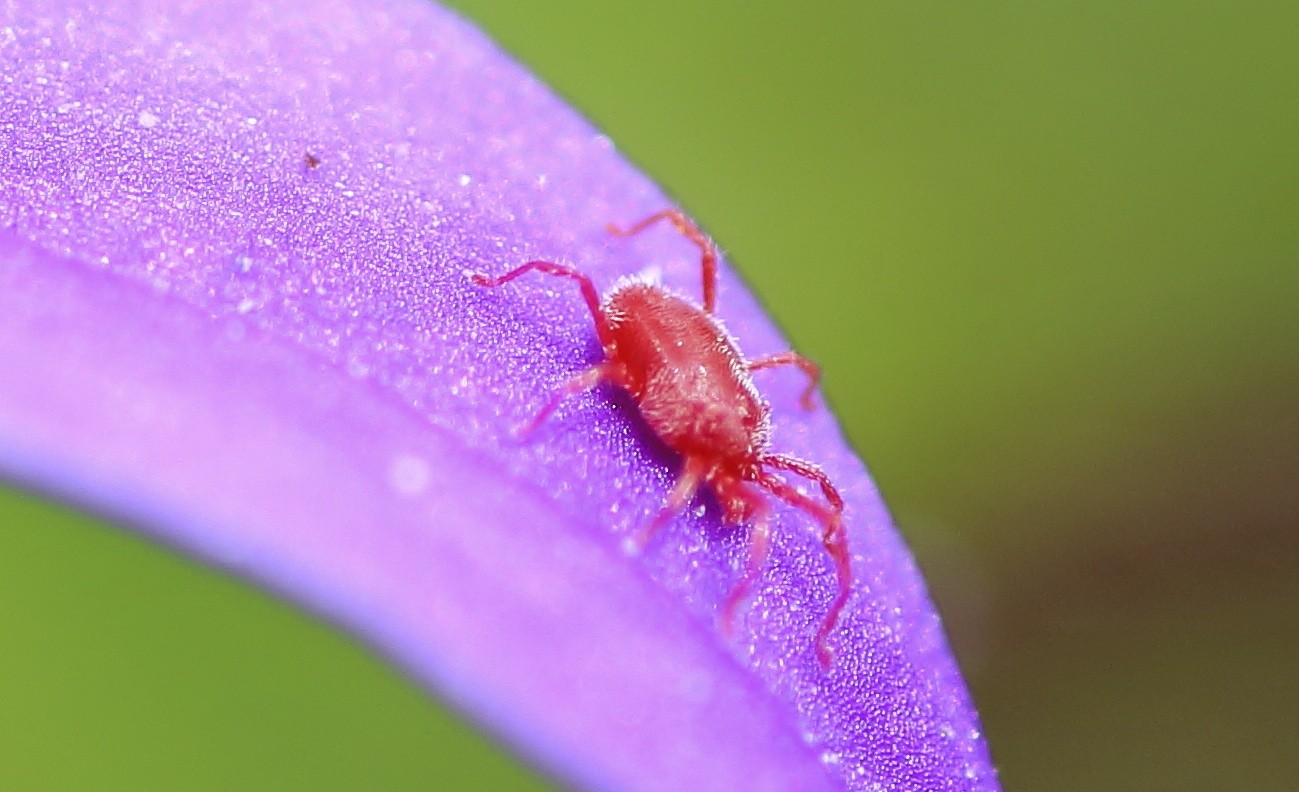
Spider mites have long existed outside in the landscape living their lives amongst the plants where organic matter thrives. They would infest cotton, corn and other food crops causing enough damage to ruin the harvest. Awareness and treatments for this pest has enabled farmers to control populations, but the spider mites have remained persistent. They are now common around the home choosing to live on any plant or shrub available. Juniper, arborvitae, succulents and pine trees are common hosts, but just about any vegetation will do.
In recent years, spider mites have found their way onto and now inside the home. The increase of indoor plants and the practice of keeping some outside for the summer and inside for the winter have allowed the spider mite to become an indoor pest. They do not migrate inside out of desire but in most cases, due to over populating outside plants.
DO SPIDER MITES DAMAGE PLANTS?
Plants with spider mite activity will likely suffer some damage. Sure signs include web like material on the bottom sides of plant leaves, bronzing of the plant stem and in extreme cases, plant death. Unlike other acari, spider mites can reproduce quickly. Several cycles may complete in one season.
If conditions are good, they may go through all cycles in under a month. Their cycle includes egg, nymph, two molts of the nymph and then adult. Since they don’t migrate quickly, most populations will grow around each other, slowly moving outward as their population increases. The main part of their nest is usually where damage is most prevalent. Expect to find dead leaves and plant parts in “bad” condition. Upon closer observation, you will see the mites feeding or slowly moving if you disturb them.
HOW TO CONTROL SPIDER MITES IN AND AROUND THE HOME
Spider mite control should be implemented around the landscape as soon as activity is diagnosed. This will prevent further damage, less chemical control and most important, prevent a local populous from getting inside the home. Just be sure to understand this process will require specific actives and almost certainly, several treatments. Retreating is generally needed because no one spray will last long enough to kill all stages. And until all local eggs hatch, they will linger if treatments are not renewed. So to insure you kill all activity, treat once a week for 3-6 treatments. This schedule is especially important during warm summer months when cycles develop quickly.
BEST SPIDER MITE OUTSIDE PRODUCTS
To get control of invading spider mites, you need to treat the ground and home siding. It all starts with the soil, grass, mulch and ground cover around the home. From there, spider mites will migrate onto and then into the home. To not see any inside, you’ll need to control them outside.
SPIDER MITE GRANULES
So to start, get the ground treated with MAXXTHOR GRANULES . These are time released and need to be renewed monthly from early spring through summer and into the fall. They will release over 30 days and do a great job of penetrating mulch and other damp areas where spider mites are known to hide. Treat around the home covering at least 10 feet out from the foundation. This will eventually give you a “mite free” zone on all sides with dirt, mulch, pine straw or turf. Remember, granules are slow to release but this is by design. Taking away their prime next site will keep them off the home and help get rid of them for good.
Most people don’t realize but spider mites LOVE grass clippings. Even a little bit can harvest thousands of mites who will migrate to find new food. So if you recycle your clippings? You should be treating your whole yard!
This short video shows you what these look like and how easy they can be to apply.
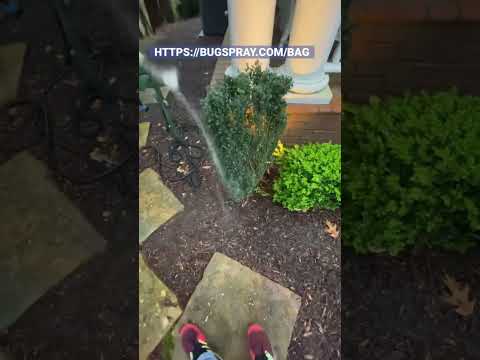
Expect to use around 1-2 lbs of granules per side of the home. Packed in easy to handle 11 lb jugs, expect to get 2 treatments around the home per jug which is enough for 2 months. Plan on treating once a month during the active season from early spring through fall. Mites are cold tolerant and in the fall is a key time to keep them away from the house so they don’t come back the following year.
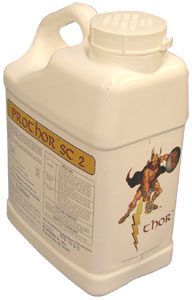


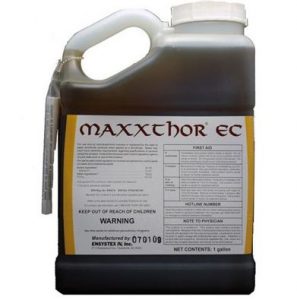
Now spray the granules and home siding. The best material for the outside landscape and on the home is MAXXTHOR EC. This concentrate uses a synthetic pyrethrum which both flushes and kills mites quickly once they move through the active.
Formulated as an oil base, it does a good job of penetrating all cracks and crevices where mites might hide and it will naturally coat all plant surfaces which is important for small pests like spider mites.
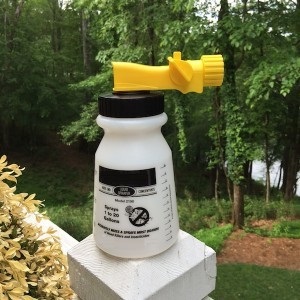
The following “short video” (less than 60 seconds) shows how to prepare the Maxxthor to spray in our Green Topped hose end sprayer. Using the Yellow Topped Sprayer will be the same and the preferred model for this pest.
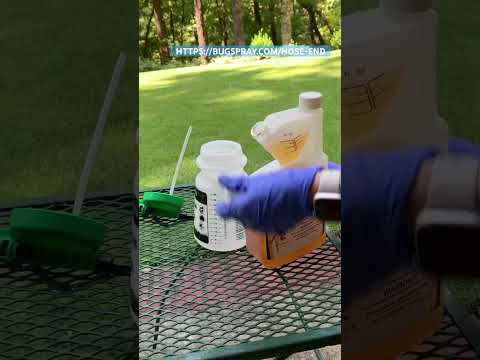
As explained in the video above, plan on using 2.5 oz of concentrate to our 20 GALLON HOSE END SPRAYER. Add water to the 5 gallon line and use the entire mixture over no more than 5,000 sq/ft. Spider mite activity may be centralized, but don’t limit your coverage area to just the active plants or just one side of the home. Its easy to miss key nest sites so its wise to treat as much as possible to ensure you don’t miss any.
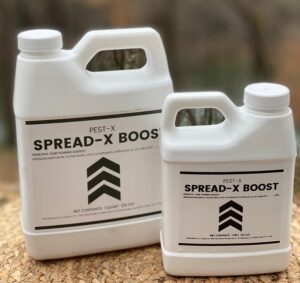
To get the most of your treatment, add SPREAD-X BOOST to your tank mix along with the Maxxthor. Boost is an adjuvant, also known as a wetter spreader or spreader sticker. It basically makes water and the mixture more “slippery” so you get better coverage. Treatments will spread 2-3 times wider and penetrate deeper.
The following short video summarizes why Boost can help deliver your treatment to where it matters the most. And this is extra helpful when treating homes with siding like vinyl, aluminum and stucco where spider mites are likely hiding.
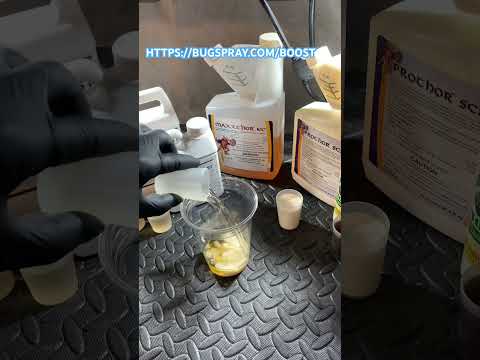
Add no more than the rate you’re applying the Maxxthor so in this case, if you’re adding 2.5 oz of Maxxthor to the hose end sprayer, add 2.5 oz of Boost too before adding water. If you’re adding Maxxthor to a pump sprayer at the rate of 1 oz per gallon, use 1 oz of Boost.
And don’t spray in the middle of the day; treat late in the day close to sunset so the treatment can dry without direct sunlight. UV light on the Boost can stress plants if the temperature is 85 degrees or higher so treat 2 hours or less before sunset to reduce sunlight stress.
When spraying for spider mites, its important to use a lot of water. This is why a hose end sprayer is well suited. Our sprayer is actually a 20 GALLON HOSE END which means you get up to 20 gallons of mixed material sprayed with one tank. So lets say you wanted to spray 10,000 sq/ft; you would add 5 oz of Maxxthor EC, fill the sprayer half way and then distribute the entire amount over the targeted 10,000 you wanted to treat.
And potted plants readily get spider mites too. Fortunately Maxxthor EC is excellent to use on household plants which show signs of activity. Take them outside to treat and dry; once dry they can be brought back inside. Be sure to inspect all plants in the home to catch any activity before it is too late. In most cases, treating plants around the infested one is a good practice. Maxxthor EC is gentle enough to use and getting the mite before it causes damage is important.
ORGANIC SPIDER MITE SPRAY FOR FRUITS AND VEGETABLES
For mites active on an edible garden plant or tree which will produce fruit or vegetables, go with MULTIPURPOSE INSECT KILLER. This concentrate is strong enough to handle mites yet approved for organic gardening and can be safely used right up to the day of harvest. Treatments will quickly work and keep plants mite free for a week or more.
Mix 6 oz per gallon of water (1.5 oz per quart) and spray all foliage of infested plants.
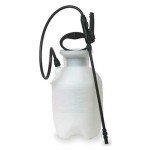
You’ll need a good PUMP SPRAYER to apply the solution; unlike spraying the yard, mulch and flower beds, a more focused sprayer is required.
BEST SPIDER MITE SPRAY FOR INSIDE THE HOUSE
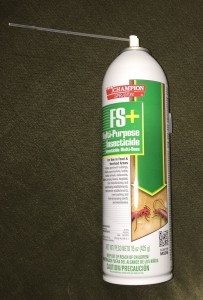
Once in the house, you’ll need treat all routes of entry with FS MP AEROSOL. This is a quick acting aerosol ideally suited for void treating where mites like to hide.
The following video shows how to treat a window properly and well worth the watch.
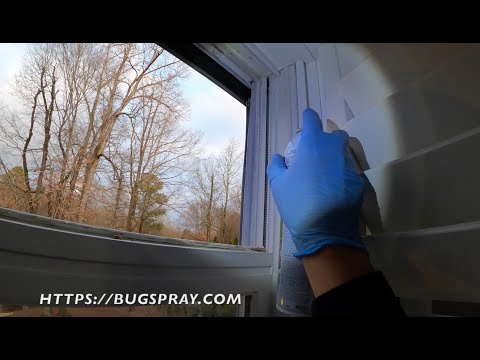
As explained in the video above, FS MP uses an oil base that helps it penetrate all the small gaps they’ll use to hide and nest. Treatments will kill quickly and provide a week or two of residual. But if you spot activity anytime during the week – even a few days after you spray – don’t wait to treat again. When spider mites get active, they’ll be persistent requiring ongoing treatments and follow-up.
SPIDER MITE SPRAY FOR THE WALLS AND CEILING
Once the mites are inside the home, they’ll often times crawl up walls and get onto the ceiling. FS MP is NOT a good spray for these surfaces as its oil based and is only intended for use in cracks and crevices.
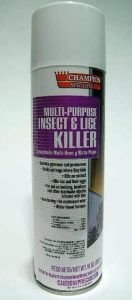
For walls and ceilings, get our MULTIPURPOSE INSECT KILLER. This water based spray will not damage or stain walls and ceilings when used properly. Lightly mist over the areas where activity is noticed. Be sure to wear googles if spraying above your head as the mist will sting your eyes if they’re not protected.
This following short video shows why this aerosol is ideal for these sensitive areas.
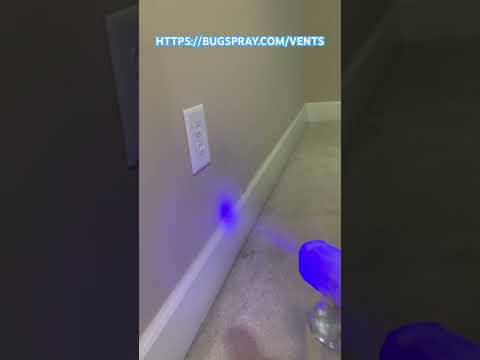
Multipurpose insect killer will quickly kill any active on walls and ceilings and once dry, will keep them from coming back. But when spider mites are invading and active, its generally accepted that you will need to spray multiple times a week until the initial invasions are subdued.
BEST RED SPIDER MITE SPRAY FOR BASEBOARDS AND CARPETS
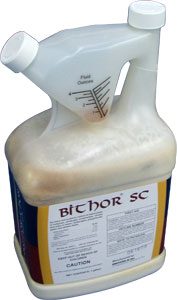
If you need to treat several rooms in the home, go with BITHOR. Similar to Maxxthor, this active is labeled for use in the home and is odorless. This form is water based so it won’t stain.
You’ll need to apply it using a PUMP SPRAYER like the one listed above. Treat baseboards, basements, garages, etc. and even carpeting if they’re migrating to those areas too. Bithor is labeled for these applications so safe enough to be used even where pets and children are active (details in the video below).
For in the home, mix up 1.5 oz per gallon of water and expect to get about 800-1000 linear feet treated per gallon of mixed spray.
The following “short video” (less than 60 seconds long) explains why its so safe for use in the home:
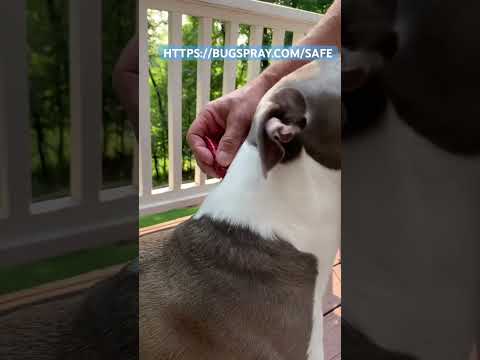
Most homes can be properly treated with one gallon of mixed material but large homes or homes with bad problems could require more. And like the outside Bithor, plan on treating until the problem is gone. In general, you won’t need to apply it as frequently as the outside spray but twice a month is suggested.
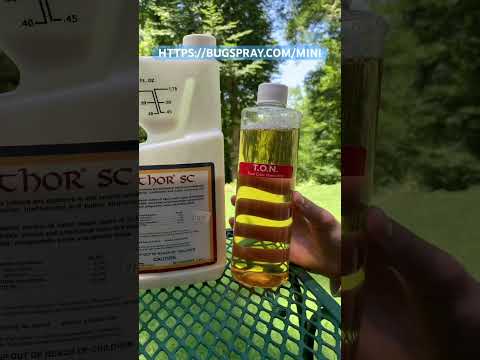
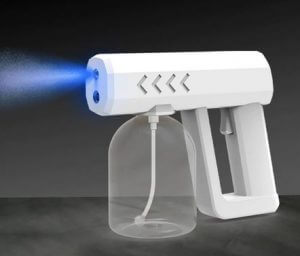
As shown in the video above, the MINI MISTER is a great way to apply it to carpeting and baseboards throughout the home. Its super easy to use and allows you to make super clean applications without over spray.
The following “short video” (less than 60 seconds long) shows how the Mini Mister works and why its such a good tool for applying a range of products in the home.
The Mini Mister will allow you to easily treat furniture, rugs, carpeting – even walls – without making a mess. And since its a fine mist there won’t be overspray or missed spots spider mites will look to exploit.
*** DUST UNDER HOME SIDING, INTO ELECTRIC OUTLETS AND BEHIND LIGHT SWITCH COVERS ***
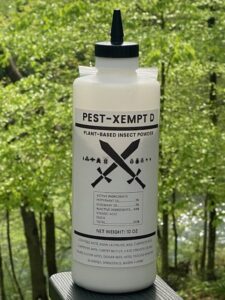
If you find them on walls, they could be entering from two infestations are when the mites have found their way onto the home. If you are seeing thousands of mites crawling on the side of your home a foot or two high, don’t panic. Using the Maxxthor as detailed above will get them on siding like brick or stucco. But if you have vinyl, aluminum or cedar shake siding, you’ll probably need to dust to get deep penetrating. The best dust for outside use is PEST-XEMPT D.
The following short video talks about how to dust your homes siding.

Xempt D features two qualities that make it more efficient compared to ordinary insecticide dusts.
First, like insecticide dusts, it will agitate insects and force them to leave or else they will die. And once they start moving, if they have dust on them they will die.
Directly treated mites will succumb to the dust within a day BUT even as the actives wear off in 1-2 months, the remaining base will keep working. So where ordinary dusts break down after 1-2 months, Xempt’s base lasts and keeps active by retaining its dehydrating feature.
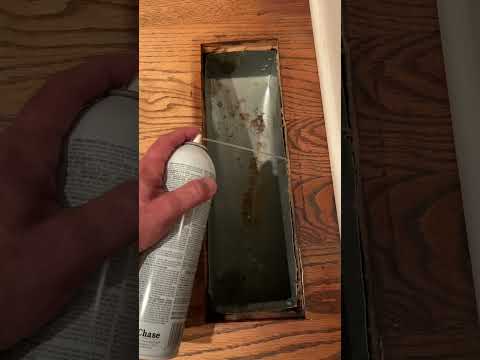
Now in a dry environment? This means treatments under electric outlets, behind switch plate covers and around air vents can last 1-2 years making Xempt Dust quite unique.
The following short video shows how to use it in these areas.
The second most important part of this feature is that Xempt D CAN GET WET BUT WILL STILL WORK! This makes it quite unique and why its so well suited for both dry AND moist environments. The only way it won’t keep working is if you have water moving which causes it to wash away. But when left in place? Xempt dust will keep working!
CONTACT US
Give us a call if you need further help. Our toll free is 1-800-877-7290 and we’re open Monday through Thursday, 9:00 AM to 4:00 PM (Eastern Standard Time).
Email questions here: https://bugspray.com/about-us/contact-us
Order online and get a 5% discount! We ship fast with 99.9% of all orders shipping within 1 business day!!
Learn more about BUGSPRAY.COM and why it’s never been easier or safer to do your own pest control.
Please show your support for our business by purchasing the items we recommend from the links provided. Remember, this is the only way we can stay around to answer your questions and keep this valuable web site up and running. Thanks for your business!
Tom says
When spraying Maxxthor on my bushes (Arborvitae) for spider mites, should I add Spread-X to the mix, or will that cause the Maxxthor to run down/drip off of the leaves?
Tech Support says
Tom,
Boost will help “spread” the treatment so in fact it will greatly help your cause. Definitely use it. And follow the recommendations we posted here about “when” to treat:
https://bugspray.com/how-does-rain-and-the-sun-affect-your-treatments
https://bugspray.com/catalog/insecticide/additive/spread-x-boost-adjuvant
Tech Support
Jane Westendorf says
Very helpful!
kathe hackett says
Pine tree dropping needles from bottom up…large clumps turning brown and dropping off…. a nursery said: no problem but its getting worse. can the tree be saved? i have another close by..what should i do ?
its taller than me and where do you get he stuff to do it with…
Tech Support says
If you have a spidermite infestation and it’s left untreated, the mites will usually kill host plants and once the host plant dies, they’ll move and migrate to the next available plant. So if you want to protect the other trees and shrubs in the yard, I suggest you spray regardless of the current condition of the pine tree you talk about in your question.
Now will treating the infested tree save it? Who knows. But really, does it matter in relation to whether or not you should treat? Not if you want to save the surrounding vegetation. So for now, I suggest you start by applying Maxxthor to the infested tree as well as the ground below. First, apply the Maxxthor Granules (https://bugspray.com/catalog/insecticide/granule/maxxthor_sg.html) and then spray over the top with the Maxxthor Concentrate. And I would refrain from using the Spreader Sticker on the infested tree as this will usually cause some burning to the needles and sustaining extra damage is something this tree doesn’t need right now given the bad “shape” you described above.
And once you knock down the local spidermites, there is a good chance the tree will come back but you won’t know until you try. As for where to get the items in our article? Just order from our cart or call your order in; we ship daily and most orders arrive around the country in 1-4 days.
Here are links to these items in our cart.
Maxxthor SG: https://bugspray.com/catalog/insecticide/granule/maxxthor_sg.html
Bithor: https://bugspray.com/catalog/insecticide/liquid/bithor_sc
david scalone says
Hello,
Does nicotine or tea work?
Tech Support says
@david scalone: Nicotine used to be a common active used for pest control. But it’s very toxic and was taken off the market some time ago. And though I’ve heard of people setting out tea leaves to repel pests inside the home, it’s not a cost effective way to treat spider mites that are infesting the yard or garden.
If you’re looking for organic spider mite control, go with some INSECTICIDAL SOAP or GARDEN DEFENSE WITH NEEM. Both of these products are approved for organic gardening and work well on spider mites.